
- Catalogs
- Lake Shore Cryotronics, Inc.
- Magnetics Catalog


Magnetics Catalog

Magnetics Catalog
- Model 475 DSP Gaussmeter: Features DSP technology with full-scale ranges from 35 mG to 350 kG, DC measurement resolution to 0.02 mG, and a basic DC accuracy of ±0.05%. It supports DC, RMS, and Peak measurement modes, with advanced features like autorange, auto probe zero, and field control.
- Model 455 DSP Gaussmeter: Capable of measuring magnetic fields using Hall effect probes with peak measurement mode for pulsed fields and various operational modes.
- Model 460 3-Channel Gaussmeter: Designed for 3-axis measurements, suitable for materials analysis and field mapping.
- Model 421 Gaussmeter: High-performance instrument for magnetic measurement applications, offering improved accuracy and resolution.
- Model 410 Hand-held Gaussmeter: A portable device for magnetic field measurements.
- Model 480 Fluxmeter: Designed for high-resolution and low-drift analytical measurements, particularly in magnetizing processes.
- Includes a variety of standard and custom Hall effect probes, magnetic field sensors, and fluxmeter coils. Specific details on selection and compatibility are provided in the catalog.
- Field Control: Built-in PI control algorithm for magnetic field control in electromagnet systems.
- High-Speed Data Transfer: IEEE-488 interface for real-time reading rates up to 100 new readings per second.
- Data Buffer: Internal memory for storing 1024 field readings, with high-speed data logging capabilities.
- Trigger In and Out: Hardware and software triggers for synchronizing measurements with other instruments.
- Display: 2-line by 20-character vacuum fluorescent display for field readings, probe temperature, and frequency.
- Keypad: 22-position keypad for easy access to features, with lockout capability to prevent unintended changes.
- Alarm and Relay: High and low alarms with display annunciator, audible beeper, and two relays for system integration.
- Peak Measurement Mode: Allows measurement of pulsed fields with high-speed data acquisition, capturing transient fields as narrow as 50 µs pulse widths. The peak reading can be held indefinitely without sag.
- Probe Connection: The Model 455 is compatible with a range of standard and custom Hall effect probes, enhancing measurement accuracy and flexibility.
- Measurement Features: Includes autorange, auto probe zero, display units in various measurements (G, T, Oe, A/m), max/min hold, relative reading, and instrument calibration options.
- Instrument Probe Features: Features like probe field compensation and temperature compensation ensure accurate and stable measurements.
- Display and Interface: The gaussmeter features a 2-line by 20-character vacuum fluorescent display, with options to show field readings, probe temperature, and frequency. It includes a 22-position keypad and supports serial and parallel computer interfaces.
- Voltage Outputs: Three voltage outputs provide different levels of signal processing, suitable for diagnostic and measurement purposes.
- General Measurement: Utilizes a single Hall effect sensor with features like linearity and temperature compensation.
- DC Measurement: Offers high resolution and accuracy with various probe types and ranges.
- AC RMS Measurement: Provides accurate readings across a wide frequency range with specified resolution and accuracy.
- Accessories: Includes I/O mating connectors, zero gauss chamber, user manual, and various cables with EEPROM for probe extension.
- Calibration Services: Offers new instrument calibration and recalibration with certificates and data.
- Interfaces: Supports RS-232C and IEEE-488.2 with LabVIEW™ driver support.
- Voltage Outputs: Three configurations with varying ranges, scales, and accuracies, all sharing a 25-pin I/O connector.
- General Specifications: Operates within specific temperature and power requirements, with CE mark approval.
- Probes and Extensions: Compatible with a range of probes and extension cables, both calibrated and uncalibrated.
- Product Description: Designed for 3-axis measurements, it combines three gaussmeters into one, suitable for materials analysis and field mapping.
- Measurement Modes: Operates in DC, RMS, and Peak modes with high accuracy and resolution.
- Range and Resolution: Offers full scale ranges from 300 mG to 300 kG with high resolution in DC mode.
- Interface: Equipped with IEEE-488 and RS-232C interfaces for command and data exchange.
- Probes and Sensors: Offers a variety of probes and sensors, factory-calibrated for accuracy.
- Display: Features a vacuum fluorescent display for field readings and instrument parameters.
- General Specifications: Includes power requirements, size, weight, and CE mark approval.
- 5¾-digit DC resolution (1 part out of ±300,000)
- Automatic drift compensation
- AC frequency response up to 50 kHz
- IEEE-488 and serial interfaces
- Storage for parameters of up to 10 coils
- Measurement: 1 input, 2-lead, ground-referenced
- Input resistance: 100 kΩ or 10 kΩ
- Maximum operating input voltage: 60 V
- DC resolution: To 5¾ digits
- AC frequency response: 2 Hz to 50 kHz
- Choose a probe matching the application needs.
- Consider probe fragility and protection.
- Be cautious with aluminum stemmed probes in AC fields due to eddy currents.
- Consider stem length and active area size based on application requirements.
- Transverse Probes: Rectangular in shape, these measure fields normal to their stem width and are suitable for general-purpose measurements.
- Axial Probes: Round in shape, these measure fields normal to their end and are often used with solenoids.
- Flexible Probes: Feature a flexible stem but are more fragile, suitable for narrow-gap applications.
- Tangential Probes: Designed to measure fields parallel to a surface, not for general use.
- Transverse Probes: Available in metal, flexible, and brass stem configurations with varying dimensions. Specific models include J02-VG, MMT-6J04-VG, and others.
- Gamma Probes: Non-metallic axial probes like HMLA-5006-HJ and MLA-5006-HJ.
- 2-Axis and 3-Axis Probes: Models such as MMY-1802-UH and MMZ-2502-UH, with lengths ranging from 2 to 60 inches.
- Calibration Data: New product calibration and recalibration certificates are available for various models, ensuring accuracy and compliance.
- Calibration: Probes and extension cables must be calibrated together at Lake Shore to maintain accuracy. Specific calibration data and certificates are provided for different probe models.
- Extension Cables: Necessary for maintaining probe accuracy, with specific models for different Gaussmeters. Cables are available in various lengths and can be factory-calibrated.
- Use zero gauss chambers to shield probes from external magnetic fields for accurate measurements.
- Ensure proper calibration of probes and cables to maintain measurement accuracy.
- Hall Probe Stands: Adjustable stands for positioning probes, available in different post heights.
- Reference Magnets: Available in axial and transverse configurations for calibration and testing purposes.
- Hall Generator Theory: Explains the Hall effect and its application in magnetic field sensors, detailing the relationship between Hall voltage, magnetic field, and sensor configuration.
- Using Hall Generators: Guidelines for connecting Hall generators to Gaussmeters, including cable configurations and sensitivity constraints.
The document outlines specifications for various Hall generators and sensors, including set voltage, operating temperature range, and temperature coefficients. The set voltage varies with a maximum of ±2.8 mV, and the operating temperature range is from -40 °C to +100 °C. The mean temperature coefficient of magnetic sensitivity and offset are provided, with values such as -0.06%/°C and ±1.2 µV/°C respectively.
Details on the compatibility of sensors with specific gaussmeters are provided, such as compatibility with the Lake Shore Model 410 gaussmeter. The document also includes ordering information for various parts and accessories, emphasizing that specifications are subject to change.
Recommendations for use include the Model 642 electromagnet power supply, which is noted for its low noise and high resolution, making it suitable for laboratory settings. It supports a true 4-quadrant output, eliminating the need for external switching.
Data on magnetic sensitivity changes with temperature is provided, indicating that sensitivity generally increases as temperature drops below 300 K, but decreases between 200 K and 100 K. The document includes tables and figures illustrating these changes.
Part numbers and descriptions for various Hall generators, sensors, and accessories are listed, such as the HGA-2010 and HGT-1010, along with their specific applications and features.
The document describes Helmholtz coils and search coils for use with specific models, detailing their field accuracy, resistance, and operating temperature ranges. These components are used for field standards and magnet moment measurements.
The document provides comprehensive technical specifications and guidelines for selecting and using Hall generators, sensors, and related accessories, emphasizing compatibility and performance under various conditions.
The document outlines specifications for electromagnets and associated equipment. The operating environment includes an ambient temperature range of +10 °C to +30 °C and humidity of 55% ±10%. Cooling water should be maintained between +15 °C to +25 °C. Internal condensation is cautioned against as it can damage the power supply.
The equipment is housed in a freestanding rack cabinet with locking wheels and lifting eye bolts. Two models are specified: Model 665 and Model 668, with dimensions of 1.35 m high × 0.7 m deep × 0.6 m wide. Model 665 weighs 250 kg, while Model 668 weighs 354 kg.
Various models are available with different voltage and power specifications. For example, Model 665-208 operates at ±100 A, ±50 V, 5.0 kW, 208 VAC. Customers are advised to consult Lake Shore for other available voltages.
The EM4 and EM7 series electromagnets feature continuously adjustable poles for rapid air gap changes, water-cooled coils for stability, and precise pole alignment. The EM4 is compact for bench-top mounting, while the EM7 offers larger air gaps.
The document provides detailed specifications on field uniformity for both EM4 and EM7 magnets, indicating the uniformity over a 1% cylindrical volume.
Support structures for the electromagnets are available, such as the EM4-HSTAND-3, which is a 3-level aluminum structure, and the EM4-STAND-2, a 2-level structure.
Requirements include a water supply or chiller, lifting equipment, a magnet power supply, and a supportive area for the magnet weight.
Lake Shore offers NesLab M-75 and M-150 recirculating chillers, designed for continuous duty circulation with CFC-free refrigeration systems. These chillers are compact and designed to minimize floor space usage.
The document provides comprehensive specifications and ordering information for electromagnets and associated equipment, emphasizing the importance of proper environmental conditions and support structures for optimal operation.
The document provides detailed specifications for various pumps and chillers, including flow rates, temperature ranges, and dimensions. The pumps are identified as PD-2 and CP-55, with a temperature range of 5°C to 35°C and a temperature stability of ±0.15°C. The reservoir volume is 0.5 gallons (1.8 liters), and the case dimensions are provided in both inches and millimeters. Shipping weights vary between 91 kg and 130 kg.
Performance specifications are influenced by temperature, ambient conditions, or coolant changes. The chillers are rated at a 65% duty cycle, suitable for common magnet testing applications. For higher duty cycle needs, a larger chiller is recommended.
The Field Controlled Electromagnet Platforms (FCP) feature adjustable air gaps, water-cooled coils, and precision yokes for field homogeneity and stability. The electromagnets are compact and suitable for bench-top mounting. The power supplies offer stable current regulation and bipolar output, eliminating the need for current reversal contactors.
The Model 475 DSP gaussmeter integrates closed-loop field control, eliminating the need for separate software control. It uses feedback from the gaussmeter Hall probe to maintain the magnetic field density at the user-set control setpoint. The system updates the analog output every 33 ms for stability.
The FCP integrates hardware and firmware for a variable magnetic field platform, suitable for user-designed magnetic measurement systems. It includes an electromagnet, bipolar power supply, DSP gaussmeter, and Hall probe.
Customers can specify voltage and pole cap diameter. Part numbers are provided for different electromagnet configurations.
The document includes a conversion table for magnetic measurement units, detailing the conversion between Gaussian and SI units.
Lake Shore Cryotronics, Inc. is a leader in measurement and control solutions, specializing in cryogenic temperatures and magnetic fields.
Catalog excerpts
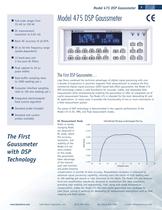
3 Full-scale ranges from 35 mG to 350 kG > DC measurement resolution to 0.02 mG Basic DC accuracy of 0.05% DC to 50 kHz frequency range (probe-dependent) 15 band-pass and 3 low-pass AC filters Peak capture to 20 ѵs pulse widths Data buffer sampling rates to 1000 readings per s > Lake Shore combined the technical advantages of digital signal processing with over a decade of experience in precision magnetic field measurements to produce the first commercial digital signal processor (DSP) based Hall effect gaussmeter, the Model 475. DSP technology creates a solid foundation for accurate, stable,...
Open the catalog to page 3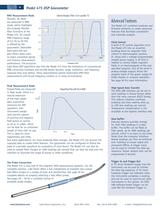
The Probe Connection The Model 475 is only half of the magnetic field measurement equation. For the complete solution, Lake Shore offers a full complement of standard and custom Hall effect probes in a variety of sizes and sensitivities. See page 26 for complete details on properly selecting a Hall effect probe. See pages 29 38 for a complete listing of available probe models. Peak Measurement Mode Pulsed fields are measured in Peak mode, which is a natural extension of the high-speed data acquisition necessary for DSP operation. Fast instrument sample rates permit capture of positive and negative...
Open the catalog to page 4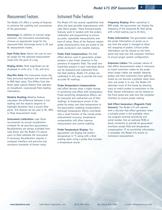
Frequency Display: When operating in RMS mode, the gaussmeter can display the frequency of the measured AC field along with a field reading (up to 20 kHz). > The Model 475 offers a variety of features to enhance the usability and convenience of the gaussmeter. The Model 475 has several capabilities that allow the best possible measurements with Lake Shore probes. These firmware-based features work in tandem with the probes calibration and programming to ensure accurate, repeatable measurements and ease of setup. Many of the features require probe characteristics that are stored in the probe connectorҒs...
Open the catalog to page 5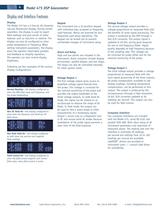
Display Keypad Voltage Output 2 The Model 475 has a 2-line by 20-character vacuum fluorescent display. During normal operation, the display is used to report field readings and give results of other features such as max/min or relative. The display can also be configured to show probe temperature or frequency. When setting instrument parameters, the display gives the operator meaningful prompts and feedback to simplify operation. The operator can also control display brightness.Following are four examples of the various display configurations: The instrument has a 22-position keypad with individual...
Open the catalog to page 6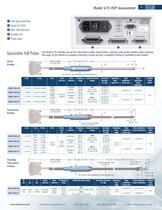
L (in)D (in)A (in)Active area (in)Stem materialFrequency rangeUsable full scale ranges Corrected accuracy (% rdg)Operating temp range (װC)Temp coefficient (max) zeroTemp coefficient (max) calibrationContains temp sensorHMNA-1904-VR 4 0.1250.187 dia ѱ0.0050.005 0.0030.030 dia (approx)Fiberglass epoxyDC to 20 kHz HSE 3.5 G, 35 G, 350 G, 3.5 kG, 35 kGѱ0.20% to 30 kG and 0.25% 30 to 35 kG0 ѰC to +75 Cб0.09 G/Cб0.04%/CYes HMMA-2502-VR 2 б0.0630.25 dia 0.0060.015 ѱ0.005AluminumDC to 10 kHz HMNA-1904-VF 4 0.1250.187 dia ѱ0.0050.005 0.003Fiberglass epoxyDC to 800 Hz HST-4 35 G, 350 G, 3.5 HMMA-2502-VF...
Open the catalog to page 7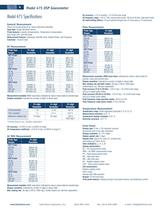
AC accuracy: 1% of reading Ѣɥ 1% of full-scale range AC frequency range: 1 Hz to 1 kHz, narrow band mode; 100 Hz to 20 kHz, wide band mode AC band limiting (filters): 18 user-selected frequencies of 3 low-pass or 15 band-pass > (Does not include probe error, unless otherwise specified) > UHS Probe Input type: Single Hall effect sensor Probe features: Measurement features: Linearity Compensation, Temperature Compensation, Auto Probe Zero, and Hot Swap Autorange, Max/Min Hold, Relative Mode, and Frequency Probe TypeRanges4-digitResolution Measurement resolution (RMS noise floor): Display resolution:...
Open the catalog to page 8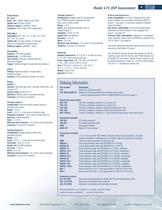
Voltage Output 3 Range: 10 V Configuration: Scale: Resolution: User-specified (defaults same as Voltage Output 2) 16-bit, 0.3 mV Voltage output of compensated DC or RMS field value, generated by DAC (also used for field control) Update rate: 30 updates/s Accuracy: ѱ2.5 mV Noise: 0.3 mV Minimum load resistance: 1 k ѢĦ (short circuit protected) Connector: In 25-pin I/O connector Hall sensor compatibility: Front panel programmable sensitivity and serial number for user-supplied Hall sensorsee page 40 Probes and Extensions Extension cable compatibility: Calibrated or uncalibrated probe extension...
Open the catalog to page 9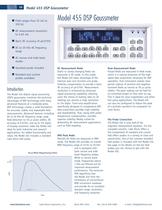
The Probe Connection The Model 455 is only half of the magnetic measurement equation. For the complete solution, Lake Shore offers a full complement of standard and custom Hall effect probes in a variety of sizes and sensitivities. One of ten common standard Hall probes is included with the Model 455. See page 13 for details on the ten Hall probes you can choose to get with the Model 455. Peak Measurement Mode Pulsed fields are measured in Peak mode, which is a natural extension of the high- speed data acquisition necessary for DSP operation. Fast instrument sample rates permit capture of positive...
Open the catalog to page 10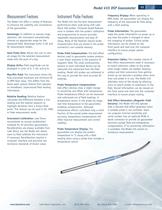
Hall Effect Generators (Magnetic Field Sensors): The Model 455 will operate with a discrete Hall effect generator when a suitable probe is not available. Users can program nominal sensitivity and serial number into an optional MCBL-6 blank connector to provide all gaussmeter functions except field and temperature compensation. If no sensitivity information is available, the Model 455 reverts to resistance measurement. Extension Cables: The complex nature of Hall effect measurements make it necessary to match extension cables to the probe when longer cables are needed. Keeping probes and their...
Open the catalog to page 11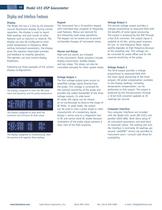
Computer Interface Two computer interfaces are included with the Model 455: serial (RS-232C) and parallel (IEEE-488). Both allow setup of all instrument parameters and read-back of measured values. The reading rate over the interface is nominally 30 readings per second. LabVIEW drivers are provided to instrument usersٗconsult Lake Shore for availability. Voltage Output 3 The third output provides a voltage proportional to measured field with the most signal processing of the three outputs. All probe compensation available to the display readings, including temperature compensation, can be performed...
Open the catalog to page 12All Lake Shore Cryotronics, Inc. catalogs and technical brochures
 Model 224 Temperature
6 Pages
 GaAlAs Diodes*
3 Pages
 DT-670 Silicon Diodes
5 Pages
 7600
760020 Pages
 8404
840424 Pages
 Model 625
5 Pages
 100 Series
3 Pages
 Model 218
4 Pages
 Model 211
4 Pages
 Model 370
10 Pages
 Thermocouple Wire
1 Page
 Ruthenium Oxide Sensors
4 Pages
 Germanium Sensors
4 Pages
 Cernox Sensors
4 Pages
 Rhodium Iron Sensors
3 Pages
 Platinum Sensors
3 Pages
 GaAlAs Sensors
3 Pages
 DT 670
4 Pages
 DT 400 Sensors
4 Pages
 Temperature Catalog
232 Pages


- Temperature probe
- Resistance temperature sensor
- Measuring machine
- Digital temperature control
- Analog I/O
- Pt100 temperature transducer
- Temperature controller
- Digital temperature controller
- Remote I/O
- Automation temperature controller
- PID temperature control
- PID temperature controller
- Modbus I/O
- Control measurement system
- Analog input module
- Configurable temperature control
- Configurable temperature controller
- Platinum resistive temperature sensor
- Thin-film temperature sensor