
- Catalogs
- Lake Shore Cryotronics, Inc.
- Germanium Sensors


Germanium Sensors

Germanium Sensors
Catalog excerpts
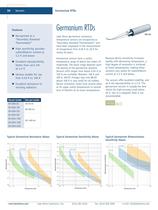
50 Germanium RTDs Sensors Germanium RTDs Features Recognized as a “Secondary Standard Thermometer” High sensitivity provides submillikelvin control at 4.2 K and below Germanium sensors have a useful temperature range of about two orders of magnitude. The exact range depends upon the doping of the germanium element. Sensors with ranges from below 0.05 K to 100 K are available. Between 100 K and 300 K, dR/dT changes sign and dR/dT above 100 K is very small for all models. Sensor resistance varies from several ohms at its upper useful temperature to several tens of kilohms at its lower temperature. Excellent reproducibility better than ±0.5 mK at 4.2 K Various models for use from 0.05 K to 100 K Excellent resistance to ionizing radiation Old part number Because device sensitivity increases rapidly with decreasing temperature, a high degree of resolution is achieved at lower temperatures, making these resistors very useful for submillikelvin control at 4.2 K and below. The sensors offer excellent stability, and ±0.5 mK reproducibility at 4.2 K. The germanium resistor is usually the best choice for high-accuracy work below 30 K. Use in a magnetic field is not recommended. New part number GR-200A-30 GR-AA Lake Shore germanium resistance temperature sensors are recognized as “Secondary Standard Thermometers” and have been employed in the measurement of temperature from 0.05 K to 30 K for nearly 40 years. GR-50-AA GR-200A-100 AA,CD GR-300-AA GR-200A-250 GR-200A-500 GR-200A-1000 GR-200A-1500 GR-1400-AA GR-200A-2500 Typical Germanium Resistance Values 108 106 107 GR-50 GR-300 GR-50 GR-1400 GR-300 GR-50 106 GR-1400 105 |Sensitivity| ()/K) Resistance ()) 104 103 102 GR-1400 GR-300 101 |Dimensionless sensitivity| 105 Typical Germanium Dimensionless Sensitivity Values Typical Germanium Sensitivity Values 104 103 102 101 100 100 101 10-1 100 0.01 0.1 1 10 100 10-2 0.04 0.1 Temperature (K) www.lakeshore.com 1 10 100 10-1 0.05 0.1 Temperature (K) Lake Shore Cryotronics, Inc. (614) 891-2244 1 10 100 Temperature (K) fax: (614) 818-1600 e-mail: [email protected]
Open the catalog to page 1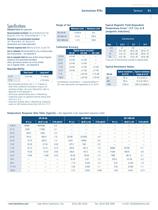
Germanium RTDs Standard Curve Not applicable Dissipation at recommended excitation (temperature and model dependent) Thermal response time 200 ms at 4.2 K, 3 s at 77 K Use in radiation Recommended for use in ionizing radia- tion environments - see Appendix B Use in magnetic field Because of their strong magneto- resistance and associated orientation effect, germanium sensors are of very limited use in magnetic fields - see Appendix B ' Recommended excitation for T < 1 K based on Lake Shore calibration procedures using an AC resistance bridge—for more information refer to 2 Short-term reproducibility...
Open the catalog to page 2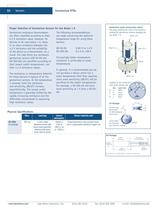
Germanium RTDs Proper Selection of Germanium Sensors Germanium resistance thermometers are often classified according to their 4.2 K resistance value. However, for devices to be used below 1 K, there is no close correlation between the result, the Lake Shore low resistance their lowest useful temperatures, not their 4.2 K resistance values. The resistance vs. temperature behavior for these devices is typical of all the germanium sensors. As the temperature is lowered, both the resistance and sensitivity (dR/dT) increase logarithmically. The lowest useful temperature is generally limited by the...
Open the catalog to page 3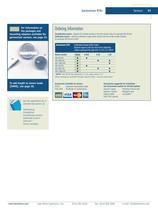
Germanium RTDs For information on the packages and mounting adapters available for germanium sensors, see page 25. Sensors 53 Ordering Information Uncalibrated sensor—Specify the model number in the left column only, for example GR-50-AA. Calibrated sensor—Add the calibration range suffix code to the end of the model number, for example GR-50-AA-0.05A. Germanium RTD Model number Calibration Range Suffix Codes Numeric figure is the low end of the calibration Letters represent the high end: A=5 K, D=100 K Uncal 0.05A 0.3D 1.4D GR-50-AA GR-300-AA GR-1400-AA GR-50-CD GR-300-CD GR-1400-CD *NOTE: The...
Open the catalog to page 4All Lake Shore Cryotronics, Inc. catalogs and technical brochures
 Model 224 Temperature
6 Pages
 GaAlAs Diodes*
3 Pages
 DT-670 Silicon Diodes
5 Pages
 7600
760020 Pages
 8404
840424 Pages
 Model 625
5 Pages
 100 Series
3 Pages
 Model 218
4 Pages
 Model 211
4 Pages
 Model 370
10 Pages
 Thermocouple Wire
1 Page
 Ruthenium Oxide Sensors
4 Pages
 Cernox Sensors
4 Pages
 Rhodium Iron Sensors
3 Pages
 Platinum Sensors
3 Pages
 GaAlAs Sensors
3 Pages
 DT 670
4 Pages
 DT 400 Sensors
4 Pages
 Magnetics Catalog
64 Pages
 Temperature Catalog
232 Pages


- Resistance temperature sensor
- Measuring machine
- Digital temperature control
- Analog I/O
- Pt100 temperature transducer
- Temperature controller
- Generator
- Digital temperature controller
- Remote I/O
- Automation temperature controller
- PID temperature control
- PID temperature controller
- Modbus I/O
- Control measurement system
- Analog input module
- Configurable temperature control
- Configurable temperature controller
- Platinum resistive temperature sensor
- Thin-film temperature sensor