
- Catalogs
- Labthink Instruments Co., Ltd.
- Comparison of Oxygen and Nitrogen Permeability of PE, BOPP and PET


Comparison of Oxygen and Nitrogen Permeability of PE, BOPP and PET

Comparison of Oxygen and Nitrogen Permeability of PE, BOPP and PET
Introduction: This document compares the oxygen and nitrogen permeability of three common packaging materials: polyethylene (PE), biaxially oriented polypropylene (BOPP), and polyethylene terephthalate (PET). The study uses the differential pressure method to measure permeability, providing insights into the barrier properties of these materials.
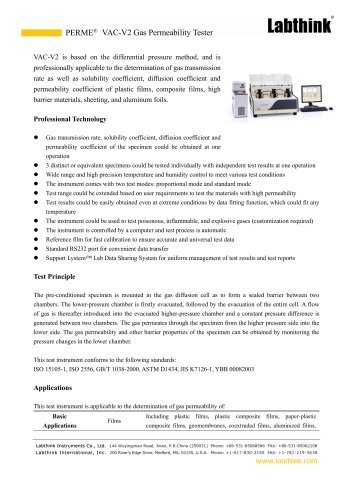
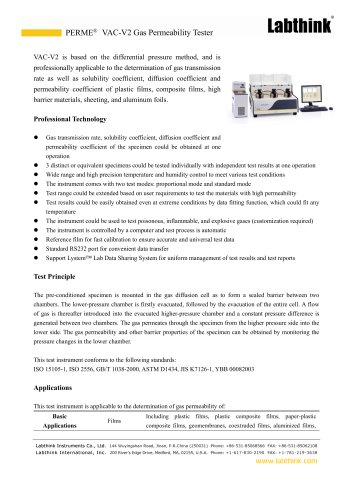
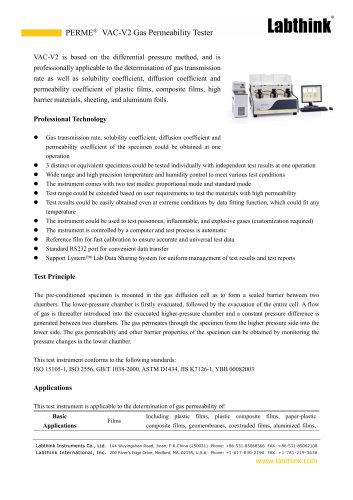
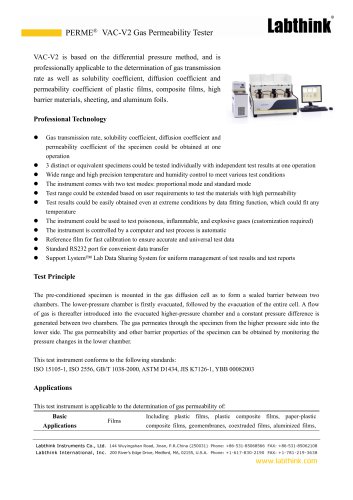
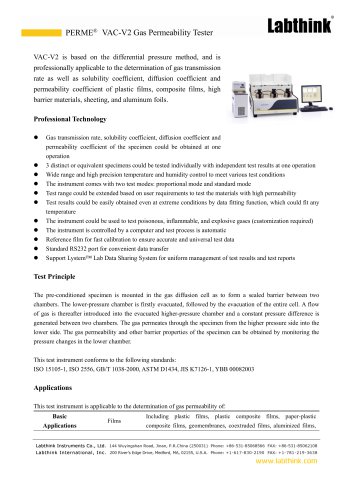
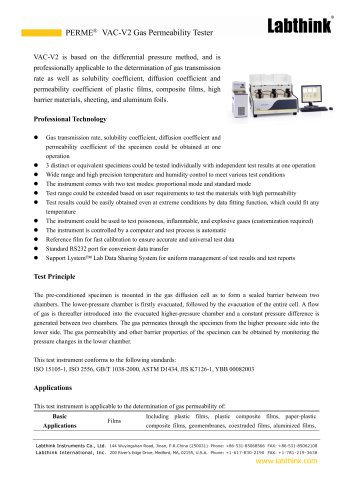
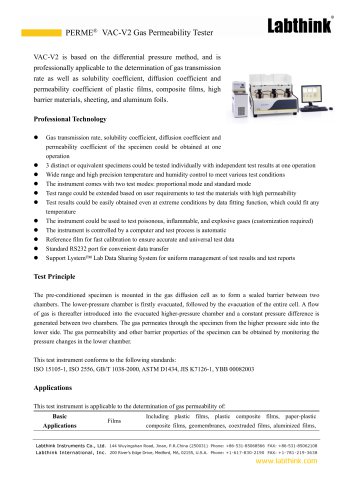
Methodology: The experiment follows the ASTM D1434 Standard Test Method for Determining Gas Permeability Characteristics of Plastic Film and Sheeting. A VAC-V2 differential pressure gas permeability tester with three independent chambers is used to test the samples. The principle involves measuring gas volume changes under constant pressure and temperature conditions.
Procedure: Three specimens of each material, with a diameter of 97 mm, are prepared. The samples are placed in the test chambers, and parameters such as sample thickness, test temperature, and humidity are set. The equipment measures the permeability by monitoring pressure changes in the lower chamber as gas permeates through the sample.
Results: The oxygen transmission rates for PE, BOPP, and PET are 1603.578, 625.068, and 16.953 cm3/(m2·24h·0.1MPa) respectively. The nitrogen transmission rates are 403.658, 120.697, and 2.487 cm3/(m2·24h·0.1MPa) respectively. PET exhibits the highest barrier properties, followed by BOPP and PE. All materials show lower permeability to nitrogen compared to oxygen, attributed to the larger molecular diameter of nitrogen.
Conclusion: The study demonstrates that PET is the most effective barrier against both oxygen and nitrogen, making it suitable for applications requiring high gas barrier properties. The differential pressure method proves efficient and cost-effective for testing gas permeability in packaging materials.
Catalog excerpts

Comparison of Oxygen and Nitrogen Permeability of PE, BOPP and PET Abstract: PE, BOPP and PET are three kinds of widely used packaging materials with different barrier properties. In this paper, we will use pressure difference method to measure the oxygen and nitrogen permeability of these three kinds of films with same thickness. The barrier properties of the three materials to oxygen and nitrogen are compared. The paper introduces the test principle, the instrument used, and provides reference for further studies of material permeability. Key words: PE, BOPP, PET, nitrogen permeability, oxygen permeability, differential pressure method, differential pressure method gas permeability tester, barrier performance Gas barrier performance is an important research field of thin film materials. According to different applications, gas barrier performance of thin film materials can be divided into barrier or preservation ability of oxygen, nitrogen, carbon dioxide, helium, water vapor, sulfur hexafluoride and other gases, due to the molecular diameter of gases, critical temperature, gas molecules and the different interaction between polymers in materials, the permeability of different materials to same gas is different, the permeability of the same materials to different gases is also different. Therefore, it is necessary to select suitable film materials according to the requirements of applications. For packaging materials, the primary task is to prevent oxidation of products. Nitrogen-filled packaging is an important measure to achieve this function. Therefore, the barrier performance of packaging materials to oxygen and nitrogen is important. In this experiment, three commonly used film materials - polyethylene (PE), biaxially oriented polypropylene (BOPP), polyethylene terephthalate (PET) were used as tested for their oxygen and nitrogen permeability. Differential pressure method is used to measure the permeability of different gases. The test process is based on ASTM D1434 Standard Test Method for Determining Gas Permeability Characteristics of Plastic Film and Sheeting. In order to test the gas permeability of three samples and improve the test efficiency, VAC-V2 differential pressure gas permeability tester with three independent chambers is used.
Open the catalog to page 1
The instrument is developed and produced by Jinan Lab s a d bthink Instrum ments. le ntial pressure method assumes that whe the volume and temper en e rature The principl of differen are c constant, the gas pressure is proportion to the gas volume. Th test chamb is divided into e nal he ber d uppe and lower parts by the clamped sa er e ample. The up pper chambe is filled wi test gas under er ith u certa pressure. The volume of the low chamber is fixed and known, and a low pressure ain e wer d nd envi ironment is fo ormed by vac cuum pumpin During th test, the ga in upper ch ng. he as hamber perm...
Open the catalog to page 2
Test results The oxygen transmission rate of PE, BOPP and PET were 1603.578 cm3/(m2·24h·0.1MPa)、 625.068 cm3/(m2·24h·0.1MPa) 、 16.953 cm3/(m2·24h·0.1MPa) respectively, the nitrogen transmission rate of PE, BOPP and PET were 403.658 cm3/(m2·24h·0.1MPa) 、 120.697 cm3/(m2·24h·0.1MPa)、2.487 cm3/(m2·24h·0.1MPa)respectively. In this paper, three kinds of samples and two kinds of gas permeability were tested by one test. The test efficiency and the cost performance ratio of the test instrument is high, and the test results are accurate. From the test results, the order of permeability to oxygen and...
Open the catalog to page 3All Labthink Instruments Co., Ltd. catalogs and technical brochures
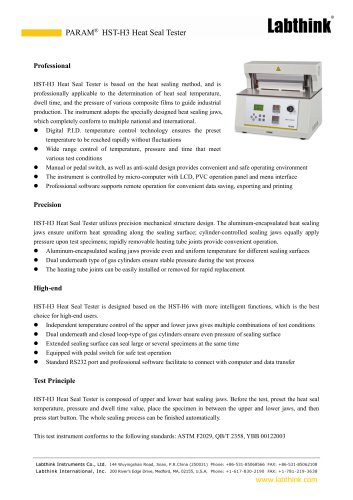 HST-H3 Heat Seal Tester
3 Pages
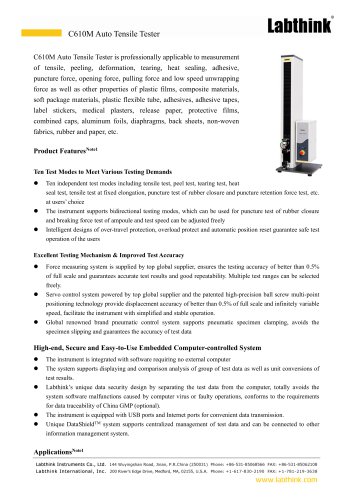 C610M
C610M3 Pages
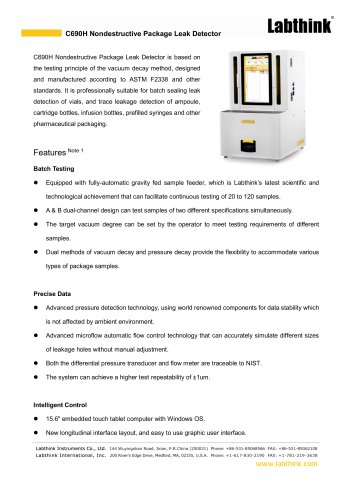 C690H
C690H4 Pages
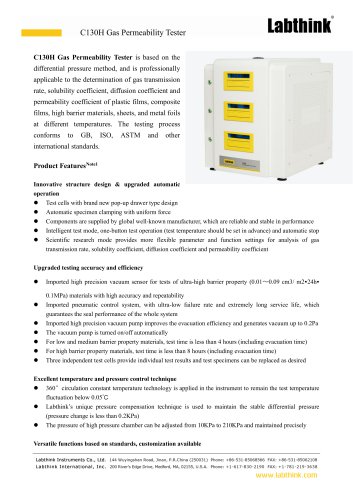 C130H
C130H4 Pages
 COF-P01
2 Pages
 VAC-V2
3 Pages
 C230H (2025)
4 Pages
 C610H
C610H3 Pages
 C206H
C206H4 Pages
 C406H
C406H5 Pages
 C403H
C403H5 Pages
 C 681M
1 Page
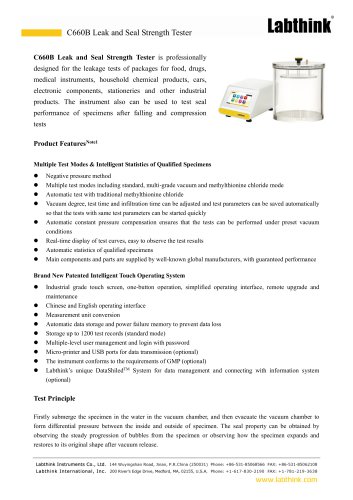 C660B (2025)
3 Pages
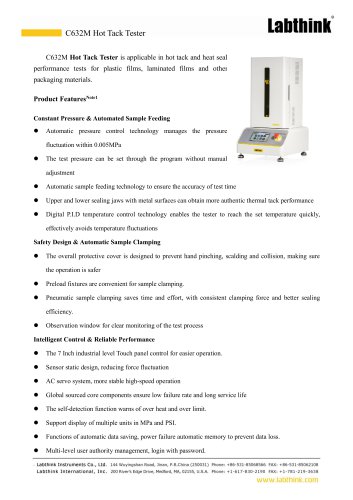 C632M
C632M3 Pages
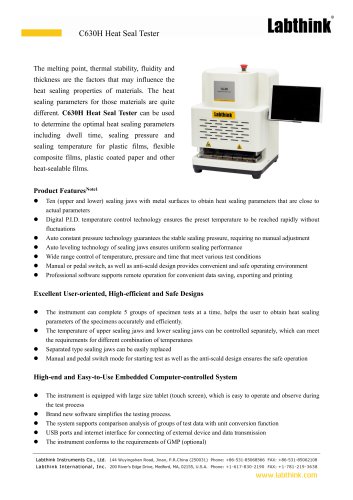 C630H
C630H3 Pages
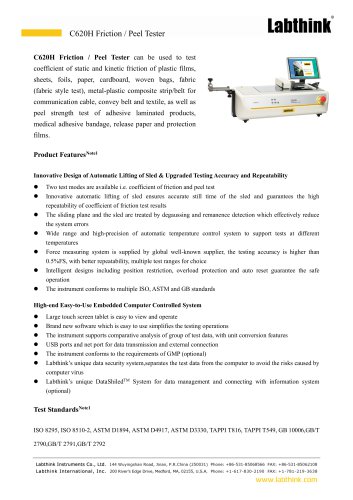 C620H
C620H3 Pages
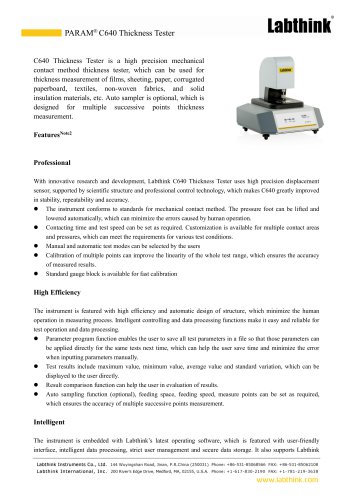 C 640
C 6404 Pages
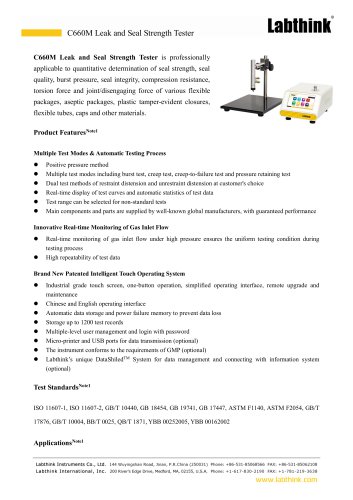 C 660M
3 Pages
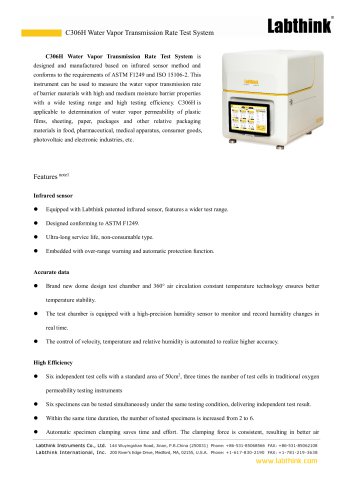 C306H (2025)
4 Pages
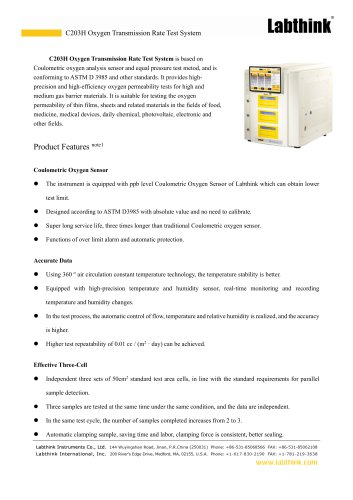 C203H
C203H4 Pages
 Heat seal testing instrument
3 Pages
 Paper Board Thickness Tester
4 Pages
 Film Thickness Meter
4 Pages
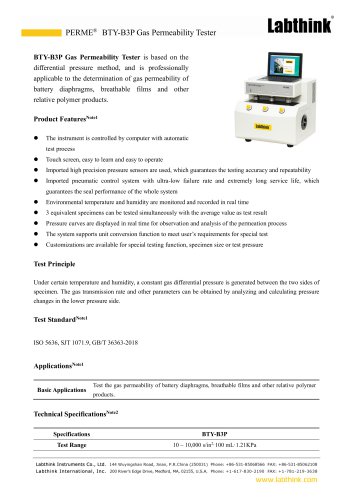 BTY-B3P
2 Pages
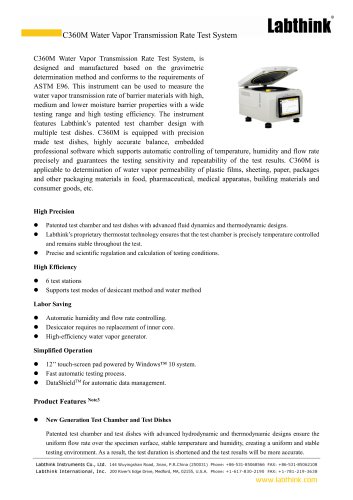 C360M
C360M4 Pages
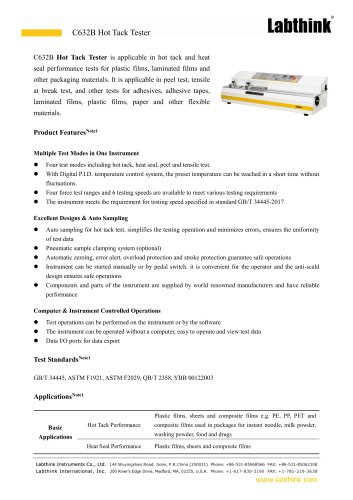 C632B
C632B3 Pages
 C632M Hot tack Tester
3 Pages
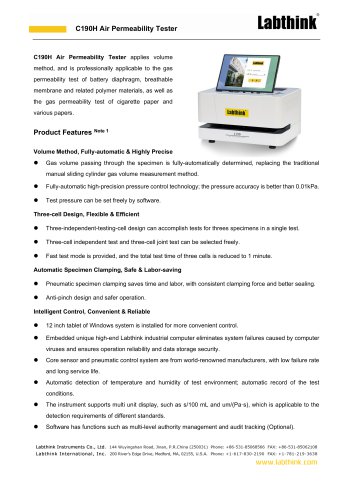 C190H
C190H3 Pages
 C650H Headspace Gas Analyzer
2 Pages
 C390H
C390H4 Pages
 C360H
C360H4 Pages
 C680M Tearing Tester
2 Pages
 C660M
C660M3 Pages
 C620H Friction / Peel Tester
3 Pages
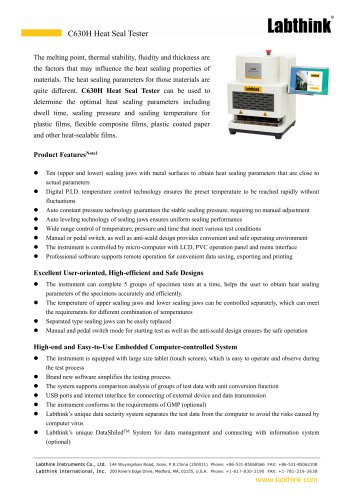 C630H Heat Seal Tester
3 Pages
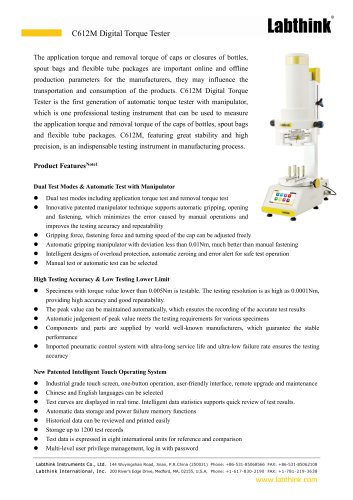 C612M Digitale Torque Tester
3 Pages
 Box Compression Tester
2 Pages
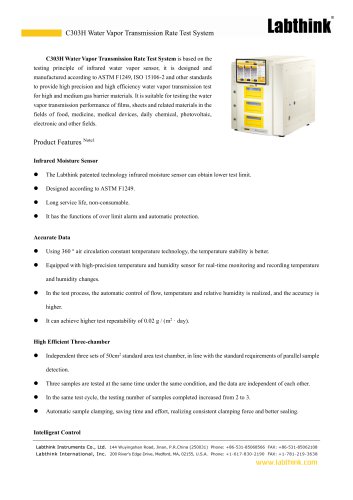 C303H
C303H4 Pages
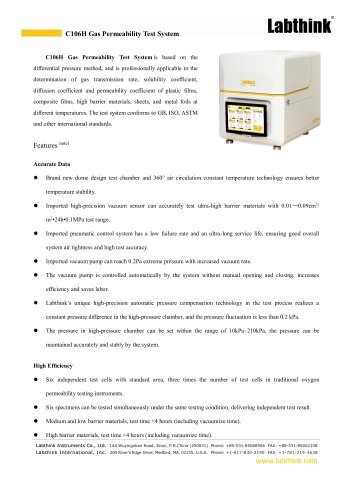 C106H
C106H5 Pages
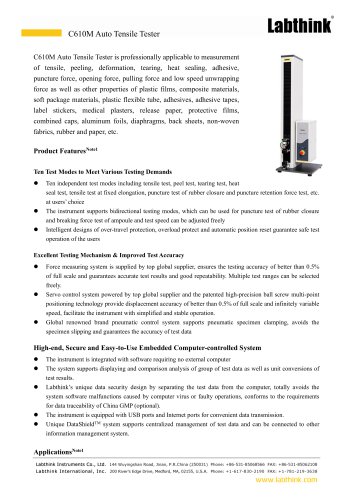 C610M Auto Testing Device
3 Pages
 Bottle Leak Tester Machine
3 Pages
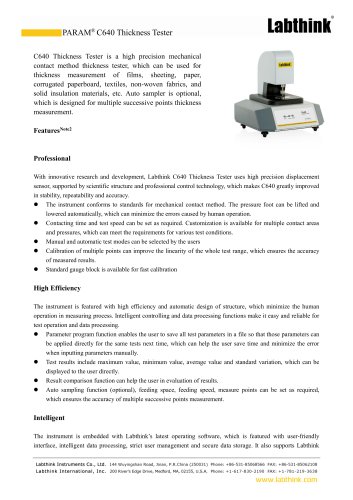 C640 Thickness Tester
4 Pages
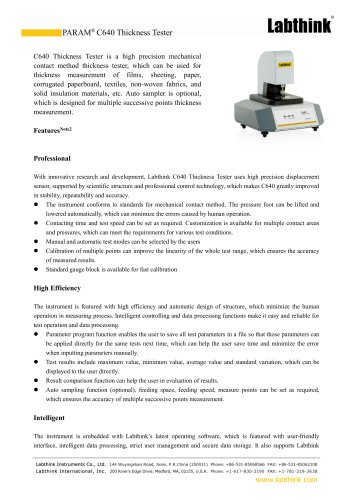 C640
C6404 Pages
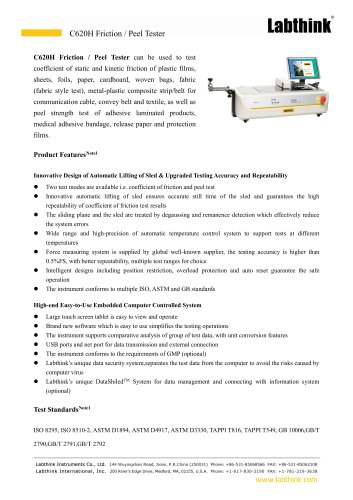 C620H Friction/ Peel Tester
3 Pages
 Pull Off Adhesion Tester
3 Pages
 Torque Measuring Devices
3 Pages
 Bottle Torque Tester
3 Pages
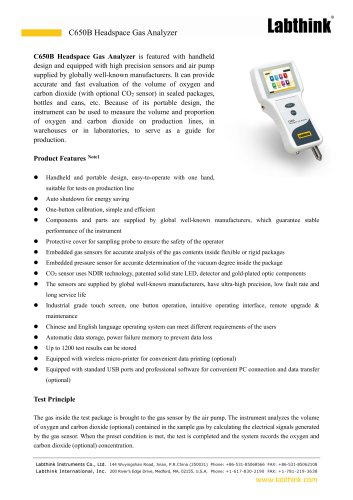 C650B Headspace Gas Analyser
2 Pages
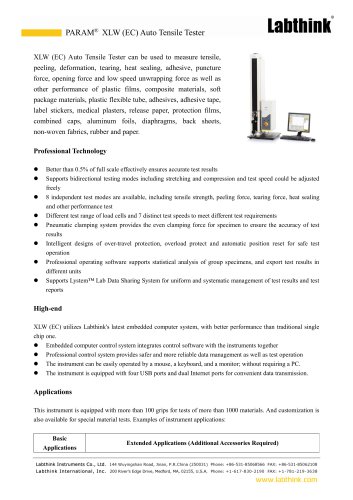 XLW (EC) Auto Tensile Tester
3 Pages
 Torque Strength Measuring
3 Pages
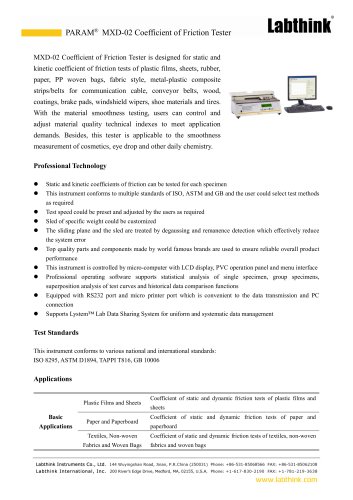 MXD-02
2 Pages
 C612M Digital Torque Tester
3 Pages
 Bag COF Tester
3 Pages
 Labthink Headspace Analyzer
2 Pages
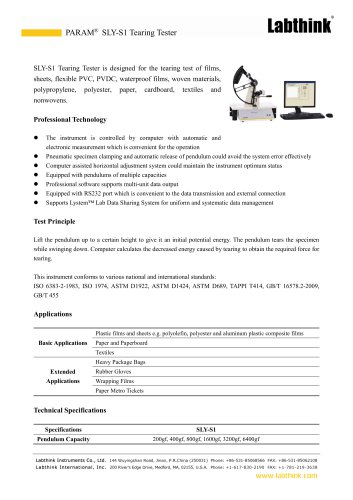 SLY-S1 Tearing Tester
2 Pages
 Sandwich Bag COF Tester
2 Pages
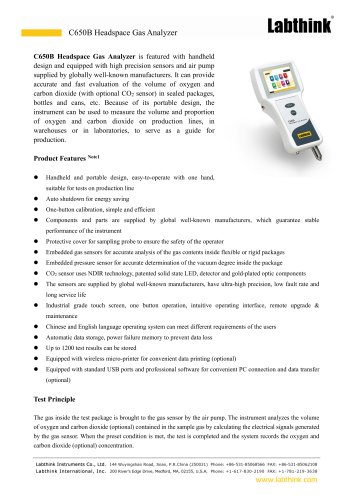 C650B Headspace GAZ Analyzer
2 Pages
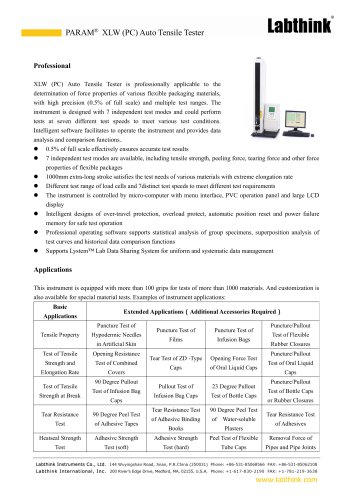 XLW (PC) Auto Tensile Tester
3 Pages
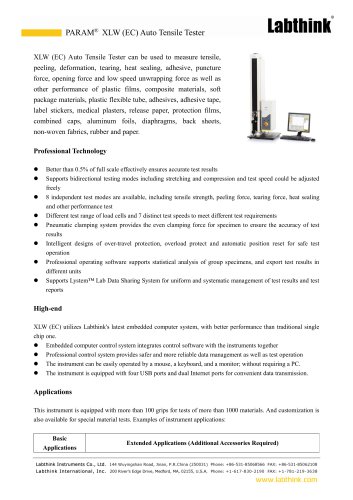 XLW (EC) Auto Testile Tester
3 Pages
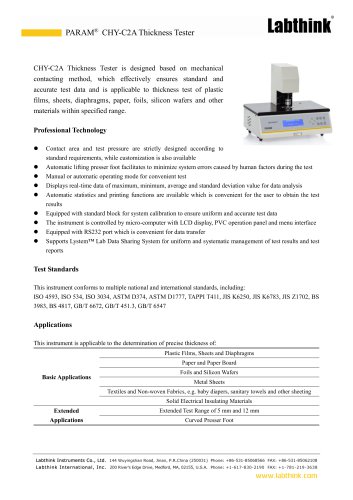 CHY-C2A
2 Pages
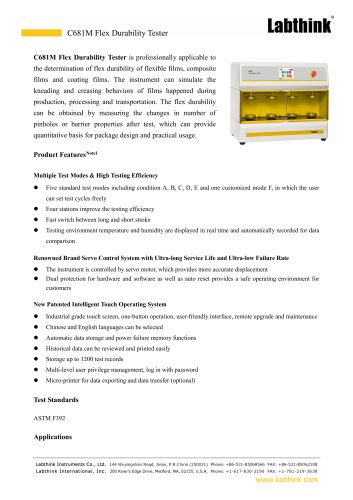 C681M Flex Durability Tester
2 Pages
 Heat Shrink Tester
2 Pages
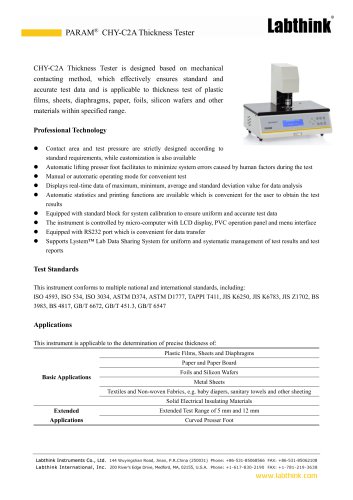 CHY-C2A Thickness Tester
2 Pages
 Tensile Testing Device
3 Pages
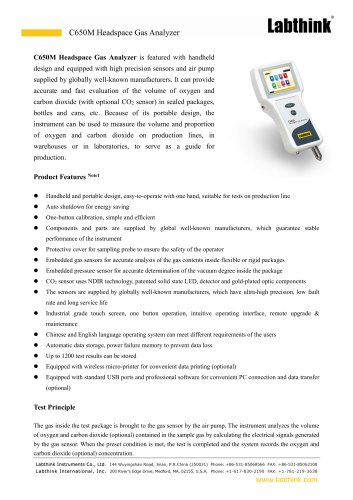 C650m Headspace Gaz Analyser
2 Pages
 MAP Packaging Burst Tester
3 Pages
 MAP Packaging Leak Tester
3 Pages
 Lug Cap Torque Tester
3 Pages
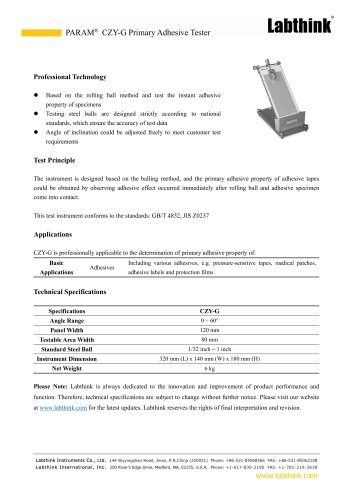 CZY - G Primary Tester
1 Page
 Motorized Pull Test Machine
3 Pages
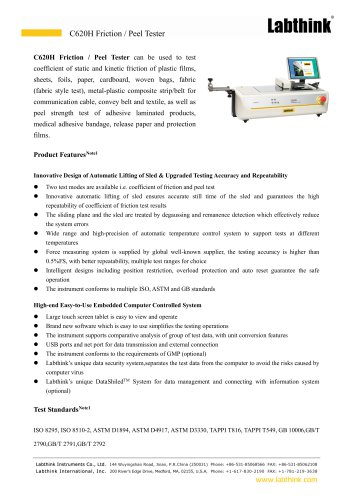 C620H Friction Tester
3 Pages
 Heat Seal Tester
3 Pages
 Roll Tack Tester
1 Page
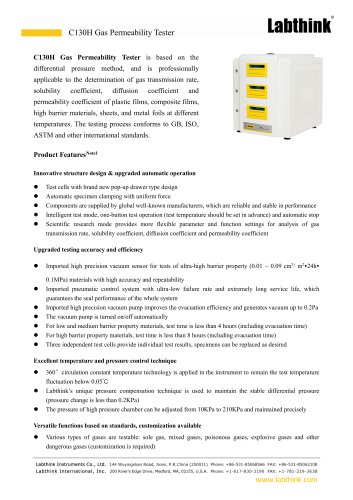 C130 Gas Permeability Tester
4 Pages
 Adhesive Tack Tester
2 Pages
 Vacuum Bag Leak Tester
3 Pages
 Micron Film Thickness Gauge
4 Pages
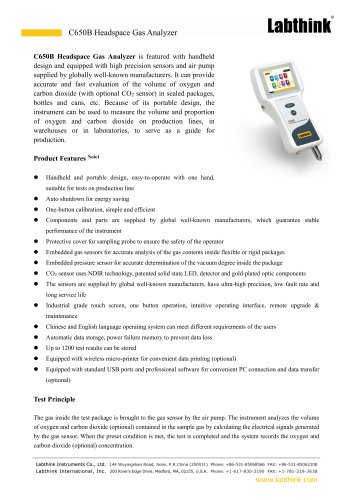 C650B Headspace Gaz Analyser
2 Pages
 Automatic Tube Leak Tester
2 Pages
 Burst Test Equipment
3 Pages
 Elongation Tester
3 Pages
 Box Compression Test Machine
2 Pages
 Adhesion Tester for Sticker
2 Pages
 Ink Rub Lab Equipment
2 Pages
 Friction Testing Machine
3 Pages
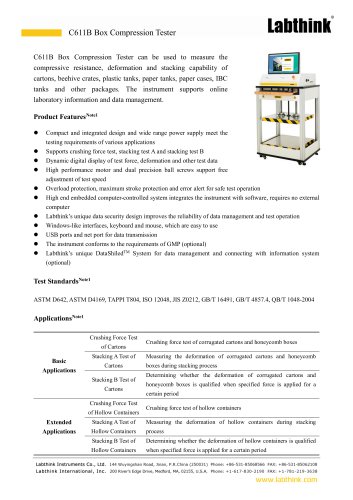 C611B
C611B2 Pages
 Fabric Thickness Measurement
4 Pages
 Snack Bag Leak Detector
3 Pages
 Carton Stacking Test Machine
2 Pages
 Sheet Metal Thickness Gauge
4 Pages
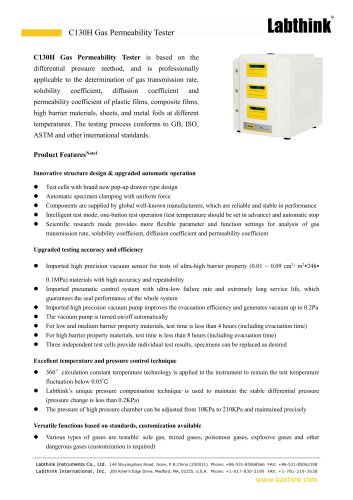 CH130
CH1304 Pages
 Residual oxygen level tester
2 Pages
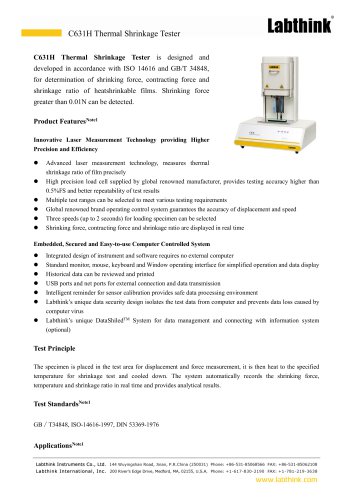 C 631 H
2 Pages
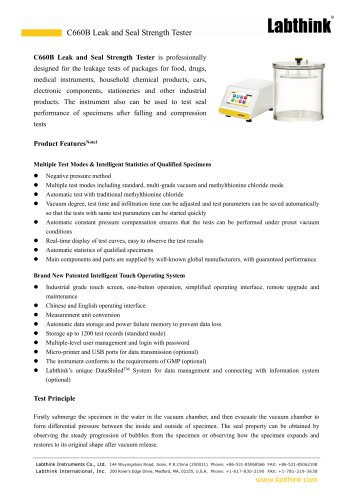 C660 B
3 Pages
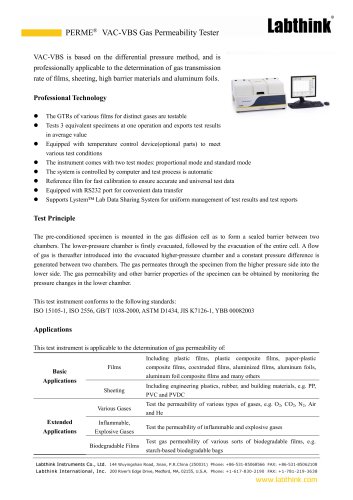 VAC-VBS
3 Pages
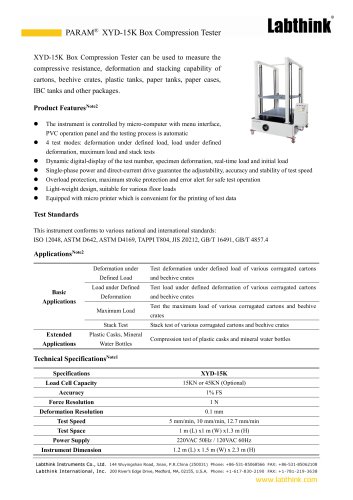 XYD-15K
2 Pages
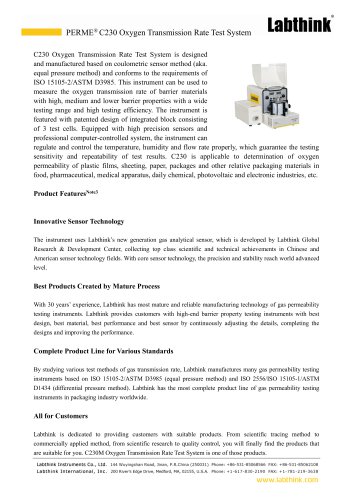 C360
C3604 Pages
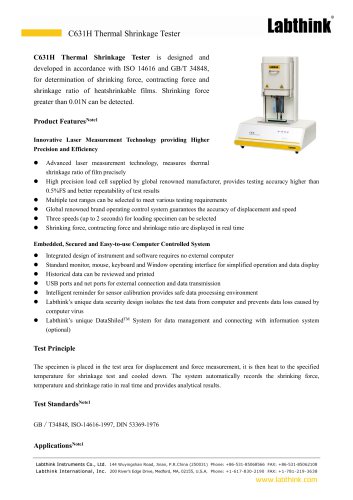 C631 H
2 Pages
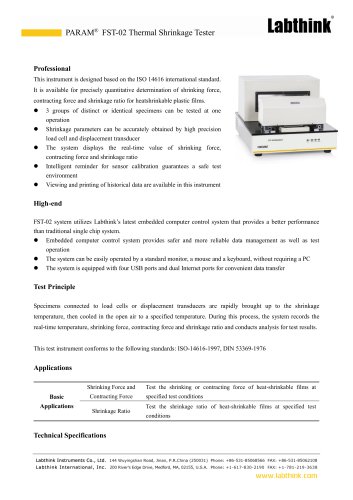 FST-02
2 Pages
 C681 M
2 Pages
 C230
C2304 Pages
 C631H
C631H2 Pages
 C612M
C612M3 Pages
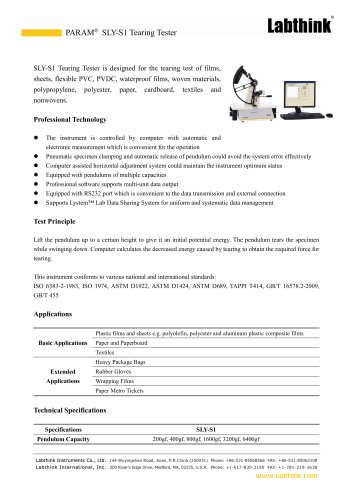 SLY-SI
2 Pages
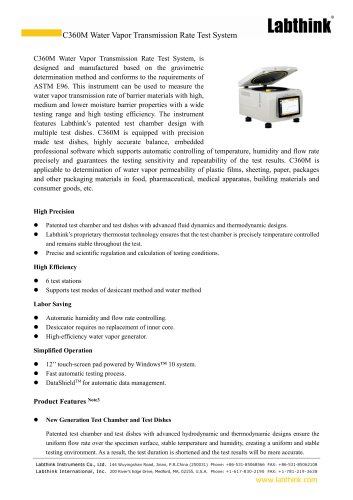 C360 M
4 Pages
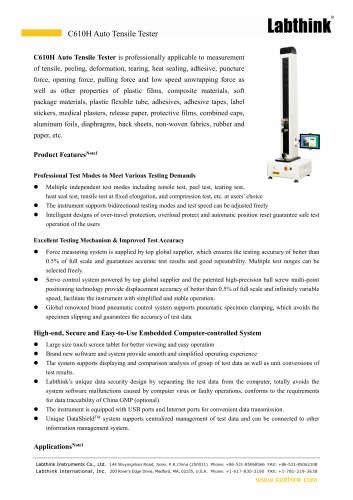 C610H Auto Tensile Tester
3 Pages
 Vacuum Tube Leak Tester
3 Pages
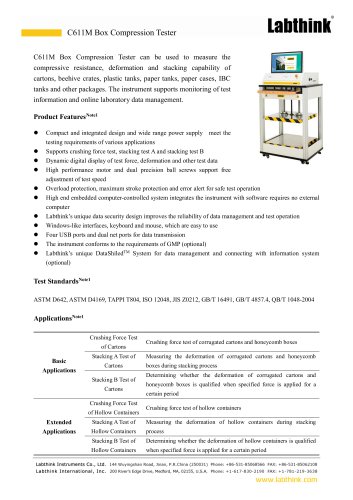 C611M
C611M2 Pages
 C330H
C330H4 Pages
 leak detector for packaging
3 Pages
 bottle torque tester machine
3 Pages
 micrometer per ASTM D374
4 Pages
 rub tester for wine labels
2 Pages
 LAB THICNESS TESTER
3 Pages
 Peel tester for 180 Degree
5 Pages
 Ball tack tester
5 Pages
 table top thickness gauge
12 Pages
 Tabletop sealing machine
14 Pages
 Film Friction Tester
2 Pages
 Head space Oxygen Analyser
2 Pages
 90 degree peel test Device
3 Pages
 C650M Headspace Gas Analyzer
2 Pages
 C650B Headspace Gas Analyzer
2 Pages
 C620H Friction
3 Pages
 Handheld Headspace Analyzer
2 Pages
 Cap Torque Machine
5 Pages
 Oxygen Permeation Analyser
3 Pages
 Oxygen Permeation Apparatus
3 Pages
 Bottle Cap Leak Tester
4 Pages
 torque meter for PET Bottles
3 Pages
 box compression device
5 Pages
 BLJ-02 Disk Stripping Tester
2 Pages
 RT-01 Rub Tester
2 Pages
 MCJ-01A Rub Tester
2 Pages
 Floor Slip Resistance Tester
5 Pages
 Leak Tester
3 Pages
 Tensile Testers
19 Pages
 Consultative Testing Service
4 Pages
 BOPP Tape Shear Tester
3 Pages
 Bell Jar leak tester
2 Pages
 COF testing of Polymer Films
2 Pages
 labthink MFY-01 Leak Tester
3 Pages
 Tablet Leak Test Apparatus
5 Pages
 Precise Tape Peeling Tester
5 Pages
 BOPP Film Thickness Meter
2 Pages
 Package Headspace Analyzer
5 Pages
 electrical torque meter
5 Pages
 tape peeling tester
5 Pages
 tensile testing instrument
5 Pages
 gas leakage detector LSSD-01
5 Pages
 XLW (G6) Auto Tensile Tester
3 Pages
 XLW (M) Auto Tensile Tester
3 Pages
 XLW (B) Auto Tensile Tester
2 Pages
 XLW Auto Tensile Tester
3 Pages
 CHY-C2 Thickness Tester
2 Pages
 CHY-CA Thickness Tester
2 Pages
 Plastic Film Thickness Test
2 Pages
 Tensile Strength Machine
5 Pages
 fogging testing machine
5 Pages
 heat sealing testing machine
5 Pages
 shrinkage testing machine
5 Pages
 torque testing machine
5 Pages
 Medical Package leak Tester
5 Pages
 Food Package leak Tester
5 Pages
 ink rubbing test machine
5 Pages
 rolling ball tack tester
5 Pages
 Glebo flex tester
5 Pages
 hot tack tester
5 Pages
 Tensile Strength Tester
5 Pages
 Rolling Ball Tester
5 Pages
 permeability apparatus
5 Pages
 CHY-CB Thickness Tester
2 Pages
 Heat Shrinkage Force Tester
5 Pages
 XLW (EC) Auto Tensile Tester
3 Pages
 gas leakage detector MFY-01
5 Pages
 materials Flex tester
5 Pages
 oxygen headspace analyzer
5 Pages
 cap torque testing machine
5 Pages
 Lasting Ahesion Tester
5 Pages
 Peeling strength tester
5 Pages
 Torque Measurement Equipment
2 Pages
 FDI-01
5 Pages
 Leakage Detector
5 Pages
 film thickness gauge
5 Pages
 rub testing machine
5 Pages
 air leakage tester
5 Pages
 vacuum leak detector
4 Pages
 plastic film testing machine
3 Pages
 carton compression test
5 Pages
 plastic cap torque tester
5 Pages
 manual torque tester
1 Page
 opening torque tester
2 Pages
 Oxygen headspace Analyzer
2 Pages
 Permeability Test System
2 Pages
 DIN 75201
2 Pages
 Tensile strength test bench
5 Pages
 impact testing equipments
2 Pages
 thickness gauge
5 Pages
 vacuum leak testing machine
2 Pages
 paper thickness measurement
5 Pages
 FDT-02 Gelbo Flex Tester
5 Pages
 Friction Coefficient Tester
5 Pages
 Drop Ball Impact Tester
5 Pages
 Dealers wanted
1 Page
 Abrasion Resistance Tester
2 Pages
 FPT-F1 Friction/ Peel Tester
2 Pages
 FT-F1 Fogging Tester
2 Pages
 Material Testing Equipment
2 Pages
 Packaging Testing
2 Pages
 Abrasion Test
2 Pages
 Torque Meter
2 Pages
 pendulum impact tester
2 Pages
 Oxygen Transmission Analyzer
2 Pages
 Friction Tester
2 Pages
 Leak Detector
2 Pages
 Analyzer for MAP
2 Pages
 Adhesive Strength Tester
1 Page
 O2 & CO2 Analyzer
1 Page
 Gas Permeability Tester
2 Pages
 Lasting Adhesive Tester
2 Pages
 Cap Torque Tester
3 Pages
 Lasting Adhesion Tester
2 Pages
 Gradient Heat Seal Tester
4 Pages
 Head space gas Analysis
4 Pages
 Headspace Gas Analyser
3 Pages
 Headspace Gas Analyzer
3 Pages
 Material Tensile Tester
5 Pages
 Ink Rub Tester
2 Pages
 medical packaging tester
3 Pages
 Hot Tack Tester (Data Sheet)
2 Pages
 Heat Sealing tester
2 Pages
 Evaporation Residue Tester
3 Pages
 Blister Package testing
3 Pages
 Gas Permeability Analyzer
3 Pages
 Tensile Testing Machine
2 Pages
 package integrity tester
2 Pages
 Oxygen permeation Analyzer
2 Pages
 Drop Impact Tester
2 Pages
 Torque tester
2 Pages
 Compression Testing Machine
2 Pages
 Material Testing Machine
3 Pages
 Shrink Film testing
2 Pages
 fogging tester
2 Pages
 Impact tester
2 Pages
 Quality Concerns of Doypacks
2 Pages
 Material Testing
2 Pages
 laboratory heat sealer
2 Pages
 Automated Heat Sealer
1 Page
 analog thickness gauge
1 Page
 Residual Gas Analyzer
1 Page
 digital torque gauge
1 Page
 packaging Industry
2 Pages
 Metrology and Test Equipment
2 Pages
 Tensile Tester
2 Pages
 material moisture monitor
2 Pages
 Gas Analyzer
2 Pages
 Headspace Gas Analyzer
1 Page
 FRICTION/PEEL TESTER
1 Page
 HOLDING TACK TESTER
1 Page
 ROLLING BALL TESTER
1 Page
 BOX COMPRESSION TESTER
1 Page
 INK RUB TESTER
1 Page
 FOGGING TESTER
2 Pages
 Film Shrinkage Tester
1 Page
 THICKNESS TESTER
1 Page
 TOQUE TESTER
1 Page
 Tearing Tester
1 Page
 Gas Permeability Tester
1 Page
 Oxygen Permeability Tester
2 Pages


























































































































Archived catalogs
 C611M
C611M2 Pages
 C611B Box Compression Tester
2 Pages
 C306H
C306H3 Pages
 C230H
C230H4 Pages
 C610M Auto Tensile Tester
3 Pages
 Leak Tester
2 Pages






- Labthink Instruments testing machine
- Labthink Instruments gas analyzer
- Measuring device
- Concentration analyzer
- Monitoring analyzer
- Test stand
- Measuring machine
- Automatic analyser
- Labthink Instruments material testing machine
- Automated testing machine
- Benchtop analyser
- Solids analyser
- Computer-controlled test machine
- Process analyzer
- Portable analyzer
- Compression testing machine
- Continuous analyzer
- Labthink Instruments digital tester
- Industrial testing machine
- Labthink Instruments vertical testing machine