

- Company
- Products
- Catalogs
- News & Trends
- Exhibitions
H2 S cartridg
H2 S cartridg
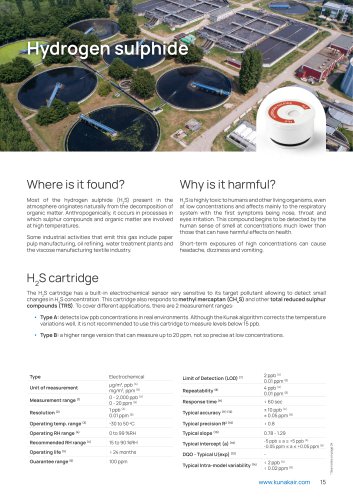
Hydrogen sulphide is primarily released into the atmosphere through the natural decomposition of organic matter. Industrial activities such as paper pulp manufacturing, oil refining, water treatment, and textile production also contribute to its presence. H2S is highly toxic, affecting the respiratory system and causing symptoms like irritation of the nose, throat, and eyes, even at low concentrations. Short-term exposure to high levels can lead to headaches, dizziness, and vomiting.
- Sensor Type: Electrochemical sensor sensitive to H2S and other reduced sulphur compounds.
- Measurement Ranges:
- Type A: Detects low ppb concentrations, not recommended for levels below 15 ppb.
- Type B: Measures up to 20 ppm, less precise at low concentrations.
- Limit of Detection (LOD): 2 ppb (Type A), 0.01 ppm (Type B).
- Repeatability: 4 ppb (Type A), 0.01 ppm (Type B).
- Response Time: Less than 60 seconds.
- Accuracy: ± 10 ppb (Type A), ± 0.05 ppm (Type B).
- Precision (R2): Greater than 0.8.
- Typical Slope: 0.78 - 1.29.
- Typical Intercept: -5 ppb to +5 ppb (Type A), -0.05 ppm to +0.05 ppm (Type B).
- Intra-model Variability: Less than 2 ppb (Type A), less than 0.02 ppm (Type B).
- Operating Temperature Range: -30 to 50 ºC.
- Operating Humidity Range: 0 to 99% RH, recommended 15 to 90% RH.
- Operating Life: Greater than 24 months.
- Guarantee Range: 100 ppm.
Catalog excerpts

Hydrogen sulphide Most of the hydrogen sulphide (H2S) present in the atmosphere originates naturally from the decomposition of organic matter. Anthropogenically, it occurs in processes in which sulphur compounds and organic matter are involved at high temperatures. H2S is highly toxic to humans and other living organisms, even at low concentrations and affects mainly to the respiratory system with the first symptoms being nose, throat and eyes irritation. This compound begins to be detected by the human sense of smell at concentrations much lower than those that can have harmful effects on health. Some industrial activities that emit this gas include paper pulp manufacturing, oil refining, water treatment plants and the viscose manufacturing textile industry. Short-term exposures of high concentrations can cause headache, dizziness and vomiting. H2S cartridge The H2S cartridge has a built-in electrochemical sensor very sensitive to its target pollutant allowing to detect small changes in H2S concentration. This cartridge also responds to methyl mercaptan (CH4S) and other total reduced sulphur compounds (TRS). To cover different applications, there are 2 measurement ranges: • Type A: detects low ppb concentrations in real environments. Although the Kunak algorithm corrects the temperature variations well, it is not recommended to use this cartridge to measure levels below 15 ppb. • Type B: a higher range version that can measure up to 20 ppm, not so precise at low concentrations. Unit of measurement Measurement range (1) Resolution (2) Limit of Detection (LOD) (7) Repeatability (8) Response time (9) Operating temp. range (3) Typical slope Recommended RH range Operating life (5) Guarantee range Typical Intra-model variability
Open the catalog to page 1All Kunak catalogs and technical brochures
 CH4 sensors
1 Page
 O3 cartridge
1 Page
 NO2 cartridge
1 Page
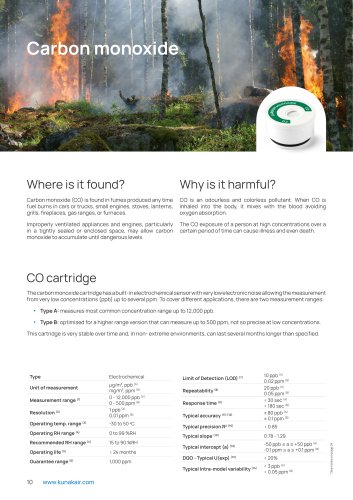 CO cartridge
1 Page
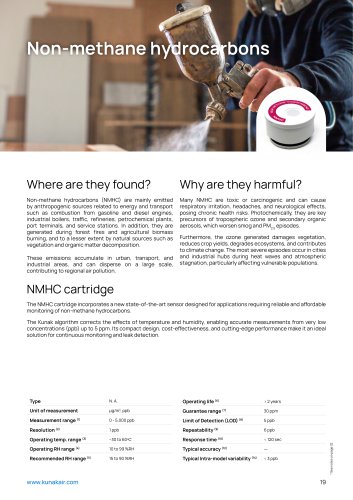 Non-methane hydrocarbon
1 Page
 Datasheet Kunak AIR
12 Pages
Archived catalogs
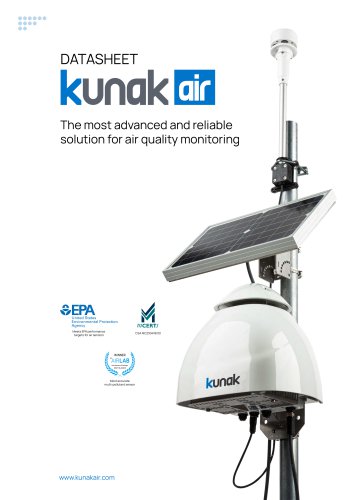 Kunak AIR Datenblatt
12 Pages
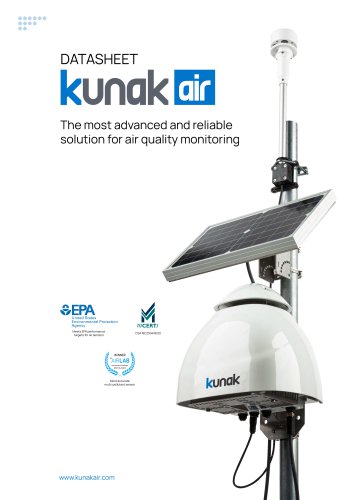 Scheda tecnica Kunak AIR
12 Pages
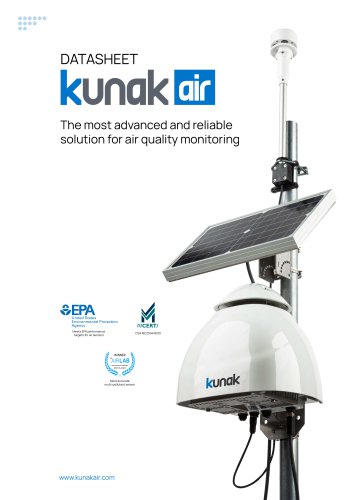 Kunak AIR datasheet
12 Pages
- Management software solution
- Analysis software solution
- Real-time software
- Computer-aided design software
- Cloud-based software
- Design software solution
- Monitoring software solution
- Industrial software
- Measurement software
- Interface software
- Visualization software solution
- Quality software
- Simulation software solution
- Automated software
- Network software
- Creation software
- Data acquisition software
- Calculation software
- Data analysis software
- Oxygen meter