

- Company
- Products
- Catalogs
- News & Trends
- Exhibitions
CH4 sensors
CH4 sensors
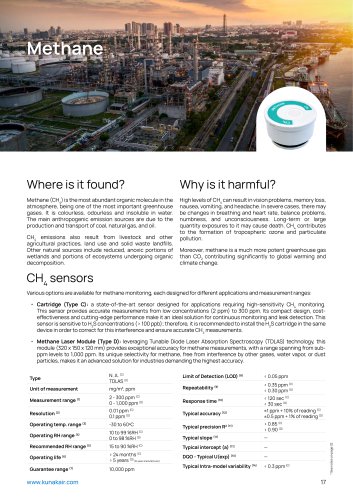
Methane (CH4) is a significant greenhouse gas, colorless, odorless, and insoluble in water. Major anthropogenic sources include coal, natural gas, oil production, livestock, agriculture, land use, and landfills. Natural sources are wetlands and decomposing ecosystems. High CH4 levels can cause health issues such as vision problems, memory loss, and in severe cases, unconsciousness or death. Methane significantly contributes to global warming and climate change.
CH4 Sensors
Two main types of methane sensors are discussed:
- Cartridge (Type C): Designed for high-sensitivity monitoring, measuring from 2 ppm to 300 ppm. It is compact, cost-effective, and ideal for continuous monitoring and leak detection. Sensitive to H2S, it is recommended to use an H2S cartridge for accurate measurements.
- Methane Laser Module (Type D): Utilizes Tunable Diode Laser Absorption Spectroscopy (TDLAS) for high accuracy, measuring from sub-ppm to 1,000 ppm. It offers unique selectivity for methane without interference from other gases, water vapor, or dust.
Technical Specifications
- Limit of Detection (LOD): < 0.05 ppm
- Repeatability: < 0.35 ppm (C), < 0.30 ppm (D)
- Response Time: < 120 sec (C), < 30 sec (D)
- Typical Accuracy: ±1 ppm + 10% of reading (C), ±0.5 ppm + 1% of reading (D)
- Precision R2: > 0.85 (C), > 0.90 (D)
- Measurement Range: 2 - 300 ppm (C), 0 - 1,000 ppm (D)
- Resolution: 0.01 ppm (C), 0.1 ppm (D)
- Operating Temperature Range: -30 to 60ºC
- Operating RH Range: 10 to 99 %RH (C), 0 to 98 %RH (D)
- Operating Life: > 24 months (C), > 5 years (D)
Catalog excerpts
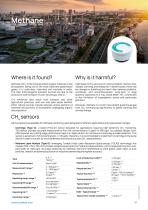
Methane (CH4) is the most abundant organic molecule in the atmosphere, being one of the most important greenhouse gases. It is colourless, odourless and insoluble in water. The main anthropogenic emission sources are due to the production and transport of coal, natural gas, and oil. CH, emissions also result from livestock and other agricultural practices, land use and solid waste landfills. Other natural sources include reduced, anoxic portions of wetlands and portions of ecosystems undergoing organic decomposition. High levels of CH4 can result in vision problems, memory loss, nausea, vomiting, and headache. In severe cases, there may be changes in breathing and heart rate, balance problems, numbness, and unconsciousness. Long-term or large quantity exposures to it may cause death. CH4 contributes to the formation of tropospheric ozone and particulate pollution. Moreover, methane is a much more potent greenhouse gas than CO2 contributing significantly to global warming and climate change. Various options are available for methane monitoring, each designed for different applications and measurement ranges: • Cartridge (Type C): a state-of-the-art sensor designed for applications requiring high-sensitivity CH4 monitoring. This sensor provides accurate measurements from low concentrations (2 ppm) to 300 ppm. Its compact design, cost-effectiveness and cutting-edge performance make it an ideal solution for continuous monitoring and leak detection. This sensor is sensitive to H2S concentrations (> 100 ppb); therefore, it is recommended to install the H2S cartridge in the same device in order to correct for this interference and ensure accurate CH, measurements. • Methane Laser Module (Type D): leveraging Tunable Diode Laser Absorption Spectroscopy (TDLAS) technology, this module (320 x 150 x 120 mm) provides exceptional accuracy for methane measurements, with a range spanning from sub-ppm levels to 1,000 ppm. Its unique selectivity for methane, free from interference by other gases, water vapor, or dust particles, makes it an advanced solution for industries demanding the highest accuracy. Unit of measurement Measurement range (1) Operating temp. range (3) Operating RH range (4) Recommended RH range (5) Operating life (6) > 5 years (D)(10 years manufacturer) Limit of Detection (LOD) (8) Repeatability (9) Typical Intra-model variability (14)
Open the catalog to page 1All Kunak catalogs and technical brochures
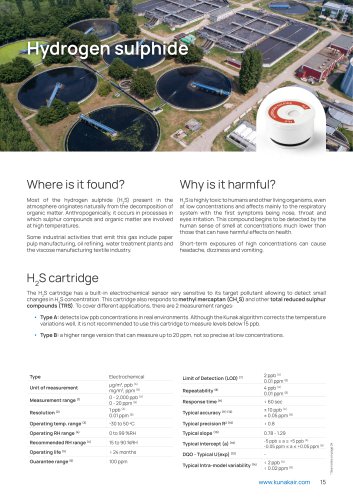 H2 S cartridg
1 Page
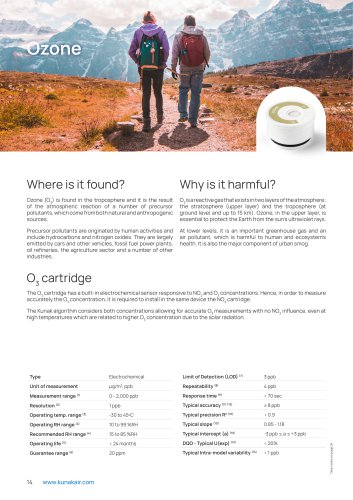 O3 cartridge
1 Page
 NO2 cartridge
1 Page
 CO cartridge
1 Page
 Non-methane hydrocarbon
1 Page
 Datasheet Kunak AIR
12 Pages

Archived catalogs
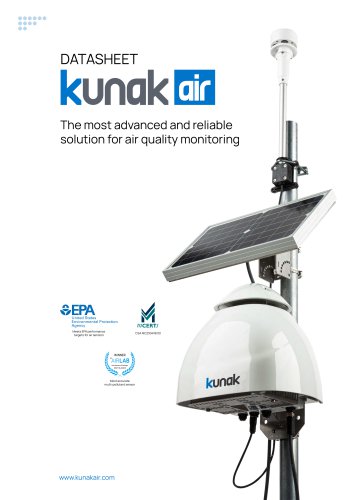 Kunak AIR Datenblatt
12 Pages
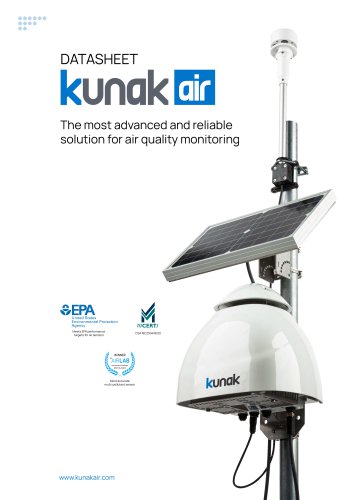 Scheda tecnica Kunak AIR
12 Pages
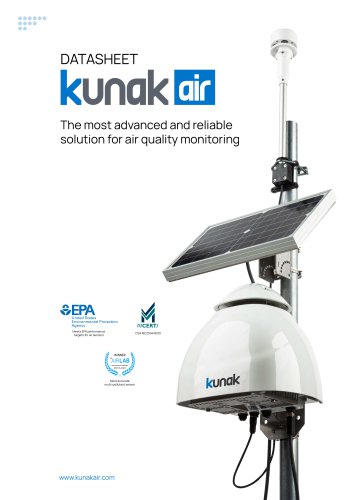 Kunak AIR datasheet
12 Pages
- Management software solution
- Analysis software solution
- Real-time software
- Computer-aided design software
- Cloud-based software
- Design software solution
- Monitoring software solution
- Industrial software
- Measurement software
- Interface software
- Visualization software solution
- Quality software
- Simulation software solution
- Automated software
- Network software
- Creation software
- Data acquisition software
- Calculation software
- Data analysis software
- Oxygen meter