
- Catalogs
- KRÜSS GmbH
- TOP VIEW ANALYZER – TVA100B

- Products
- Catalogs
- News & Trends
- Exhibitions
TOP VIEW ANALYZER – TVA100B
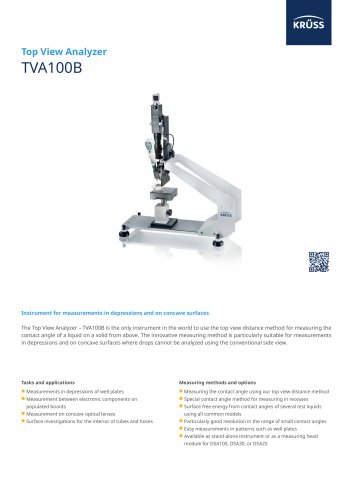
TOP VIEW ANALYZER – TVA100B
- Measurements in depressions of well plates.
- Measurement between electronic components on populated boards.
- Measurement on concave optical lenses.
- Surface investigations for the interior of tubes and hoses.
- Contact angle measurement using the top view distance method.
- Special contact angle method for measuring in recesses.
- Surface free energy determination from contact angles of several test liquids using common models.
- High resolution for small contact angles.
- Easy measurements in patterns such as well plates.
- Available as a stand-alone instrument or as a measuring head module for DSA100, DSA30, or DSA25.
The Top View Analyzer – TVA100B is unique in using the top view distance method for measuring the contact angle of a liquid on a solid from above. This method is ideal for measurements in depressions and on concave surfaces where conventional side view analysis is not possible.
The method involves determining the curvature of a drop's surface, which correlates with the contact angle, from the distance of reflected light spots in a video image. These spots are created by LEDs positioned above the drop. The calculation requires variables such as working distance, LED spacing, optical enlargement, and dosed drop volume.
- Camera System: USB 3.0 connection, up to 2300 fps.
- Optics: 6.5× zoom, manual.
- Illumination: LED, adjustable.
- Dosing System: Electronic pipette for precise drop generation with a resolution of 0.01 µL, minimum drop volume of 0.2 µL, and capacity of 10 µL.
- Contact Angle: Range from 3.5° to 75°, with accuracy of ±0.1° (3.5° to 23°) and ±1° (23° to 75°).
The TVA100B features high-quality optics and a high-resolution camera for precise measurement of point distances. The drop volume is dosed with precision, allowing for quick changes of the liquid to determine the surface free energy of the sample.
Catalog excerpts
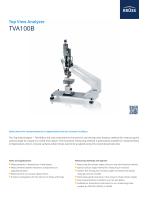
Instrument for measurements in depressions and on concave surfaces The Top View Analyzer – TVA100B is the only instrument in the world to use the top view distance method for measuring the contact angle of a liquid on a solid from above. The innovative measuring method is particularly suitable for measurements in depressions and on concave surfaces where drops cannot be analyzed using the conventional side view. Measuring methods and options ■ Measurements in depressions of well plates ■ Measurement between electronic components on ■ Measuring the contact angle using our top view distance method ■ Special contact angle method for measuring in recesses ■ Surface free energy from contact angles of several test liquids populated boards ■ Measurement on concave optical lenses ■ Surface investigations for the interior of tubes and hoses using all common models ■ Particularly good resolution in the range of small contact angles ■ Easy measurements in patterns such as well plates ■ Available as stand-alone instrument or as a measuring head module for DSA1
Open the catalog to page 1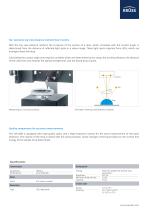
Our exclusive top view distance method: how it works With the top view distance method, the curvature of the surface of a drop, which correlates with the contact angle, is determined from the distance of reflected light spots in a video image. These light spots originate from LEDs, which are arranged above the drop. Calculating the contact angle only requires variables which are determined by the setup: the working distance, the distance of the LEDs from one another, the optical enlargement, and the dosed drop volume. Measuring on a concave surface Principle of the top view distance method Quality...
Open the catalog to page 2All KRÜSS GmbH catalogs and technical brochures
 DROP SHAPE ANALYZER – DSA30M
2 Pages
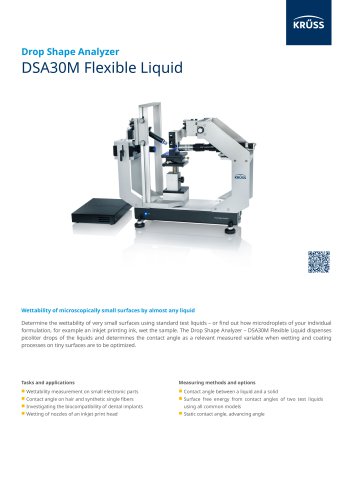 DSA30M Flexible Liquid
2 Pages
 Product Overview 2025
84 Pages
 Tensíío
2 Pages
 Ayríís
2 Pages
 FORCE TENSIOMETER – K20
2 Pages
 FORCE TENSIOMETER – K6
1 Page
 DROP SHAPE ANALYZER – DSA30
2 Pages
 DROP SHAPE ANALYZER – DSA30R
2 Pages
 Drop Shape Analyzer DSA25
2 Pages
 DROP SHAPE ANALYZER – DSA100
2 Pages
 Dynamic Foam Analyzer DFA100
2 Pages
 DSA100, DSA30, EasyDrop
5 Pages
 DSA100, DSA30
4 Pages
 DSA100
3 Pages


- KRÜSS measuring instrument
- Concentration analyzer
- Monitoring analyzer
- Liquids analyzer
- Automatic analyser
- Benchtop analyser
- Solids analyser
- Process analyzer
- Real-time analyzer
- Laboratory analyzer
- Digital gauge
- Digital analyzer
- Portable gauge
- Infrared analyser
- Calibration analyzer
- Temperature analyzer
- Industrial measuring module
- Analyzer for the food industry
- High-performance analyzer
- Benchtop measuring module