
- Catalogs
- KRÜSS GmbH
- DROP SHAPE ANALYZER – DSA30M

- Products
- Catalogs
- News & Trends
- Exhibitions
DROP SHAPE ANALYZER – DSA30M

DROP SHAPE ANALYZER – DSA30M
- Wettability measurement on small electronic parts.
- Contact angle analysis on hair and synthetic fibers.
- Biocompatibility investigation of dental implants.
- Analysis of micromechanical components, such as those in watches.
- Contact angle measurement between a liquid and a solid.
- Surface free energy calculation using contact angles of two test liquids with common models.
- Static contact angle and advancing angle measurements.
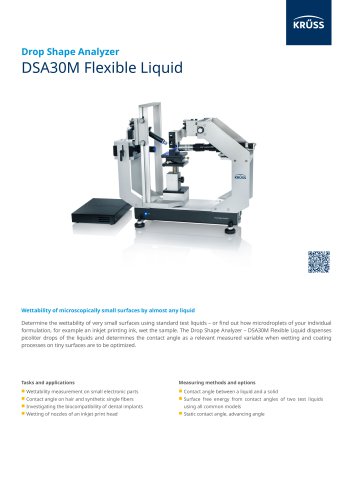
The DSA30M is designed for precise wettability analysis on extremely small surfaces using a picoliter dosing system and powerful microscope optics. It is suitable for analyzing samples like hairs or dental implant screw windings.
The instrument is equipped for microdrop analysis with dosing units capable of dispensing 20 or 60 picoliter drops. The 20 picoliter unit can be heated. Standard water dosing can be expanded with modules for diiodomethane and glycerine to determine surface free energy.
The DSA30M features high-quality microscopic lenses and powerful illumination, ensuring reliable measurement results. A high-speed camera allows for the analysis of ultra-small, rapidly evaporating, or absorbed droplets.
- Camera System: CF04: 2.3 Mpix, up to 2300 fps; CF10: 5.3 Mpix, up to 3450 fps.
- Optics: 6.5× microscope zoom, manual.
- Illumination: High power monochromatic LED.
- Dosing System: Software-controlled, minimum drop volume of 20 pL.
- Contact Angle: Range 0 to 180°, resolution 0.01°.
Catalog excerpts

Drop Shape Analyzer Precise wettability analysis on extremely small surfaces The Micro configuration of our DSA30 was specially designed to investigate the contact angle on surfaces which require very small drops for analyzing them. The DSA30M solves this task with a picoliter dosing system and powerful microscope optics. The result is a versatile instrument that provides precise contact angle and surface free energy results for samples such as hairs or the screw windings of dental implants. ■ Wettability measurement on small electronic parts ■ Contact angle on hair and synthetic single fibers ■ Investigating the biocompatibility of dental implants ■ Micromechanical components, e.g. in watches Measuring methods and options ■ Contact angle between a liquid and a solid ■ Surface free energy from contact angles of two test liquids using all common models ■ Static contact angle, advancing angle
Open the catalog to page 1
The available dosing units for 20 or 60 picoliter minimum volume dispense microscopically small drops of test liquid onto the sample. The fine positioning of the dosing unit and the sample allows precise placement of the drops. The dosing unit for 20 picoliters can also be heated. The standard equipment for water dosing can be expanded to include modules for diiodomethane and glycerine in order to determine the surface free energy with contact angles of two or three liquids. Together with other evaluation options, this result provides important information for adhesion, e.g. of fiber coatings....
Open the catalog to page 2All KRÜSS GmbH catalogs and technical brochures
 DSA30M Flexible Liquid
2 Pages
 Product Overview 2025
84 Pages
 Tensíío
2 Pages
 Ayríís
2 Pages
 FORCE TENSIOMETER – K20
2 Pages
 FORCE TENSIOMETER – K6
1 Page
 TOP VIEW ANALYZER – TVA100B
2 Pages
 DROP SHAPE ANALYZER – DSA30
2 Pages
 DROP SHAPE ANALYZER – DSA30R
2 Pages
 Drop Shape Analyzer DSA25
2 Pages
 DROP SHAPE ANALYZER – DSA100
2 Pages
 Dynamic Foam Analyzer DFA100
2 Pages
 DSA100, DSA30, EasyDrop
5 Pages
 DSA100, DSA30
4 Pages
 DSA100
3 Pages


- KRÜSS measuring instrument
- Concentration analyzer
- Monitoring analyzer
- Liquids analyzer
- Automatic analyser
- Benchtop analyser
- Solids analyser
- Process analyzer
- Real-time analyzer
- Laboratory analyzer
- Digital gauge
- Digital analyzer
- Portable gauge
- Infrared analyser
- Calibration analyzer
- Temperature analyzer
- Industrial measuring module
- Analyzer for the food industry
- High-performance analyzer
- Benchtop measuring module