
- Catalogs
- Koul Tools
- AN HOSE ASSEMBLY TOOLS

- Products
- Catalogs
- News & Trends
- Exhibitions
AN HOSE ASSEMBLY TOOLS

AN HOSE ASSEMBLY TOOLS
This document provides instructions for the AN Hose Assembly Tool, a device designed to facilitate the assembly of hoses. Users are encouraged to watch instructional videos available on the KOUL Tools website for a comprehensive understanding of the tool's operation.
The tool is engineered to assist in the assembly of AN hoses, which are commonly used in automotive and aerospace applications. It is designed to improve efficiency and reduce the risk of damage during assembly.
1. Prepare the hose and fittings according to the manufacturer's guidelines.
2. Use the AN Hose Assembly Tool to align and secure the hose and fittings.
3. Follow the step-by-step process demonstrated in the instructional videos to ensure proper assembly.
For optimal results, it is recommended to familiarize oneself with the tool by watching the videos provided on the KOUL Tools website. Regular maintenance of the tool will ensure longevity and consistent performance.
For further assistance, users can contact KOUL Tools at (928) 854-6706.
Catalog excerpts
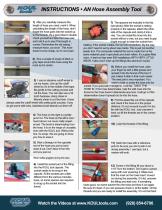
INSTRUCTIONS • AN Hose Assembly Tool 1) After you carefully measure the length of hose you need, mark it. When calculating the length of the hose, don’t forget the hose goes into the socket up to the threads. It’s a good idea to double check yourself and take the hose over and hold it up to see if the length is correct. Remember the old saying, “ measure twice, cut once”. This hose doesn’t come cheap, so it's not a bad 2) Give a couple of wraps of black or gray tape around the hose using the mark as it’s center. 3) I use an abrasive cutoff wheel to cut my hoses. Line up the cutoff wheel so it's in the middle of the tape. Be gentle in the cutting process and cut the hose. You can also use a 32 tooth hacksaw, sharp chisel or Beverly shear to cut the hose. I have always used the cutoff wheel with pretty good success. If you do get some wild hairs, (stainless braid strands) cut them off. 4) The hose on the right is a pretty good cut. The hose on the left is one I heard about, but never really experienced. The braid is delaminating from the hose. It is on the verge of unusable, even with the KOUL tool. Without the tool, it’s scrap. We are going to show you how to save it. 5) Stick a blowgun in the opposite end of the hose you just cut and clean it out. Don’t blow it from the end you just cut. 6) Install the socket part of the fitting into the KOUL tool capsule. The socket needs to be snug in the capsule. All the sockets are a little different from the various manufactures, so some spacers are required to snug up the socket into the funnel. 7) The spacers are included in the kits, (see photo) After the socket is resting properly in the capsule, attach the other side of the capsule and clamp it into a vise. You can install the hose into the socket without a vise, but you need to grip it tight enough to keep the socket from rotating. If the socket rotates, the tool will not perform. By the way, you don’t need to worry about vise marks. This is just not another plastic tool. The composite material the tool is made from is the same material used in sprockets and chain rollers. It's a glass filled nylon. A test tool has seen 800 installations WITH VERY LITTLE WEAR. It also won’t mark up the fittings like aluminum would. 8) Before you install the hose, wipe your finger tip with a little grease and spread it into the funnel of the tool. It just makes it slide in that much easier. The next part is very important. You need to twist or screw the hose into the socket. If you just push it straight in, it will fail. TWIST THE HOSE IN. If the hose delaminates, help the wild ones into the funnel so the hose doesn’t delaminate anymore. It will go in if the delamination doesn’t spread too far into the hose. 9) Pull the assembly out of the capsule and check if the hose is in the proper distance. It’s not unusual to push it in too far with the KOUL tool. Just unscrew it back out till the threads are in the correct position. 10) Lube the threads of the fitting. 12) Screw in the fitting till your about a 1/16" from the bottom. Don’t get to carried away with over powering it. Make sure that the mark on the hose hasn’t moved out during the assembly. If it did, unscrew the fitting and start over. If everything looks good, run some solvent thru the hose and blow it out again. Be sure it’s clean. If you can pressure check it, all the better. Oil the threads and you are ready to install the assembly. It's not that hard
Open the catalog to page 1All Koul Tools catalogs and technical brochures
 SURSEAT P-45 & P-37
1 Page
 SURSEAT P-51
1 Page
 EZ-ON HOSE PRESS
2 Pages