

Technical Catalogue
Technical Catalogue
This technical catalogue provides detailed information on ball screws, emphasizing the company's expertise in design, production, and sales. It highlights the commitment to high-quality products that meet international standards, supported by advanced manufacturing technologies and a robust quality assurance policy.
The company offers a wide range of high-accuracy ball screws, focusing on performance, efficiency, and reduced maintenance costs. Customers benefit from a broad product range, allowing for tailored solutions. A ball screw repair service is available for emergencies.
The quality assurance system is certified under UNE-EN ISO 9002, ensuring compliance with customer requirements and zero defects. Regular audits maintain high standards, and control certificates cover aspects like lead accuracy and rigidity.
Ball screws replace sliding friction with rolling friction, offering high accuracy, minimal axial play, and smooth operation. They achieve efficiency up to 97-98%, significantly higher than conventional screws.
The catalogue includes design calculations for buckling, critical speed, load ratings, and life expectancy, aiding in selecting the appropriate ball screw for specific applications.
Details on types of ends, storage, working temperature, protection, materials, lubrication, and mounting are provided to ensure proper use and maintenance.
Guidance on preventive measures and solutions to common problems is included to enhance reliability and longevity.
A selection procedure and questionnaire assist in choosing the most suitable ball screw for specific needs.
Ball screws transform rotary motion into linear motion with high efficiency, requiring less driving force due to reduced rolling friction. They offer high precision, durability, and allow for higher translation speeds with reduced vibrations and wear.
Ball screws are manufactured according to proprietary standards and DIN 69051, available in rolled and ground versions.
Ball screws are used in industries such as CNC machine tools, packaging, printing, automotive, aerospace, and medical technology.
Key terms include nominal diameter, pitch circle diameter, lead, contact angle, and axial play. The gothic groove profile is preferred for optimal load distribution.
Nuts are classified by recirculation type, number of circuits, and shape, with systems for both internally and externally recirculating systems.
The document outlines different types of nuts used in ball screws, including single and double nuts with various flange configurations.
Acceptance tests are conducted according to DIN 69051/3 and ISO 3408/3 standards, with specific formulas for calculating deviations and travel variations.
Various tests ensure precision and functionality, with specific tolerances outlined for different travel lengths and conditions.
Graphical methods evaluate actual mean travel deviations, with procedures for determining maximum spans and drawing parallel lines to assess travel variations.
The document emphasizes the importance of adhering to specified standards and conducting thorough testing to ensure reliability and accuracy.
Preloading eliminates backlash, increases rigidity, and improves positioning accuracy. Two methods are discussed: using oversized balls and offsetting the lead in the nut's central area.
Single nuts can be preloaded by inserting larger balls, while double nuts use a spacer to determine preload magnitude.
Customers should specify preload values based on intended use, with a standard preload of 6% of the dynamic load rating if unspecified.
Axial stiffness is crucial for positioning accuracy, with formulas provided for calculating rigidity in different mounting scenarios.
The document discusses speed limitations, critical speed, and provides a detailed chart illustrating the relationship between nominal diameter and unsupported length.
Static and dynamic load ratings are defined, with modified ratings for different operating conditions.
Methodology for calculating life expectancy considers fatigue and wear, with formulas for varying loads and speeds.
Tables account for operating conditions and motion types, affecting the equivalent mean load.
Guidelines for selecting ball screws based on operational speed and load conditions are provided.
Detailed specifications include dimensions, load capacities, and material properties.
Design calculations for determining necessary characteristics for machine drives are outlined.
Recommendations include supporting long ball screws at multiple points and accounting for thermal expansion.
Formulas for maximum radial deviation, axial elongation, torque, and power calculations are provided.
Parameters such as unsupported length, critical speed, and total rigidity are calculated to ensure they exceed operating conditions.
An example calculation illustrates the design process for selecting a ball screw system.
Detailed calculations for shaft torsion and preload torque emphasize precision in mechanical calculations.
Ball screws are sensitive to shocks and corrosive agents, requiring proper packaging and storage.
Ball screws are supplied with PTFE seals, with additional protection recommended for corrosive environments.
Proper lubrication is essential for preventing rust and reducing wear, with specific recommendations for different conditions.
Critical steps for mounting and dismantling are outlined to ensure longevity.
Recommendations include avoiding corrosive environments and preventing radial loads on the nut.
- Never remove the nut; it should be blocked during machining.
- Ensure the ballscrew is centered and fixed firmly.
- Prevent coolant or metal chips from entering the nut.
- If the nut comes out of the screw, contact the manufacturer.
- After machining, clean the ballscrew thoroughly and apply proper lubrication.
- Excessive backlash, insufficient preloading, and inadequate bearings.
- Incorrect installation of bearings and insufficient rigidity of nut or bearing housings.
- Improper mounting of nut or bearings and bearing housing parallelism error.
- Faulty coupling of motor and ball screw shaft, clogging of shaft thread by foreign matters.
- Nut out of its travel, recirculating circuit damaged, bending of ball screw shaft.
- Improper nut assembly, damage during transport, ball fracture, and excessive torsion.
- On/off functioning and sticking.
- Consider load conditions, operating speed, operational life requirements, positioning accuracy, maximum travel, shocks and vibrations, lubrication, corroding environments, working temperature, and type of mounting.
- Evaluate shaft deflection, buckling, torsion, lead, critical speed, quality, circuits, life expectancy, nut rigidity, driving torque, efficiency, and power.
- Includes details on operating conditions, life expectancy, mounting conditions, shaft and nut dimensions, precision, preload, rigidity, lubrication, protection, and quantity required.
Catalog excerpts
husillos a bolas CATALOGO TECNICO > ballscrews TECHNICAL CATALOGUE >
Open the catalog to page 1
atesora unalarga experiencia en el diseo, produccin y comercializaciᳳn de husillos a bolas. Nuestro constanteesfuerzo en la bsqueda del ms alto nivel de CALIDAD hace que podamos ofrecer al mercado un producto de calidad contrastada a nivel internacional.utiliza avanza-dos medios y tecnologꡭas pun- teras de fabricacin, sistemas informticos y de CAD/CAM apli- cados a la producci㡳n de husillos a bolas.con una clarapoltica de aseguramiento de CALIDAD, dispone del Certificado de Registro de Empresa ER- 071/2/96 de acuerdo con la norma UNE-EN ISO 9002.formado porun conjunto de PERSONAS alta- mente...
Open the catalog to page 2
Las principales ventajas ofrecidas por loshusillos a bolas de precisin para elmovimiento lineal, en sustitucin de los cl㳡si- cos husillos de rosca trapezoidal son un mayor rendimiento y eficacia, y una disminucin de los costes de mantenimiento.Los clientes se benefician asmismo, de laposibilidad que les ofrece de escogerentre una de las gamas m㭡s amplias del merca- do de husillos a bolas, lo que nos permite poder recomendar y suministrar el husillo a bolas ms adecuado a cada tipo de aplicacin.Nuestro objetivo primordial es el de pres-tar un servicio adecuado y de calidad al cliente.trata de mejorar...
Open the catalog to page 4
el fin de cumplir con los requisitos especficos de su aplicacin (aunque sea difcil predecir el rendimiento de un husillo a bolas bajo condi- ciones de trabajo extremas, siempre podremos efectuar una simulacin de vida del husillo a bolas e incluso ver su comportamiento en los bancos de pruebas).Este asesoramiento incluye la seleccindel tipo de husillo a bolas m㳡s conveniente en cada caso, segn dimetro, paso, precarga, material, lubricaciꡳn, etc. El sistema CAD nos permite simular, optimizar y actualizar los dise- os, por lo que podemos ofrecerle una rpida y adecuada respuesta.estᡡ equipado con...
Open the catalog to page 5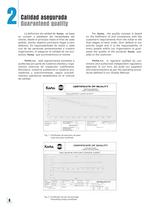
La definicin de calidad de se basaen cumplir y satisfacer las necesidades del cliente, desde el principio hasta el final de cada pedido, siendo objetivo prioritario llegar a cero defectos. Es responsabilidad de todos y cada una de las personas pertenecientes a nuestra organizacin, el asegurar la calidad de los pro-ductos que suministremos al cliente.est㳡 regularmente sometido aauditoras por parte de nuestros clientes y orga- nismos externos de inspeccin cualificados. Asmismo, nosotros auditamos a nuestros pro- veedores y subcontratistas, segn procedi- mientos operativos establecidos en el manual...
Open the catalog to page 6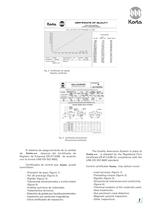
Fig. 3 Certificado de rigidezRigidity certificate Fig. 4 Certificado dimensionalDimensional certificate >
Open the catalog to page 7
Una de las principales novedades queencontramos en los husillos a bolas, es que el rozamiento por deslizamiento que se produce en los husillos convencionales es sustituido por un rozamiento de rodadura, de la misma mane- ra que ocurre en los rodamientos, con las con- siguientes ventajas que esto supone en favor de los accionamientos mandados por husillos a bolas.cuida con rigor la calidad y preci-sin en la fabricacin de los husillos a bolas, mediante sofisticados sistemas de medicin (rayos lser, perfil㡳metros, pro- yectores de perfiles, rugosmetros, medi- dor de par continuo, etc.), haciendo...
Open the catalog to page 8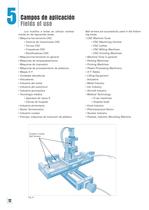
Husillos a bolas Ball Screws Fig. 6 >
Open the catalog to page 12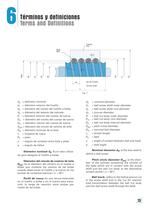
TuercaBola BallNut Screw shaft D w αϕ pw 4 1 1 2 3 d d d d D D D D P h eje de husillo l 1 Fig. 7 d > = dimetro nominald d > = nominal diameterd > 1 = dimetro exterior del husillod > 1 = ball screw shaft outer diameterd > 2 = diᡡmetro del ncleo del husillo a bolasd > 2 = ball screw shaft root diameterd > 3 = dimetro del asiento del cojineteD = diꡡmetro exterior del cuerpo de tuercaD > 3 = journal diameterD= ball nut body outer diameterD > 4 = dimetro del ncleo del cuerpo de tuercaD > 4 = ball nut body root diameterD > 3 = diạmetro interior del cuerpo de tuercaD > 3 = ball nut body internal diameterD...
Open the catalog to page 13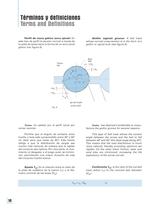
Perfil de rosca gtico (arco ojival): Eneste tipo de perfil la secci鳳n normal a travs de la pista de bolas tiene la forma de un arco ojival gtico (ver figura 8). ha optado por el perfil ojival porvarias razones:Permite que el 鳡ngulo de contacto entrehusillo y bola est comprendido entre 40 y 50麺 (lo ideal sera que fuese de 45). Este hecho obliga a que la distribucin de cargas sea mucho ms racional, de manera que la rigidez del conjunto sea ptima. Por otra parte, el roza- miento, el desgaste, y el juego axial, se minimi- zan, permitiendo una mayor duraciᳳn de vida del conjunto husillo-tuerca. Gothic...
Open the catalog to page 14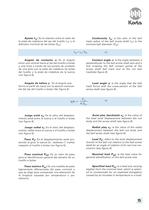
Ajuste f > rs : Es la relacin entre el radio dela pista de rodadura del eje del husillo (r Conformity f > rs : is the ratio of the balltrack radius of the ball screw shaft (r > s ) y eldimetro nominal de las bolas (D > s ) to thenominal ball diameter (D > w ). > w ): f > rs = r > s / D > w (2) (3) Angulo de contacto Angulo de h㡩lice α : Es el nguloentre una vertical hacia el eje del husillo a bolas y una lnea a trav᭩s de los puntos de contacto de una bola con la pista de rodadura de bolas del husillo y la pista de rodadura de la tuerca (ver figura 8). Contact angle α : is the angle between aperpendicular...
Open the catalog to page 15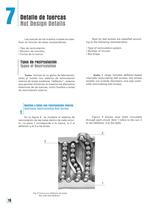
Las tuercas de los husillos a bolas se clasi-fican en funcin de estas caractersticas:㭕 Tipo de recirculacin. N㕺mero de circuitos. Forma de la tuerca.incluye en su gama de fabricaciճn,tanto el husillo con sistema de recirculacin interna de bolas mediante deflector㓔, sistema que permite minimizar al mximo los dimetros exteriores de las tuercas, como husillos a bolas de recirculaciᡳn externa. En la figura 9 se muestra el sistema derecirculacin de las bolas dentro de cada circui- to. La pieza 1 corresponde a la tuerca, la 2 al deflector y la 3 a las bolas. Nuts for ball screws are classified accord-ing...
Open the catalog to page 16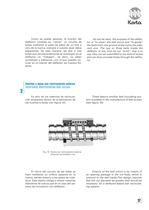
Como se puede apreciar, la funcin deldeflector consiste en cerrar㓔 un circuito de bolas mediante el paso de stos de un hilo a otro de la tuerca, siempre y cuando sean stos adyacentes. De esta manera, las dos o tres bolas que permanentemente se sumergen en el deflector no 驓trabajan, es decir, no estԡn sometidos a esfuerzos, con lo que pueden cir- cular en el interior del deflector de manera flo- tante. As can be seen, the purpose of the deflec-tor is to closeӔ the ball circuit and to guideӔ the balls from one groove of the nut to the adja- cent one. The two or three balls inside the deflector...
Open the catalog to page 17All KORTA catalogs and technical brochures
 DIMENSIONAL CATALOGES
48 Pages
 High Speed BallScrew
4 Pages
Archived catalogs
 Dimensional Catalogue
48 Pages