
- Catalogs
- Konica Minolta Sensing
- Reference PV Cells


- Products
- Catalogs
- News & Trends
- Exhibitions
Reference PV Cells

Reference PV Cells
Catalog excerpts

For adjusting solar simulator intensity Reference PV Cells AK Series Reference PV Cells AK Series are the result of collaborative research between Konica Minolta and Japan’s National Institute of Advanced Industrial Science and Technology. Full lineup of 7 models with various relative spectral sensitivities allows you to select the perfect fit for your needs NEW For 2-junction For 2-junction solar cells solar cells (a-Si: Top layer) (µc-Si: Bottom layer) For 3-junction solar cells (Top layer) For 3-junction solar cells (Middle layer) For 3-junction solar cells (Bottom layer) For crystalline solar cells For dye-sensitized (N719) solar cells • Relative spectral responses of Reference PV Cells AK Series AK Series Relative Spectral Response [A/W] Patent application number (Japan) 2010-131945 * AK-200 is a crystalline Si solar cell with cover glass. • AK-120, AK-130, and AK-140 are the world's first reference PV cells exclusively for 3-junction solar cells. • AK-300 is the world's first reference PV cell exclusively for dye-sensitized solar cells. Spectral sensitivity closely matches that of N-719 which is the typical dye used for dye-sensitized solar cells.
Open the catalog to page 1
Industry’s best spectral mismatch performance for high accuracy and high stability! Spectral mismatch suppressed to less than 1% Byemployingthehigh-accuracyopticalfiltertechnologycultivatedforourcolor-measuringinstruments,wehavesucceededingreatlyreducing spectralmismatch,whichisamajorproblemwithconventionalcells.Spectralmismatchcanbereducedto1%orless,evenwhenevaluatingsolar cell performance using JIS C-8942 Class C solar simulators. Relative spectral sensitivity of AK-100 100% Relative spectral sensitivity of AK-110 Relative spectral sensitivity of AK-120 Relative spectral sensitivity of AK-130...
Open the catalog to page 2
The graphs at right show the spectral mismatch between a-Si, μc- Si, EVA-encapsulated multi-crystalline, and dye-sensitized solar cells and the corresponding AK Series Reference PV Cell. Spectral mismatch is below 1% in all cases (when using solar simulators with Grade A spectral match under JIS C 8912), showing AK Series Reference PV Cells can be used for solar cells having a variety of relative spectral responses. Improved durability against solar simulator light Standardreferencecellsusingopticalfilterstypicallyhavelowdurabilityagainstexposuretosolarsimulatorlight.Thiscauseschanges incharacteristicsduetotheeffectsoflightexposure(solarization)...
Open the catalog to page 3
Main specifications sensitized type Crystalline type Receptor area Aperture area Temperature sensor XLR-type Cannon plug (JIS standard) Connector for temperature measurement LEMO connector (WPVS standard) Operating temperature/humidity range 20 to 30°C, relative humidity 65% or less Storage temperature/humidity range 15 to 30°C, relative humidity 30 to 75% with no condensation Short-circuit current Short-circuit current values measured under Konica Minolta standard test method are listed in the included test report. Standard accessories Storage Case PV-A01, M4 screws (4pcs), Connector for I-V...
Open the catalog to page 4All Konica Minolta Sensing catalogs and technical brochures
 SpectraMagic NX2
2 Pages
 Spectrophotometer CM-25cG
3 Pages
 ProMetric® I
2 Pages
 basICColor Catch
4 Pages
 CHROMA METER CR-400/410
5 Pages
 CM-512m3A
3 Pages
 CM-700d / CM-600d
4 Pages
 CM-M6
CM-M64 Pages
 CM-25cG
5 Pages
 CM-26dG / CM-26d / CM-25d
6 Pages
 FD-7 and FD-5
6 Pages
 CA-410
8 Pages
 Automotive Industry Solutions
14 Pages
 AK series
4 Pages
 SpectraMagicNX
6 Pages
 CM-3700A
4 Pages
 CRI Illuminance meter CL-70F
2 Pages
 Rhopoint IQ FLEX
2 Pages
 CR-10 PLUS
2 Pages
 Color Analyzer CA-2500
2 Pages
 Incident Color Meter CL-500A
4 Pages
 CL-200A
5 Pages
 Gloss-Meter Rhopoint iQ
4 Pages
 BC-10 Gloss Meters
2 Pages
 CM-2500d Spectrophotometers
3 Pages
 CM-3220d Spectrophotometers
2 Pages
 CM-3630 Spectrophotometers
6 Pages
 Reference PV Cells AK-200
2 Pages
 Color Readers CECF-9
2 Pages
 Color Readers CR-14
2 Pages
 Color Analyzers CA-310
2 Pages
 Light Cabinets
4 Pages


Archived catalogs
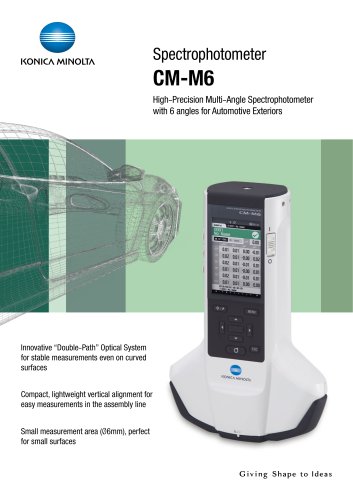 CM-M6 2020
4 Pages
 Spectrophotometer CM-M6
3 Pages
 spectroradiometer
6 Pages
 chroma-meter
5 Pages
 light meter
14 Pages
 glossmeter
2 Pages
 Digital Konsensus Pro
4 Pages
 Dry Film
2 Pages
 Regius Model 110
5 Pages
 magicolor 1600W
4 Pages
 PagePro 1380MF
4 Pages
 Bizhub 751
8 Pages
 Bizhub C650
8 Pages


- Digital imager
- Visible imager
- CMOS camera module
- Industrial camera module
- Management software solution
- Monitoring analyzer
- Analysis software solution
- Infrared imager
- Measuring machine
- Automatic analyser
- Windows software
- Image processing camera module
- Portable analyzer
- Measurement software
- GigE Vision camera
- Compact imager
- Inspection imager
- Rugged camera
- High-speed camera module
- Calibration analyzer