
- Catalogs
- Konica Minolta Sensing Americas
- CR-410C Coffee

- Company
- Products
- Catalogs
- News & Trends
- Exhibitions
CR-410C Coffee

CR-410C Coffee
Specialty coffee, often referred to as "gourmet" or "premium" coffee, is made from exceptional beans grown in ideal climates, offering distinctive flavors influenced by the soil. The term was coined by Erna Knutsen in 1974 to describe beans with outstanding flavor from special microclimates. The specialty coffee market has grown significantly, with a notable presence in the U.S. food service industry.
- Defined by its lack of defects and distinctive flavor.
- Affordable, with a cup costing about 24 cents.
- 75% of the 300 million daily cups of coffee in the U.S. are home-brewed.
- 13% of American adults consume specialty coffee daily.
- Unique flavors are due to micro-climates, similar to wine and honey.
- Espresso contains less caffeine than regular drip coffee.
- Arabica is the predominant coffee species globally.
- Coffee originated in Ethiopia, not Colombia or Brazil.
- The industry employs over 20 million people worldwide.
- 42 beans are needed for an average espresso serving.
The CR-410 is a portable colorimeter used for coffee roasting control, calibrated with the SCAA Roast Color Classification System. It features a PASS/FAIL control and can measure various coffee forms, including powder, instant, and freeze-dried. The device can store up to 100 standards and 200 samples, with data processed through the DP-400. It can also be calibrated for other products like chocolate and raw materials using traditional color spaces.
Catalog excerpts
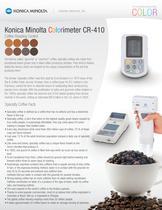
Konica Minolta Colorimeter CR-410 Coffee Roasting Control Sometimes called "gourmet" or "premium" coffee, specialty coffees are made from exceptional beans grown only in ideal coffee-producing climates. They tend to feature distinctive flavors, which are shaped by the unique characteristics of the soil that produces them. The phrase "specialty coffee" was first used by Erna Knutsen in a 1974 issue of the Tea & Coffee Trade Journal. Knutsen, then a coffee buyer for B.C. Ireland in San Francisco, coined the term to describe beans of outstanding flavor produced by special micro climates. With the proliferation of cafes and gourmet coffee retailers in the 1990s, specialty coffee has become one of the fastest growing food service markets in the world, netting an estimated $9.6 billion in the U.S. alone in 2004. Specialty Coffee Facts • Specialty coffee is defined as a coffee that has no defects and has a distinctive flavor in the cup. • Specialty coffee, a term that refers to the highest-quality green beans roasted by true crafts people, is surprisingly affordable. One cup costs about 24 cents; making it cheaper than bottled water. • Every day, Americans drink more than 300 million cups of coffee; 75 % of those cups are home-brewed. • Last year, 13 % of the adult American population enjoyed a daily cup of specialty coffee. • Like wine and honey, specialty coffee has a unique flavor thanks to the micro-climates that produce it. • In 1683, one pound of coffee in New York was worth as much as four acres of land. • To be considered truly fresh, coffee should be ground right before brewing and brewed within three to seven days of roasting. • Surprisingly, espresso contains less caffeine than a regular serving of drip coffee. In fact, in the espresso brewing method, water is in contact with the grounds for only 20 to 25 seconds and extracts less caffeine than methods that put water in contact with the grounds for several minutes. • Strong-tasting coffee has no more caffeine than its weak-tasting counterpart. Caffeine contributes no taste; it's a product of the type of bean, water-to-coffee ratio, and brewing method. • The vast majority of the world's coffee is the Arabica species. • Thanks to some popular commercials, most of us believe that coffee originated in Colombia or Brazil. Not so; it originated in Ethiopia. • The global coffee industry employs more than 20 million people. • It takes approximately 42 coffee beans to make an average serving of espresso.
Open the catalog to page 1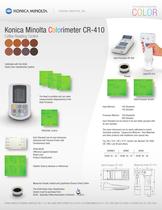
Konica Minolta Colorimeter CR-410 Coffee Roasting Control Data Processor DP-400 Calibrated with the SCAA Roast Color Classification System Head CR-410 The Head is portable and can make measurements independently of the Data Processor. Data Processor Screen Head Memory Processor Memory 100 Standards 200 Samples Each Standard can be stored in its own folder grouped with its own samples The same instrument can be easily calibrated to control Chocolate products, “Cappuccino Mixtures”, Raw Materials and other products with traditional color spaces like; PASS/FAIL Control Each Standard has its own...
Open the catalog to page 2All Konica Minolta Sensing Americas catalogs and technical brochures
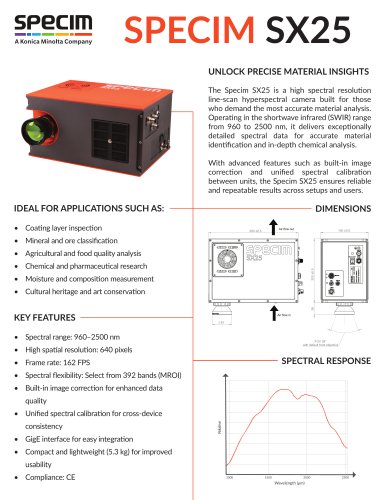 Specim SX25
2 Pages
 LumiTop Series
16 Pages
 LumiSuite
8 Pages
 CAS140D_IR
2 Pages
 CAS140CT_IR
8 Pages
 CAS125
4 Pages
 LumiCam 4000B_2400B_V2
12 Pages
 ISP Series
16 Pages
 DTS 140D NVIS
5 Pages
 ACS & ACU Series
12 Pages
 Spectrophotometer CM-36dG
8 Pages
 LGS 650
8 Pages
 LumiCam Series
16 Pages
 CAS 120
8 Pages
 CAS 140D
16 Pages
 New GM series gloss
4 Pages
 Spectrophotometer CM-5
3 Pages
 SPECTROPHOTOMETER CM-3700A
3 Pages
 CRI Illuminance Meter CL-70F
2 Pages
 Chroma Meter CS-150
3 Pages
 CHROMA METER CS-200
6 Pages
 Chroma Meter CL-200A
4 Pages
 2D Color Analyzer CA-2500
8 Pages
 Skin Analysis Software CM-SA
4 Pages
 GTI GLE-M
2 Pages
 GTI MiniMatcher Series
2 Pages
 Rhopoint TAMS™
6 Pages
 Rhopoint IQ FLEX 20
2 Pages
 Uni Gloss 60A/S/CT
4 Pages
 BC-10 Plus
4 Pages
 CR-410PB
4 Pages
 CR-400/410
5 Pages
 CM-3700A
3 Pages
 CM-700d/600d
3 Pages
 cm-25cg
2 Pages
 cm-m6
cm-m62 Pages
 DTS140 NVIS
6 Pages
 Rhopoint IQ-S
4 Pages
 RHOPTOINT instruments
6 Pages
 LumiCam 2400
4 Pages
 Medidor de Brillo 268A
4 Pages
 CM-25cG
4 Pages
 FD-9
FD-96 Pages
 RHOPOINT Flex 60 / Flex 20
2 Pages
 CR-20
CR-202 Pages
 CR-10 Plus
2 Pages
 CM-600D SPECTROPHOTOMETER
3 Pages
 ISP Series Integrating Spheres
17 Pages
 LCS IV
1 Page
 ISP40
ISP404 Pages
 LGS 1000
4 Pages
 LGS 350
8 Pages
 ISP 500
4 Pages
 ISP 2000
2 Pages
 ISP 150L
2 Pages
 ISP 1000
4 Pages
 LEDGON LED GONIOPHOTOMETER
4 Pages
 LED-81X/-850
4 Pages
 ACS-530
4 Pages
 LED 25
4 Pages
 LSM 350
4 Pages
 DTS 500 SPECTRORADIOMETER
8 Pages
 THE DTS 400 SYSTEM
2 Pages
 LUMICAM 1300
8 Pages
 CAS 140CTS
4 Pages
 MAS 40
8 Pages
 SPECTRO 320
12 Pages
 MM-4E CONTROLLED LIGHTING
2 Pages
 Chlorophyll Meter SPAD-502
2 Pages
 MULTI GLOSS 268PLUS
2 Pages
 CM-SA SKIN ANALYSIS SOFTWARE
4 Pages
 CM-5 SPECTROPHOTOMETER
3 Pages


- Power supply unit
- DC power supply
- Digital imager
- AC/DC power supply
- Measuring device
- CMOS camera module
- Konica Minolta industrial camera
- LED lighting
- Analysis software solution
- Konica Minolta infrared camera
- Measuring machine
- Process software
- Real-time software
- Windows software
- Calibration system
- Solids analyser
- Single-output power supply
- Detection camera system
- Plastic cap
- Cylindrical cap