
- Catalogs
- Konica Minolta Sensing Americas
- Chlorophyll Meter SPAD-502

- Company
- Products
- Catalogs
- News & Trends
- Exhibitions
Chlorophyll Meter SPAD-502

Chlorophyll Meter SPAD-502
- Portability: Weighing only 225g, it is small enough to fit in a pocket.
- Ease of Use: Measurements are taken by inserting a leaf and closing the measuring head, without needing to cut the leaf.
- Water Resistance: Suitable for outdoor use in rain, though not immersible.
- Low Power Consumption: Utilizes LED light sources, allowing approximately 20,000 measurements with two AA batteries.
- Small Measuring Area: Measures a 2 × 3mm area, suitable for small leaves.
- High Accuracy: Provides accuracy within ± 1.0 SPAD unit for rice-plant leaves.
- Data Memory: Stores up to 30 measurements, with options to recall or delete data and calculate averages.
- Reading Checker: Ensures accurate functioning of the device.
- Measurement System: Optical density difference at two wavelengths.
- Light Source: Two LEDs.
- Receptor: One silicon photodiode.
- Display: 3-digit LCD for measurement data, 2-digit LCD for data number.
- Controls: Includes power switch, average key, data delete keys, and data recall key.
- Power Source: Two AA-size alkaline-manganese batteries.
- Accuracy and Repeatability: Within ± 1.0 SPAD unit accuracy, ± 0.3 SPAD units repeatability.
- Temperature Range: Operational from 0 to 50°C, storage from -20 to +55°C.
- Dimensions: 164 × 78 × 49mm.
Catalog excerpts
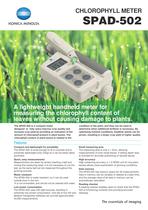
CHLOROPHYLL METER A lightweight handheld meter for measuring the chlorophyll content of leaves without causing damage to plants. The SPAD-502 is a compact meter designed to help users improve crop quality and increase crop yield by providing an indication of the amount of chlorophyll present in plant leaves. The chlorophyll content of plant leaves is related to the condition of the plant, and thus can be used to determine when additional fertilizer is necessary. By optimizing nutrient conditions, healthier plants can be grown, resulting in a larger crop yield of higher quality. Features Compact and lightweight for portability The SPAD-502 is small enough to fit in a pocket and is extremely lightweight (only 225g) so it can be easily taken anywhere. Small measuring area The measuring area is only 2 × 3mm, allowing measurements of even small leaves. A sliding depth stop is included for accurate positioning of sample leaves. Quick, easy measurements Measurements are taken by simply inserting a leaf and closing the measuring head. It is not necessary to cut the leaf, so the same leaf can be measured throughout the growing process. High accuracy High measuring accuracy (± 1.0 SPAD unit for rice-plant leaves) allows close examination of growing conditions. Water-resistant The SPAD-502 is water-resistant, so it can be used outside even in the rain. *It is not immersible, and should not be cleaned with water. Low power consumption The SPAD-502 uses LED light sources, resulting in extremely low power consumption. One set of two AA-size alkaline-manganese batteries can provide approximately 20,000 measurements. Data memory The SPAD-502 has memory space for 30 measurements. Data in memory can be recalled or deleted at a later time, and the average value of all data in memory can be automatically calculated. Reading checker A reading checker enables users to check that the SPAD502 is functioning correctly and providing accurate readings.
Open the catalog to page 1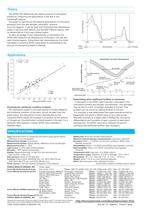
The SPAD-502 determines the relative amount of chlorophyll present by measuring the absorbance of the leaf in two wavelength regions. The graph at right shows the spectral absorbance of chlorophyll extracted from two leaf samples using 80% acetone. From the diagram, it can be seen that chlorophyll has absorbance peaks in the blue (400-500nm) and red (600-700nm) regions, with no transmittance in the near-infrared region. To take advantage of this characteristic of chlorophyll, the SPAD-502 measures the absorbances of the leaf in the red and near-infrared regions. Using these two transmittances,...
Open the catalog to page 2All Konica Minolta Sensing Americas catalogs and technical brochures
 Specim SX25
2 Pages
 LumiTop Series
16 Pages
 LumiSuite
8 Pages
 CAS140D_IR
2 Pages
 CAS140CT_IR
8 Pages
 CAS125
4 Pages
 LumiCam 4000B_2400B_V2
12 Pages
 ISP Series
16 Pages
 DTS 140D NVIS
5 Pages
 ACS & ACU Series
12 Pages
 Spectrophotometer CM-36dG
8 Pages
 LGS 650
8 Pages
 LumiCam Series
16 Pages
 CAS 120
8 Pages
 CAS 140D
16 Pages
 New GM series gloss
4 Pages
 Spectrophotometer CM-5
3 Pages
 SPECTROPHOTOMETER CM-3700A
3 Pages
 CRI Illuminance Meter CL-70F
2 Pages
 Chroma Meter CS-150
3 Pages
 CHROMA METER CS-200
6 Pages
 Chroma Meter CL-200A
4 Pages
 2D Color Analyzer CA-2500
8 Pages
 Skin Analysis Software CM-SA
4 Pages
 GTI GLE-M
2 Pages
 GTI MiniMatcher Series
2 Pages
 Rhopoint TAMS™
6 Pages
 Rhopoint IQ FLEX 20
2 Pages
 Uni Gloss 60A/S/CT
4 Pages
 BC-10 Plus
4 Pages
 CR-410PB
4 Pages
 CR-400/410
5 Pages
 CM-3700A
3 Pages
 CM-700d/600d
3 Pages
 cm-25cg
2 Pages
 cm-m6
cm-m62 Pages
 DTS140 NVIS
6 Pages
 Rhopoint IQ-S
4 Pages
 RHOPTOINT instruments
6 Pages
 LumiCam 2400
4 Pages
 Medidor de Brillo 268A
4 Pages
 CM-25cG
4 Pages
 FD-9
FD-96 Pages
 RHOPOINT Flex 60 / Flex 20
2 Pages
 CR-20
CR-202 Pages
 CR-10 Plus
2 Pages
 CM-600D SPECTROPHOTOMETER
3 Pages
 ISP Series Integrating Spheres
17 Pages
 LCS IV
1 Page
 ISP40
ISP404 Pages
 LGS 1000
4 Pages
 LGS 350
8 Pages
 ISP 500
4 Pages
 ISP 2000
2 Pages
 ISP 150L
2 Pages
 ISP 1000
4 Pages
 LEDGON LED GONIOPHOTOMETER
4 Pages
 LED-81X/-850
4 Pages
 ACS-530
4 Pages
 LED 25
4 Pages
 LSM 350
4 Pages
 DTS 500 SPECTRORADIOMETER
8 Pages
 THE DTS 400 SYSTEM
2 Pages
 LUMICAM 1300
8 Pages
 CAS 140CTS
4 Pages
 MAS 40
8 Pages
 SPECTRO 320
12 Pages
 MM-4E CONTROLLED LIGHTING
2 Pages
 CR-410C Coffee
2 Pages
 MULTI GLOSS 268PLUS
2 Pages
 CM-SA SKIN ANALYSIS SOFTWARE
4 Pages
 CM-5 SPECTROPHOTOMETER
3 Pages


- Power supply unit
- DC power supply
- Digital imager
- AC/DC power supply
- Measuring device
- CMOS camera module
- Konica Minolta industrial camera
- LED lighting
- Analysis software solution
- Konica Minolta infrared camera
- Measuring machine
- Process software
- Real-time software
- Windows software
- Calibration system
- Solids analyser
- Single-output power supply
- Detection camera system
- Plastic cap
- Cylindrical cap