
- Catalogs
- Konica Minolta Sensing Americas
- CAS140D_IR

- Company
- Products
- Catalogs
- News & Trends
- Exhibitions
CAS140D_IR

CAS140D_IR
- Highly accurate IR measurements with improved optical architecture.
- Increased throughput by up to 70% compared to its predecessor, CAS 140CT IR.
- Reduced stray light and faster electronics for quicker processing.
- Integration time reduced from 10 ms to 1 ms, and total scanning time from 16 ms to 9 ms.
- Model: CAS 140D 171
- Wavelength range: 780 – 1700 nm
- Detector: InGaAs with 512 pixels
- Spectral resolution: 9 nm
- Wavelength accuracy: ±0.5 nm
- Integration time: 1 ms - 3 s
- Sensor dynamic range: 9000:1
- Non-Linearity: ±1%
- Cooling: TEC @ -10 °C
- Stray light levels: 0.08% for broadband, 0.03% for LED, 0.015% with laser.
- Sensitivity: Irradiance range from 1 x 10⁻⁶ to 1.5 x 10³ W/m²nm; Radiant flux from 5 x 10⁻⁶ to 4 x 10³ W.
- Baseline noise: ±0.05%
- Transmission measuring accuracy: ±0.2% T
- Focal length: Approx. 120 mm f/3.5 with plane ruled grating.
- Slit options: 100 µm, 50 µm
- Filter wheel: Max. 7 slots for density filters OD 0.5 to OD 3.5.
- PC interface: USB 2.0
- Triggering: 1 TTL input, 2 software-controlled TTL outputs, 1 TTL output with flash pulse.
- Dimensions: 144 x 341 x 359 mm³
- Weight: Approx. 9 kg
- Power supply: 100 – 240 VAC 50/60 Hz
- Power consumption: Max. 70 VA
- Operating temperature: 15 – 35 °C; relative humidity 0 – 70% max., non-condensing.
Catalog excerpts
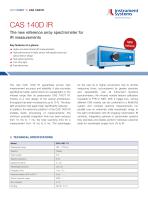
CAS 140D IR The new reference array spectrometer for IR measurements Key features at a glance y Highly accurate infrared (IR) measurements y High-performance InGaAs sensor with greatly improved optical bench design y High signal sensitivity y ow stray light L y Fast electronics The new CAS 140D IR guarantees proven high measurement accuracy and reliability. It also promises significantly better performance for wavelengths in the infrared range than its predecessor CAS 140CT IR. Thanks to a new design of the optical architecture, throughput has been increased by up to 70 %. The stray light proportion has again been significantly reduced. In addition, the electronic platform of the CAS 140D IR enables faster processing of measurements: the minimum possible integration time has been reduced from 10 ms to 1 ms, the total scanning time for a measurement from 16 ms to 9 ms. The advantages \\ TECHNICAL SPECIFICATIONS Model Wavelength range Pixel number Spectral resolution Datapoint interval Wavelength accuracy Integration time Shortest duration SOT to EOT Sensor dynamic range for the user lie in higher productivity due to shorter measuring times, accompanied by greater precision and repeatability. Like all Instrument Systems spectrometers, the infrared models feature calibration traceable to PTB or NIST. With a trigger box, various different CAS models can be combined to a MultiCAS system and complex spectral measurements run parallel over an extremely wide wavelength range. In the right combination with 2D imaging colorimeters, IR cameras, integrating spheres or goniometer systems they precisely and reliably perform individual customer tasks for wavelength ranges from UV to
Open the catalog to page 1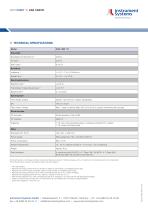
\\ TECHNICAL SPECIFICATIONS Model Stray light Broadband for Illuminant A For LED With Laser Sensitivity Irradiance Radiant flux Spectrophotometry Baseline noise Transmission measuring accuracy Baseline drift Spectrograph Focal length, grating Approx. 120 mm f/3.5 / plane ruled grating Filter wheel / Shutter Max. 7 slots for density filters OD 0.5 to OD 3.5; position monitoring with encoder Electrical data AD converter 1 TTL input with ascending slope; 2 software-controlled TTL outputs; 1 TTL output with flash pulse Power supply Power consumption Ambient temperature 15 – 35 °C; relative humidity...
Open the catalog to page 2All Konica Minolta Sensing Americas catalogs and technical brochures
 Specim SX25
2 Pages
 LumiTop Series
16 Pages
 LumiSuite
8 Pages
 CAS140CT_IR
8 Pages
 CAS125
4 Pages
 LumiCam 4000B_2400B_V2
12 Pages
 ISP Series
16 Pages
 DTS 140D NVIS
5 Pages
 ACS & ACU Series
12 Pages
 Spectrophotometer CM-36dG
8 Pages
 LGS 650
8 Pages
 LumiCam Series
16 Pages
 CAS 120
8 Pages
 CAS 140D
16 Pages
 New GM series gloss
4 Pages
 Spectrophotometer CM-5
3 Pages
 SPECTROPHOTOMETER CM-3700A
3 Pages
 CRI Illuminance Meter CL-70F
2 Pages
 Chroma Meter CS-150
3 Pages
 CHROMA METER CS-200
6 Pages
 Chroma Meter CL-200A
4 Pages
 2D Color Analyzer CA-2500
8 Pages
 Skin Analysis Software CM-SA
4 Pages
 GTI GLE-M
2 Pages
 GTI MiniMatcher Series
2 Pages
 Rhopoint TAMS™
6 Pages
 Rhopoint IQ FLEX 20
2 Pages
 Uni Gloss 60A/S/CT
4 Pages
 BC-10 Plus
4 Pages
 CR-410PB
4 Pages
 CR-400/410
5 Pages
 CM-3700A
3 Pages
 CM-700d/600d
3 Pages
 cm-25cg
2 Pages
 cm-m6
cm-m62 Pages
 DTS140 NVIS
6 Pages
 Rhopoint IQ-S
4 Pages
 RHOPTOINT instruments
6 Pages
 LumiCam 2400
4 Pages
 Medidor de Brillo 268A
4 Pages
 CM-25cG
4 Pages
 FD-9
FD-96 Pages
 RHOPOINT Flex 60 / Flex 20
2 Pages
 CR-20
CR-202 Pages
 CR-10 Plus
2 Pages
 CM-600D SPECTROPHOTOMETER
3 Pages
 ISP Series Integrating Spheres
17 Pages
 LCS IV
1 Page
 ISP40
ISP404 Pages
 LGS 1000
4 Pages
 LGS 350
8 Pages
 ISP 500
4 Pages
 ISP 2000
2 Pages
 ISP 150L
2 Pages
 ISP 1000
4 Pages
 LEDGON LED GONIOPHOTOMETER
4 Pages
 LED-81X/-850
4 Pages
 ACS-530
4 Pages
 LED 25
4 Pages
 LSM 350
4 Pages
 DTS 500 SPECTRORADIOMETER
8 Pages
 THE DTS 400 SYSTEM
2 Pages
 LUMICAM 1300
8 Pages
 CAS 140CTS
4 Pages
 MAS 40
8 Pages
 SPECTRO 320
12 Pages
 MM-4E CONTROLLED LIGHTING
2 Pages
 CR-410C Coffee
2 Pages
 Chlorophyll Meter SPAD-502
2 Pages
 MULTI GLOSS 268PLUS
2 Pages
 CM-SA SKIN ANALYSIS SOFTWARE
4 Pages
 CM-5 SPECTROPHOTOMETER
3 Pages


- DC power supply
- Digital imager
- AC/DC power supply
- Measuring device
- CMOS camera module
- Konica Minolta industrial camera
- LED lighting
- Analysis software solution
- Konica Minolta infrared camera
- Measuring machine
- Process software
- Real-time software
- Windows software
- Calibration system
- Solids analyser
- Single-output power supply
- Detection camera system
- Plastic cap
- Cylindrical cap