
- Catalogs
- Kolibrik.net s.r.o.
- High-power EIS Analysis System

High-power EIS Analysis System

High-power EIS Analysis System
The MegaEIS product family is a modular testing system designed for Electrochemical Impedance Spectroscopy (EIS) analysis of fuel-cell stacks and electrolyzers. It includes a power stage for handling power and an EIS acquisition system for simultaneous impedance spectroscopy analysis across all cells. The system supports up to 1000 cells and 2 kA current, with a maximum internal power dissipation of 20 kW. It is water-cooled and can work with external DC loads up to 300 kW.
The system is suitable for hydrogen fuel cells, water electrolyzers, solid-oxide cells, redox-flow batteries, and lithium batteries. It is used in research and development, manufacturing testing, and quality control.
- Power Supply: 110-230 VAC / 50-60 Hz, 3x 400 VAC for high-power devices
- Protection Rating: IP20
- Input Voltage: Up to 1000 V
- Total Input Current: Up to 2000 A
- Cooling: Water
- Voltage Range: Up to ±1000 V
- Sampling: 24-bit ADCs, up to 1.25 Msps for EIS measurements
- Measurement Resolution: 0.001% of selected range
- Accuracy: Voltage ≤ 0.1% of range + 0.1% of reading, Current ≤ 0.1% of range + 0.5% of reading
- EIS Frequency: 1 mHz to 100 kHz
- Connection: USB 2.0, Ethernet
- Software: Control software for MS Windows with scripting and remote control capabilities
Various configurations are available for different applications, including hydrogen fuel cell stacks and electrolyzers, with varying voltage, current, and power dissipation specifications.
All data is for informational purposes and not guaranteed for legal purposes. Kolibrik.net reserves the right to change the document or product without notice.
Catalog excerpts

High-power EIS Analysis System For fuel cell stacks For electrolyzers Simultaneous multi-channel EIS Acquisition MegaEIS Product Family
Open the catalog to page 1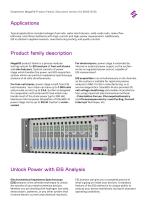
Datasheet | MegaEIS Product Family | Document version 2.2 2023-12-05 Applications Typical applications include hydrogen fuel cells, water electrolyzers, solid-oxide cells, redox-flow batteries, and lithium batteries with high-current and high-power requirements. Additionally, EIS is utilized in applied research, manufacturing testing, and quality control. Product family description MegaEIS product family is a precise modular testing system for EIS analysis of fuel-cell stacks and electrolyzers. System consists of power stage which handles the power, and EIS acquisition system which can perform...
Open the catalog to page 2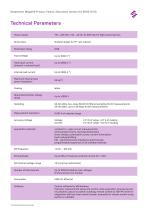
Datasheet | MegaEIS Product Family | Document version 2.2 2023-12-05 *) According to particular model
Open the catalog to page 3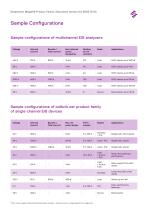
Datasheet | MegaEIS Product Family | Document version 2.2 2023-12-05 ') P/G - Full 4-quadrant Potentiostat/Galvanostat. Zeroload - optional true zero-voltage operation for single cells.
Open the catalog to page 4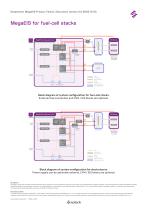
Datasheet | MegaEIS Product Family | Document version 2.2 2023-12-05 MegaEIS for fuel-cell stacks Block diagram of system configuration for fuel-cell stacks. External load connection and CVM / EIS blocks are optional. Block diagram of system configuration for electrolyzers. Power supply can be optionally external. CVM / EIS blocks are optional. Disclaimer All rights reserved. All data contained within this manual is for information purposes only and is not guaranteed for legal purposes. The Information has been checked carefully and is believed to be accurate; however, no responsibility is assumed...
Open the catalog to page 5All Kolibrik.net s.r.o. catalogs and technical brochures
 Cell Voltage Monitor CVM-24P
4 Pages
 Cell Voltage Monitor CVM32A
4 Pages
 DCDC-S Family
3 Pages
 Potentiostat PTC-0520E
2 Pages


- Monitoring analyzer
- Measurement software
- DC-DC converter
- Continuous analyzer
- Power quality analyzer
- Industrial DC/DC converter module
- Temperature monitoring module
- Power analyzer
- Simultaneous analyzer
- Digital monitoring module
- Modular analyzer
- Data acquisition analyzer
- Benchtop monitoring system
- Hydrogen analyzer
- Compact monitoring module
- Multi-channel analyzer
- Voltage analyzer
- Voltage monitoring module
- Rack-mount DC/DC converter
- Multi-channel monitoring module