
- Catalogs
- Koch-Glitsch
- SUPERFRAC® Trays - Project Report

SUPERFRAC® Trays - Project Report

1 / 2 PagesView full catalog
SUPERFRAC® Trays - Project Report
Product catalog summary
Introduction: The Fluid Catalytic Cracking Unit (FCCU) was initially designed for a feed rate of 25,000 BPSD but has undergone several revamps to increase its capacity to approximately 50,000 BPSD. The depropanizer and propylene splitter columns were upgraded to handle increased loads and maintain product quality.
Specifications and Upgrades: The depropanizer was retrayed in 1985 with improved two-pass sieve trays for a design rate of 70 m3/hr. However, increased FCCU feed rates required handling LPG rates of up to 85 m3/hr. The propylene splitter was revamped in 1988 to meet tighter product specifications, which increased product purity but limited throughput.
Solutions Implemented: To address these challenges, both columns were retrayed. The depropanizer column was equipped with Koch-Glitsch SUPERFRAC trays, and the propylene splitter with Koch-Glitsch NYE TRAYS. The NYE TRAYS allowed for a one-to-one replacement of existing sieve trays, maintaining purity while increasing capacity. SUPERFRAC trays were used where both increased capacity and improved product purity were required.
Performance Data:
- Depropanizer Performance: The product splits at new feed rates exceeded design expectations, with tray efficiencies calculated to be greater than 90%. Future increases in LPG production are feasible.
- Propylene Splitter Performance: The splitter operated at or above design tray loadings while maintaining specifications. Product purities and recoveries indicate tray efficiencies comparable to design.
Results: The upgrades resulted in a significant increase in FCCU throughput, effectively doubling column capacities since original construction while achieving better-than-design fractionation.
Operational Date: The upgraded systems were operational by Spring 1992.
Key Performance Tables:
- Table 1: FCCU Depropanizer Performance - Highlights include increased feed rates and improved product splits with higher reflux rates and ratios.
- Table 2: Propylene Splitter Performance - Shows increased feed rates, propylene product output, and improved propylene recovery over the years.
See more
Catalog excerpts
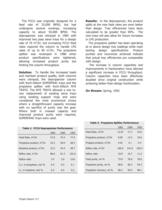
Table 2: Propylene Splitter Performance Table 1: FCCU Depropanizer Performance 1983 1990 1993 > 3 1983 1985 1992 Feed Rate, m /hr 12.07 17.3 24.0 Feed Rate, m > 3 /hr 57.8 74.4 77.0 Propylene product, m > 3 /hr 8.05 13.2 19.6 Propylene product, m > 3 /hr 25.3 30.0 28.3 Propane product, m > 3 /hr 4.02 4.1 4.4 Butylene product, m > 3 /hr 32.5 44.4 48.7 Reflux rate, m > 3 /hr 160.0 141.6 220.4 Reflux rate, m > 3 /hr 86.6 91.3 102.6 Reflux ratio 19.9 10.7 11.2 Reflux ratio 3.4 3.0 3.63 Feed purity, wt % 73.0 76.0 78.0 C > 4 + in propylene, mol % 0.4 0.5 0.1 Propylene purity, wt % 98.8 96.3 94.2 C...
Open the catalog to page 2All Koch-Glitsch catalogs and technical brochures
 Metal random packing
12 Pages
 INTALOX- ULTRA packing
8 Pages
 FLEXITRAY
12 Pages
 Mist Elimination product catalog
20 Pages


Archived catalogs
 Plastic Random Packing
16 Pages
 IMTP® High Performance Packing
12 Pages
 INTALOX® ULTRA
4 Pages
 Structured Packing
8 Pages
 SATURN® Technology
2 Pages
 SPEED-WAY® Manways
2 Pages
 FLEXILOCK® Tray Construction
2 Pages
 OMNI-FIT® Technology
2 Pages
 FLEXITRAY® Valve Trays
12 Pages
 PROVALVE® Valve Trays
2 Pages


*Prices are pre-tax. They exclude delivery charges and customs duties and do not include additional charges for installation or activation options. Prices are indicative only and may vary by country, with changes to the cost of raw materials and exchange rates.
About DirectIndustry
DirectIndustry is a marketplace that offers B2B players a complete experience, from product sourcing to purchase. DirectIndustry is an entity of VirtualExpo Group.
Are you a buyer?
Are you a supplier?