
- Catalogs
- Koch-Glitsch
- Mist Elimination Liquid-Liquid Coalescing

Mist Elimination Liquid-Liquid Coalescing

Mist Elimination Liquid-Liquid Coalescing
Mist eliminators are essential in processes involving gas and liquid interactions to prevent liquid droplet entrainment, which can cause inefficiencies, product loss, and equipment damage. Understanding droplet formation mechanisms is crucial for selecting and designing effective mist eliminators.
Droplet Formation Mechanisms
- Mechanical Action: Produces droplets 5-10μ in diameter.
- Chemical Reaction: Forms submicron droplets requiring high-efficiency separation.
- Condensation: Generates large droplets (50+ microns) and fine submicron entrainment.
Applications of Mist Eliminators
- Knockout Drums: Remove droplets larger than 5-10 microns to reduce product loss and equipment damage.
- Distillation Towers: Prevent contamination and improve product purity by addressing entrainment issues.
- Evaporators: Achieve steam condensate purity levels below 1 to 50 ppm, protecting equipment and preventing pollution.
- Steam Drums: Ensure high steam purity without external separators.
- Scrubbers: Improve efficiency and capacity in severe services like FGD systems.
Process Applications
- Refineries: Increase throughput and yield by reducing entrainment in fractionators.
- Gas Absorption Systems: Minimize chemical losses and improve efficiency with high-efficiency mist eliminators.
- Petrochemical Plants: Extend compressor life and protect downstream equipment.
- Flue Gas Desulfurization: Use FLEXICHEVRON™ mist eliminators for fouling resistance.
- Sulfuric Acid Plants: Prevent corrosion and ensure environmental compliance.
Equipment Selection Guide
- DEMISTER™ Mist Eliminators: High separation efficiency at low cost, suitable for various materials.
- FLEXICHEVRON™ Mist Eliminators: Ideal for high capacity and fouling resistance.
- DEMISTER-PLUS™ Mist Eliminators: Suitable for high-pressure applications requiring minimized vessel size.
- FLEXIFIBER™ Mist Eliminators: Effective for submicron particle removal.
Design Considerations
- Design parameters include liquid viscosity, surface tension, and entrainment loading.
- High capacity DEMISTER styles offer increased design capacity and efficiency.
- FLEXICHEVRON mist eliminators provide low pressure drop and handle high liquid loads.
The document discusses various types of mist eliminators designed by Koch-Glitsch, focusing on their applications, design parameters, and performance characteristics. These devices are crucial in processes where mist elimination is necessary to prevent equipment damage and ensure process efficiency.
Applications
FLEXICHEVRON mist eliminators are recommended for applications where wire mesh mist eliminators might get plugged, such as air pollution control scrubbers and high vacuum applications. They are particularly useful in environments with sticky or viscous droplets.
Design Parameters
The performance of mist eliminators is influenced by gas velocity, vapor density, liquid density, and surface tension. The design of the chevron, including blade spacing and liquid draining capability, affects the reentrainment point and overall capacity.
High Capacity FLEXICHEVRON™ Mist Eliminators
These mist eliminators, including styles 250 and 350, are designed for high-pressure systems and feature separate liquid drainage channels. They allow for higher gas velocities and efficient mist removal, especially at higher pressures.
Materials of Construction
FLEXICHEVRON mist eliminators are constructed from materials such as stainless steel, carbon steel, nickel-based alloys, and titanium, with special materials available upon request.
DEMISTER-PLUS™ Mist Eliminators
This advanced design is used to minimize vessel size or increase capacity. It combines the efficiency of DEMISTER mist eliminators with the high throughput capacity of FLEXICHEVRON mist eliminators, allowing for significant capacity gains in existing vessels.
Separator Optimization
The YORK-EVENFLOW™ vane inlet device improves flow distribution in separation vessels, reducing channeling and preventing reentrainment of liquid droplets. It is custom-engineered for both vertical and horizontal vessels.
Computational Fluid Dynamics (CFD) Modeling
CFD modeling is used to optimize design, troubleshoot, and develop products by simulating flow conditions and vessel geometry. It helps identify poor flow distribution and optimize design modifications for improved performance.
FLEXIFIBER™ Mist Eliminators
These mist eliminators are designed to reduce visible stack gas plumes and provide unlimited turndown. They are suitable for various industrial applications and can achieve high separation efficiency of submicron liquid particles.
Conclusion
Koch-Glitsch offers a range of mist eliminators tailored to different industrial needs, focusing on efficiency, capacity, and material suitability. Their designs incorporate advanced technologies and materials to optimize performance and reduce operational costs.
This document discusses the challenges and solutions related to the separation of immiscible liquids in industrial processes. It highlights the use of KOCH-OTTO YORK liquid-liquid coalescer systems to improve separation efficiency, achieving minimal liquid dispersion in effluent streams.
Causes of Liquid-Liquid Dispersions
Liquid-liquid dispersions occur due to the mixing of immiscible liquids, often necessary for mass transfer or chemical reactions. The separation efficiency depends on droplet size, physical properties of the liquids, and the presence of impurities. Theoretical calculations are limited due to real-world complexities, necessitating a combination of principles, experience, and testing for equipment design.
Design of Coalescer Vessels
Traditional separators rely on gravity for droplet settling, which is inefficient for small droplets. The document explains the use of parallel plate separators and coalescing media like KY-FLEX™ and KY-MESH™ to enhance separation by increasing droplet size and optimizing vessel design.
Coalescer Options
1. Parallel Plate Separators: Effective for droplets down to 40-100 microns, suitable for processes with solids or tarry liquids.
2. KY-FLEX™ Media: Offers improved collection and drainage, suitable for processes with severe solids loadings.
3. KY-MESH™ Media: Focuses on coalescing small droplets into larger ones for efficient separation.
Applications
The document outlines coalescer designs for various applications, including:
- Hazy distillates in storage tanks
- Refinery fractionator overhead reflux drums
- Alkylation units in refineries
- Wastewater treatment facilities
- Three-phase horizontal coalescer/settler systems in distillation columns and oil/gas production
Contact Information
Contact details for Koch-Glitsch offices worldwide are provided, along with emergency numbers and trademark information.
Legal Notice
The document concludes with a legal notice regarding the accuracy and reliability of the information provided.
Catalog excerpts

Mist Elimination Liquid-Liquid Coalescing
Open the catalog to page 1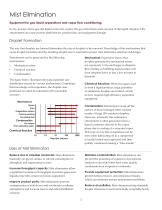
Mist Elimination Equipment for gas-liquid separations and vapor flow conditioning. In any process where gas and liquid come into contact, the gas will entrain some amount of the liquid droplets. This entrainment can cause process inefficiencies, product loss, and equipment damage. Droplet Formation The way that droplets are formed determines the size of droplets to be removed. Knowledge of the mechanisms that cause droplet formation and the resulting droplet size is essential to proper mist eliminator selection and design. Entrainment can be generated by the following mechanisms: Mechanical action...
Open the catalog to page 2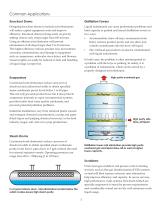
Common Applications Knockout Drums Distillation Towers Designing knockout drums to include mist eliminators will reduce capital equipment costs and improve efficiency. Knockout drums relying solely on gravity settling remove only drops larger than 100 microns. Using an efficient mist eliminator will prevent entrainment of all drops larger than 5 to 10 microns. This higher efficiency reduces product loss; downstream corrosion; contamination; and damage to equipment such as compressors, molecular sieve driers, and blowers. Vessel weights can easily be reduced to half, and handling of liquid slugs...
Open the catalog to page 3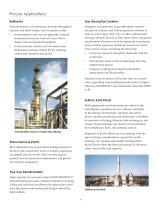
Process Applications Refineries Mist eliminators in fractionators increase throughput capacity and allow deeper cuts for greater yields. Designers and operators of gas absorption systems use glycols, amines, and other proprietary solvents to remove water vapor, H2S, CO2, or other contaminants from gas streams. However, they often follow equipment specifications that have not been optimized to minimize losses of these expensive chemicals. Losses can result from several causes, including the following: In atmospheric and vacuum pipestills, reduced entrainment from the wash oil zones allows deeper...
Open the catalog to page 4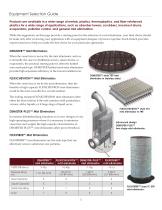
Equipment Selection Guide Products are available in a wide range of metals, plastics, thermoplastics, and fiber-reinforced plastics for a wide range of applications, such as absorber towers, scrubbers, knockout drums, evaporators, pollution control, and general mist elimination. While the suggestions on this page provide a starting point for the selection of a mist eliminator, your nal choice should be made only after reviewing your application with an equipment designer of proven expertise. Koch-Glitsch provides expert resources to help you make the best choice for your particular application....
Open the catalog to page 5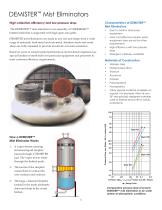
DEMISTER™ Mist Eliminators High collection efficiency and low pressure drop. The DEMISTER™ mist eliminator is an assembly of YORKMESH™ knitted mesh that is supported with high open area grids. DEMISTER mist eliminators are made to any size and shape from a wide range of materials, both metal and non-metal. Stainless steels and exotic alloys are fully annealed to provide maximum corrosion resistance. Based on years of actual in-plant performance, Koch-Glitsch engineers use special families of mesh styles for particular equipment and processes to meet customer efficiency requirements. Characteristics...
Open the catalog to page 6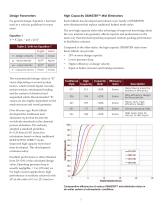
Design Parameters High Capacity DEMISTER™ Mist Eliminators For general design, Equation 1 has been used as a velocity guideline for many years. Koch-Glitsch has developed and rened a new family of DEMISTER mist eliminators that replace traditional knitted mesh styles. V = K [(oL – ov) / ov]½ Table 2. Units for Equation 1 ft/sec m/sec ρv - vapor density K - capacity factor The new high capacity styles take advantage of improved knowledge about the way internal wire geometry affects capacity and performance in the same way that structured packing surpassed random packing performance in distillation...
Open the catalog to page 7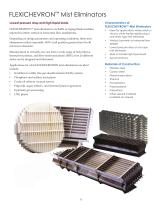
FLEXICHEVRON™ Mist Eliminators Lowest pressure drop and high liquid loads. FLEXICHEVRON™ mist eliminators are baffle or zigzag blade modules tailored for either vertical or horizontal flow installations. Depending on design parameters and operating conditions, these mist eliminators collect essentially 100% of all particles greater than 8 to 40 microns in diameter. Manufactured in virtually any size from a wide range of metal alloys, thermal-set plastics, and fiber-reinforced plastic (FRP), over 20 different styles can be designed and fabricated. Applications for which FLEXICHEVRON mist eliminators...
Open the catalog to page 8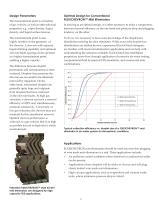
Design Parameters The reentrainment point is a function of gas velocity, as well as other physical properties, e.g., vapor density, liquid density, and liquid surface tension. The reentrainment point is also highly sensitive to the geometry of the chevron. A chevron with superior liquid draining capability and optimum chevron blade spacing can be operated at a higher reentrainment point, yielding a higher capacity. The difference between droplet penetration and reentrainment is often confused. Droplets that penetrate the chevron are too small to be effectively removed by impaction. On the other...
Open the catalog to page 9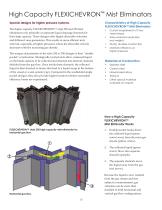
High Capacity FLEXICHEVRON™ Mist Eliminators Special designs for higher pressure systems. The higher capacity FLEXICHEVRON™ style 250 and 350 mist eliminators rely primarily on separate liquid drainage channels for their high capacity. These designs offer higher allowable velocities and different vane geometries. This results in more efficient mist removal, especially at higher pressures where the allowable velocity decreases with the increasing gas density. The unique characteristic of the style 250 or 350 designs is their “double pocket” construction. Strategically located slots allow coalesced...
Open the catalog to page 10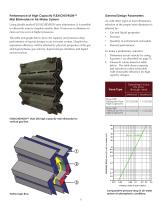
Performance of High Capacity FLEXICHEVRON™ Mist Eliminators in Air/Water System General Design Parameters Using double pocket FLEXICHEVRON mist eliminators, it is possible to efficiently remove droplets smaller than 10 microns in diameter in clean service even at higher pressures. The table and graph below show the capacity and pressure drop performance of typical designs in an air/water system. Droplet size separation efficiency will be affected by physical properties of the gas and liquid phases, gas velocity, liquid and gas densities, and liquid surface tension. As with other types of mist...
Open the catalog to page 11All Koch-Glitsch catalogs and technical brochures
 Metal random packing
12 Pages
 INTALOX- ULTRA packing
8 Pages
 FLEXITRAY
12 Pages
 Mist Elimination product catalog
20 Pages

Archived catalogs
 Plastic Random Packing
16 Pages
 IMTP® High Performance Packing
12 Pages
 INTALOX® ULTRA
4 Pages
 Structured Packing
8 Pages
 SATURN® Technology
2 Pages
 SPEED-WAY® Manways
2 Pages
 FLEXILOCK® Tray Construction
2 Pages
 OMNI-FIT® Technology
2 Pages
 FLEXITRAY® Valve Trays
12 Pages
 PROVALVE® Valve Trays
2 Pages


