
- Catalogs
- Klüber Lubrication
- Metalworking - Lubrication of machine tool systems


Metalworking - Lubrication of machine tool systems
Metalworking - Lubrication of machine tool systems
This section discusses the importance of lubrication in cutting machine tools, focusing on stability, performance, and product availability. Klüber Lubrication collaborates with OEMs to provide high-performance lubricants and professional consultancy.
Economic Considerations
The document emphasizes the significance of life cycle costs (LLC) and total cost of ownership (TCO) in machine tool operations, highlighting how specialty lubricants can enhance machinery performance and reduce costs.
Lubrication of Spindle Bearings
Spindle bearings require high-speed ratings and low friction. Lubrication can be achieved with oil or grease, with grease offering reliable performance. Key requirements include corrosion protection and resistance to water and cooling lubricants.
Oil and Grease Lubrication Techniques
Oil injection and minimum oil quantity lubrication are preferred for high speeds. Grease lubrication is noted for its simplicity and effectiveness, with specific requirements for corrosion protection and wear resistance.
Application and Quantity of Grease
Guidelines are provided for determining the correct grease quantity, emphasizing the importance of avoiding over or under-lubrication. The running-in process for high-speed precision bearings is also discussed.
Conclusion
Klüber Lubrication offers specialized lubricants and expert support to optimize machine tool performance, ensuring long service life and reduced maintenance costs.
Lubrication of Clamping Systems
Lubricants must match chucks to maintain consistent clamping forces. Key requirements include protection against frictional and fretting corrosion. Pastes like Klüber ALTEMP Q NB 50 are effective due to their adhesive properties.
Lubrication of Gears in Drilling and Milling Heads
Gears require reliable operation and long service life. Lubricants must offer corrosion protection and resistance to water and cooling lubricants. Greases based on low-viscosity synthetic oils are preferred.
Lubrication of Drive and Guide Systems
Linear motion guides require high precision and reliability. Lubricants must provide corrosion protection and wear resistance. Different base oil viscosities are needed depending on speed and load.
Lubrication Mechanisms
Fluid and adhesive lubrication are the main mechanisms. Adhesive lubrication is preferred for high-speed gears due to lower losses.
Specifications and Recommendations
Guidelines for initial greasing and relubrication processes are provided. Frequent relubrication with small quantities is recommended. Cleaning the guide or lead screw before relubrication is advised.
Speed-Viscosity Ratio
Appropriate base oil viscosities are outlined for different speed conditions. The choice of lubricant depends on speed, load, and desired properties.
Procedures and Standards
OEMs handle initial greasing, while operators manage relubrication. Preliminary tests with selected products are recommended.
Publisher Information
Published by Klüber Lubrication München KG, the document is intended for readers with technical expertise and advises conducting preliminary tests.
Company Overview
Klüber Lubrication is a global specialist in tribological solutions, offering innovative lubricants for over 80 years, focusing on personal contact and consultation.
Catalog excerpts

your global specialist Special knowledge Producing to plan. Special knowledge for the lubrication of cutting machine tools
Open the catalog to page 1
Welcome to the world of top-class mechanical engineering 3 The lubrication of spindle bearings 4 The lubrication of clamping systems 8 The lubrication of gears in drilling and milling heads 10 The lubrication of drive and guide systems 13 © picture p.2/p.8: FORKARDT DEUTSCHLAND GmbH e Illustration p. 11: HEADTec GmbH 0 Foto p. 13: NSK Precision Europe GmbH
Open the catalog to page 2
Welcome to the world of top-class mechanical engineering Machinery manufacture without machine tools? Inconceivable! Without machine tools you can‘t manufacture machines in or for other sectors. Also the demands on cutting machine tools as regards production planning are becoming progressively more stringent, so that customers also expect a lot from machine tool lubricants: • Stability during the manufacturing process – for highest machine availability • good production performance – also for future safety and environmental requirements and increasing productivity • high product availability...
Open the catalog to page 3
The lubrication of spindle bearings The machining times per workpiece are getting progressively shorter, the cutting performance levels ever higher. This is made possible by higher speeds at the main spindles of the machine tools concerned – with simultaneously constant values for cut width and the feed motion. Specific requirements for rolling bearings in high-speed spindles are: • high speed rating (n · dm ) • simultaneous absorption of radial and axial forces • low friction enabling cool running The preferred option for this application are angular contact ball bearings with pressure angles...
Open the catalog to page 4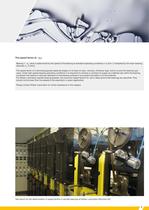
The speed factor (n · dm): Bearing n · dm value is determined by the speed of the bearing at standard operating conditions n in [min –1] multiplied by the mean bearing diameter dm in [mm]. The speed factor of a lubricating grease depends largely on its base oil type, viscosity, thickener type, and of course the bearing type used. Under high-speed bearing operating conditions it is important to achieve a constant oil supply at a defined rate within the bearing combined with optimum lubricant adhesion to the bearing surfaces if successful lubrication is to be achieved. For Klüber Lubrication spindle...
Open the catalog to page 5
Application of grease lubrication Depending on the bearing type, size and its intended application, initial lubrication can be made at the bearing manufacturer. Rolling bearing manufacturers have developed their own initial lubrication techniques for the application of grease. The chosen technique normally involves a central lubricating system conveying the grease from its original container to the filling station, from where it is applied to the bearing via nozzles. How much grease does the bearing need? For lifetime lubrication, the required grease quantities are determined in accordance with...
Open the catalog to page 6
For instance, the department responsible for spindle bearings at Schaeffler KG recommends the following for its spindle bearings type B, HS and HC:3) a) Rotating speed = 0.5 · n max Five intervals of 20 s running time and 2 min rest period b) Rotating speed = 0.75 · n max Five intervals of 20 s running time and 2 min rest period c) Rotating speed = n max Five intervals of 20 s running time and 2 min rest period Ten intervals of 30 s running time und 2 min rest period Ten intervals of 1 min running time and 1 min rest period According to this recommendation, the intervals featuring longer running...
Open the catalog to page 7
The lubrication of clamping systems Lubricant and chuck have to be perfectly matched, because their paramount task is to establish constant defined clamping forces – and this over a high number of clamping cycles. If the clamping force weakens, tools or workpieces may become detached. This holds true for all types of chucks – be they scroll chucks, cam chucks or spiral chucks. The specific requirements for the lubricants used in clamping systems are: • consistent clamping forces for all chuck types • protection against frictional and fretting corrosion (tribocorrosion) at frictional or positive...
Open the catalog to page 8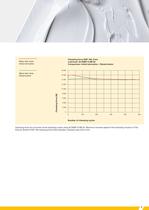
Clamping force KSP 160, 6 bar Lubricant: ALTEMP Q NB 50 Comparison: Initial lubrication – Relubrication Mean test value Initial lubrication 18 000 Mean test value Relubrication 16 000 14 000 12 000 Clamping force [N] 10 000 8 000 6 000 4 000 2 000 0 0 100 200 300 400 500 Number of clamping cycles Clamping force as a function of the clamping cycles using ALTEMP Q NB 50. Maximum traverse speed of the clamping chucks on Fritz Schunk GmbH‘s KSP 160 clamping force block (tandem clamper) was 0.52 m/min. 9
Open the catalog to page 9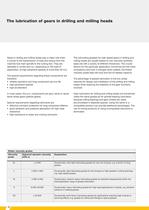
The lubrication of gears in drilling and milling heads Gears in drilling and milling heads play a major role when it comes to the transmission of load and torque from the machine tool main spindle to the cutting tool. They are operated in cycles and run, depending on the type of application, at high peripheral speeds of more than 20 m/s. The special requirements regarding these components are therefore: • reliable operation and long component service life • high peripheral speeds • high acceleration In most cases, the a.m. components are spur, bevel or spiral bevel wheel gears (palloid gears)....
Open the catalog to page 10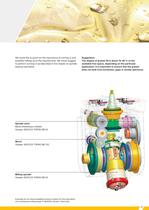
We would like to point out the importance of running-in and possible refilling up to the required level. We would suggest to perform running-in as described in the chapter on spindle bearing lubrication. Suggestion: The degree of grease fill is about 70–90 % of the available free space, depending on the particular application. It is important to ensure that the grease does not leak from boreholes, gaps or similar apertures. Spindle drive Bevel wheels/spur wheels Grease: ISOFLEX TOPAS NB 52 Worm Grease: ISOFLEX TOPAS NB 152 Milling spindle Grease: ISOFLEX TOPAS NB 52 Example for an intercompatible...
Open the catalog to page 11
Changing, unsteady operating states, manifested in abrupt changes in temperature or power consumption levels, for example, may have adverse effects on both the grease and the component. These may occur if • after standstill there is an abrupt change from one lubrication mechanism to another, due to the slow warming of the gear unit and the resultant alteration in the consistency of the grease • the transmission of torque and power and hence the load and consistency of the grease vary significantly • the system is being run with too much grease, producing forced fluid lubrication caused by the...
Open the catalog to page 12All Klüber Lubrication catalogs and technical brochures
 Geared up for success.
32 Pages
 KlueberEfficiencySupport
7 Pages
 Klübermatic lubricant dispensers
13 Pages
 All sprays at a glance
2 Pages
 Driving with Klüber Lubrication.
15 Pages
 Bonded coatings
16 Pages
 Automotive industry
16 Pages
 Cement industry
2 Pages
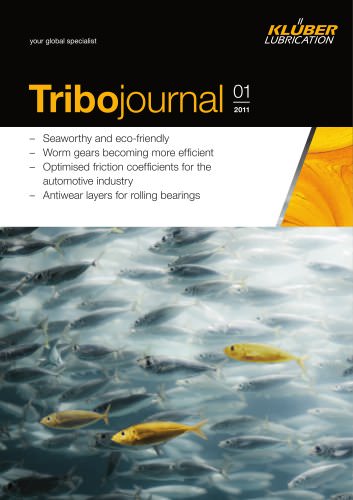 Tribojournal edition 1 - 2011
32 Pages
 Seaworthy
24 Pages
 Pneumatics
24 Pages

















- Klüber Lubrication synthetic lubricant
- Mineral lubricant
- Klüber Lubrication anti-corrosion lubricant
- Klüber Lubrication bearing lubricant
- Klüber Lubrication high-temperature lubricant
- Industrial oil
- Mineral oil
- Klüber Lubrication bearing grease
- Metal lubricant
- Anti-corrosion oil
- Klüber Lubrication long-life lubricant
- Metal oil
- Universal lubricant
- Klüber Lubrication high-temperature oil
- Klüber Lubrication low-temperature lubricant
- Klüber Lubrication high load capacity lubricant
- Klüber Lubrication high-temperature grease
- Metal spray