
- Catalogs
- Klüber Lubrication
- Geared up for success.


Geared up for success.

Geared up for success.
This document provides detailed guidance on gear lubrication, focusing on selecting and applying gear oils to enhance performance and longevity. It highlights the role of lubricants as integral design elements in gear systems.
Modern gear systems demand high-performance lubricants due to increased power-to-weight ratios and higher operating temperatures. Klüber Lubrication has developed advanced gear oils to meet these demands, reducing wear and improving efficiency.
Choosing the appropriate gear oil involves considering performance, speed, environmental influences, and operating conditions. Key parameters include oil type, wear protection, and viscosity, which help absorb forces, reduce friction, minimize wear, and dissipate heat.
Gear oil properties are influenced by base oils and additives, with essential requirements outlined by international standards. These include operating temperature range, viscosity, ageing behavior, low-temperature behavior, corrosion protection, foaming behavior, and elastomer compatibility.
Oil temperatures in industrial gears range from 20 to 150°C. High temperatures can indicate malfunctions, and maintaining appropriate temperatures is crucial for gear performance.
Viscosity is crucial for forming a lubricant film. It decreases with temperature and increases with load. A high viscosity index (VI) ensures stable viscosity across temperature changes, enhancing lubricant performance.
Oil ageing is influenced by temperature, air exposure, and metal contact. Synthetic oils offer better ageing resistance, leading to longer oil change intervals.
Synthetic oils exhibit superior cold flow behavior compared to mineral oils, making them suitable for low-temperature applications.
Gear oils must protect against corrosion on steel and copper. Klüber Lubrication's oils meet international standards for corrosion protection.
Gear housings require coatings resistant to oil types and temperatures. Compatibility tests are recommended for synthetic oils.
Gear oils should minimize foam formation to maintain lubricant properties. Klüber Lubrication's oils meet stringent foaming test requirements.
Gear oils must be compatible with sealing materials to prevent leakage. Klüber Lubrication collaborates with Freudenberg to ensure compatibility, achieving long run-times.
The document lists various types of gear oils, including mineral oils and synthetic oils such as polyalphaolefin (PAO), polyglycol (PG), and ester oils. Each type is evaluated based on its thermal resistance, compatibility with seal materials, and performance in different gear types.
The thermal resistance of gear oils varies, with mineral oils typically resistant up to 100°C, while synthetic oils like PAO and PG can withstand temperatures up to 160°C. This makes synthetic oils more suitable for high-temperature applications.
The document emphasizes the importance of wear protection in gear manufacturing, highlighting tests such as the FZG scuffing test and the FAG FE8 wear test. Klüber Lubrication’s gear oils are noted for surpassing standard requirements, offering superior protection against scuffing, micropitting, and rolling bearing wear.
Synthetic gear oils are shown to reduce friction losses significantly, leading to improved gear efficiency. The document provides data indicating that synthetic oils can improve efficiency by more than 20% in worm and hypoid gears and up to 1% in spur and bevel gears.
The choice between mineral and synthetic oils depends on operating conditions. Synthetic oils are recommended for high-temperature environments and applications requiring extended oil change intervals. The document also discusses the compatibility of different oils with seal materials and their miscibility with mineral oils.
Klüber Lubrication’s synthetic gear oils offer enhanced performance over standard mineral oils, providing better thermal resistance, wear protection, and efficiency. These oils are particularly beneficial in critical applications where standard oils may not suffice.
The document categorizes machinery based on the type of shocks they experience (light, moderate, heavy) and provides examples of driving machines with different operating characteristics. It also includes a table for determining the application factor (KA) based on the operating characteristics of both the driving and driven machines.
Guidelines for selecting the appropriate viscosity for mineral and synthetic gear oils are provided. The selection is based on the force-speed factor (ks/v) and the expected operating temperature. The document includes specific instructions for spur gears, bevel gears, and worm gears, with diagrams illustrating the viscosity selection process.
The document outlines various lubrication methods, including immersion lubrication, splash lubrication, and force-feed lubrication. It provides recommendations for immersion depth and lubrication methods based on the type of gears and their operating conditions.
Detailed procedures for performing oil changes are provided, including steps for normal oil changes and handling contaminated gears. The document emphasizes the importance of flushing and cleaning gears to remove oil residues and prevent contamination.
The document advises on the careful process of changing from mineral to synthetic gear oils. It highlights the need for flushing systems to remove mineral oil residues and ensure compatibility with synthetic oils. Specific recommendations are given for using polyalphaolefin (PAO) based synthetic oils.
For gear oils, it is crucial to minimize the content of other substances to maintain the original properties. At operational temperatures above 80°C, seals made from fluorinated rubber or PTFE are recommended, while NBR seals are suitable below 80°C. For internal gearbox coatings, epoxy and polyurea paints are advised.
From Mineral Oil to Polyglycol (PG): Polyglycols are not miscible with mineral or other synthetic oils but can mix with polyglycols from different manufacturers. Ensure compatibility of seals, paints, and inspection glasses with polyglycol oils. For temperatures over 80°C, use fluorinated rubber or PTFE seals; below 80°C, NBR seals are also resistant.
From Mineral Oil to Ester (E): Esters can mix with mineral oils and polyalphaolefins but have limited miscibility with polyglycols. Mixing with esters from other manufacturers is allowed if they are the same type. Minimize the content of other oils to preserve the original properties.
Polyglycols are generally neutral towards ferrous and most non-ferrous metals. However, in applications involving aluminium alloys, dynamic loads, high sliding speeds, and high loads may increase wear. Compatibility tests are recommended in such cases.
For function testing, running-in, and long-term storage of gears intended for polyglycol lubrication, Klübersynth GEZ 6-220 is recommended.
Klüber Lubrication München SE & Co. KG provides this technical brochure based on general experience and knowledge. It does not guarantee product suitability for specific applications, and preliminary field tests are advised. The company reserves the right to change technical data without notice.
Catalog excerpts

your global specialist Special knowledge Useful information on oil lubrication of gears
Open the catalog to page 1
Selection of the right gear oil Overview of Klüber gear oils Viscosity selection Oil level, immersion depth and oil quantities
Open the catalog to page 2
Gear oils made by Klüber Lubrication Increasing demands on the gear and the lubricant Your global specialist! Today, demands for the transmission of ever growing power and torque in gears of all performance grades in combination with reduced size and weight require new gear designs, new materials, improved surface treatment, modern production techniques as well as the application of mineral and synthetic high-performance lubricants. We are where you are. Our specialists are there to support you, wherever you need them. We help you select the right product or develop a solution tailored to your...
Open the catalog to page 3
Selection of the right gear oil Maximum operational reliability throughout a gearbox’s service life can only be ensured if lubricants are not only considered necessary operating materials but are taken into account during all design phases as integral structural elements. Ideally, the lubricant should be selected in the design phase of the gear. This brochure describes in a few steps how to select the right gear oil. For special applications, however, e.g. where very long service intervals are to be expected, or where operating conditions are very special, you should consult with the experts...
Open the catalog to page 4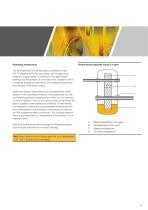
Operating temperature Temperatures typically found in a gear The oil temperature in industrial gears is between 20 and 150 °C, depending on the type of gear and the application. Heating of a gear system, in particular of the gear wheels, bearings and the lubricant, is one of the most important criteria to evaluate the gear’s performance. The existing temperatures are indicative of the power losses. Apart from design-related influences, oil temperatures mainly depend on the operating conditions. Oil temperatures rise with an increasing ambient temperature and when the oil is exposed to thermal...
Open the catalog to page 5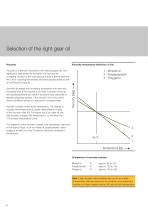
Selection of the right gear oil Viscosity Viscosity-temperature behaviour of oils 1 Mineral oil 2 Polyalphaolefin 3 Polyglycol Viscosity decreases with increasing temperature and rises with increasing load. If the viscosity is too high, increased churning and squeezing losses can result in excessive heat, especially at elevated peripheral speeds. If the viscosity is too low, mixed friction conditions prevail and will result in increased wear. Viscosity is highly influenced by temperature. The change in viscosity with temperature is usually determined by means of the viscosity index (VI). The...
Open the catalog to page 6
Ageing behaviour Low-temperature behaviour An oil’s chemical structure continuously changes when it is subjected to high temperatures, mixed with air or in contact with metal catalysts like copper, iron and others, causing it to age. The speed of the ageing process primarily depends on the oil’s structure and the amount and duration of heat to which the oil is subjected. Also, contaminants like water, rust or dust contribute to oil ageing. By adding special additives the lubricant manufacturer can retard the ageing process effectively. Depending on the base oil type, lubricating oils solidify...
Open the catalog to page 7
Selection of the right gear oil Anti-corrosion properties Anti-corrosion properties of gear oils are assessed individually for: Hint: When using a gear oil for components made of or con taining copper, like brass or bronze, it should pass the copper corrosion test according to ISO 2160 with the rating 1a or 1b. – corrosion protection on steel – orrosion protection on copper c (compatibility with nonferrous metals) All gear oils from Klüber Lubrication which comply with the requirements of DIN 51517 for CLP lubricating oils are not corrosive on copper and prevent corrosion on steel. Corrosion...
Open the catalog to page 8
Foaming behaviour Gear oils should be able to separate dispersed air rapidly and prevent the formation of stable surface foam. Foam is generated by air bubbles rising to the surface. The bubbles should burst as quickly as possible to keep foam to a minimum. The oil manufacturer can reduce the foaming tendency by adding anti-foam additives. However, too high a concentration may affect the air shedding capacity. The foaming tendency of a lubricating oil is determined according to ISO 6247 or ASTM D 892. Particularly in case of splash-lubricated gears operating at medium to high peripheral speeds,...
Open the catalog to page 9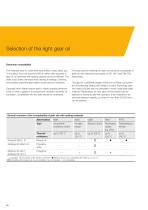
Selection of the right gear oil Elastomer compatibility The materials used for radial shaft seals (RSS) or static seals, e.g. O-ring seals, must not become brittle or softer when exposed to gear oil, as otherwise their sealing capacity would be affected. The seals would suffer premature wear, leading to leakage. Cleaning and possibly expensive gear repairs would become necessary. Especially when higher torques lead to higher operating temperatures, or when a gearbox is changed from mineral to synthetic oil lubrication, compatibility with the seals should be considered. The tests used for verifying...
Open the catalog to page 10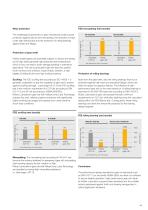
FZG micropitting test (results) Heavily loaded gears are potentially subject to seizure and pitting, as the high loads generate high pressures and temperatures, which in turn can lead to tooth damage resulting in premature gear failure. The risk is particularly high with less than perfect tooth contours and surfaces, impact loads, vibration, a high degree of sliding friction and high surface pressure. Scuffing: The FZG scuffing test according to ISO 14635-1 is generally undertaken to test the capability of gear oils to protect against scuffing damage. Load stage KS 12 of the FZG scuffing test...
Open the catalog to page 11
Selection of the right gear oil Mineral or synthetic gear oils Today, many enclosed industrial gearboxes are still lubricated with mineral oils. Where these oils come up against their limitations, e.g. in terms of operating temperatures, the use of synthetic gear oils should be considered. Gear lubricants based on the following synthetic oils have proven most effective: With polyglycol oils, very low friction results can be attained, which is why they are preferably used for the lubrication of gears with a high proportion of sliding friction, e.g. worm and hypoid gears. When combined with corresponding...
Open the catalog to page 12All Klüber Lubrication catalogs and technical brochures
 KlueberEfficiencySupport
7 Pages
 Klübermatic lubricant dispensers
13 Pages
 All sprays at a glance
2 Pages
 Driving with Klüber Lubrication.
15 Pages
 Bonded coatings
16 Pages
 Automotive industry
16 Pages
 Cement industry
2 Pages
 Tribojournal edition 1 - 2011
32 Pages
 Seaworthy
24 Pages
 Pneumatics
24 Pages

















- Klüber Lubrication synthetic lubricant
- Mineral lubricant
- Klüber Lubrication anti-corrosion lubricant
- Klüber Lubrication bearing lubricant
- Klüber Lubrication high-temperature lubricant
- Industrial oil
- Klüber Lubrication bearing grease
- Metal lubricant
- Anti-corrosion oil
- Klüber Lubrication long-life lubricant
- Metal oil
- Universal lubricant
- Klüber Lubrication high-temperature oil
- Klüber Lubrication low-temperature lubricant
- Klüber Lubrication high load capacity lubricant
- Klüber Lubrication high-temperature grease
- Metal spray