
- Catalogs
- KLN Ultraschall AG
- Ultrasonic welding

Ultrasonic welding

Ultrasonic welding
The document describes the ultrasonic welding process, where ultrasonic vibrations are converted into mechanical vibrations to generate heat for plasticizing materials. The system includes a generator, converter, amplitude transformer, and sonotrode, operating in resonance. The process differentiates between far-field and near-field welding based on the distance of the sonotrode from the welding zone.
Process Engineering
Construction of the Joining Zones
The geometry of the joining zones significantly influences the welding outcome. Key considerations include weld seam load, tightness, optics, melt expulsion, material type, and positioning. An energy direction transmitter is crucial for efficient energy input.
The Phases of Ultrasonic Welding
The process involves three phases: the start phase (melting of the energy direction transmitter), the melting phase (coupling of parts), and the holding phase (cooling under pressure).
Welding Types
Path-dependent Welding
Involves stopping the ultrasound based on a trigger point or tool zero position.
Time-dependent Welding
The process stops after a pre-set time.
Energy-dependent Welding
A specific energy amount must be delivered to the part.
Process Parameters
Key parameters include amplitude, working pressure, descent speed, welding time, holding time, and trigger pressure, all of which are adjustable based on material and part specifications.
Advantages of Ultrasonic Welding
Ultrasonic welding allows for three-dimensional weld seams with short cycles, requires no post-processing, is environmentally friendly, and uses less energy compared to other methods.
Ultrasound Principle
Ensures efficient sound transmission with full contact between the sonotrode and workpiece.
Machine Technology
The document mentions the Omega III series of welding machines, available with pneumatic or servo-electronic drives, and offers expert consultation for optimal welding geometry.
Application Examples
Illustrations include components like a center console cover and charging plug, demonstrating practical applications of ultrasonic welding.
Catalog excerpts
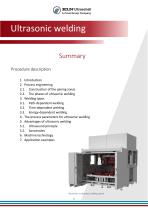
Ultrasonic welding Summary Procedure description 1. Introduction 2. Process engineering 2.1. Construction of the joining zones 2.2. The phases of ultrasonic welding 3. Welding types 3.1. Path-dependent welding 3.2. Time-dependent welding 3.3. Energy-dependent welding 4. The process parameters for ultrasonic welding 5. Advantages of ultrasonic welding 5.1. Ultrasound principle 5.2. Sonotrodes 6. Machine technology 7. Application examples Illustration 1 Ultrasonic welding system
Open the catalog to page 1
1. Introduction The ultrasonic vibrations are produced in a generator, which converts the incoming mains voltage into high-frequency energy. This high-frequency electrical energy is converted into mechanical vibration energy of the same frequency via the transducer (converter). The entire resonance unit consists of a generator, converter, amplitude transformer and sonotrode and operates in resonance. In ultrasonic welding, the heat required for plasticizing is generated by converting ultrasonic vibrations into mechanical vibrations and then transferred to the workpiece to be welded with a certain...
Open the catalog to page 2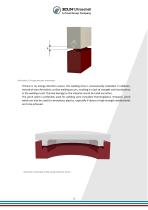
Illustration 2 Energy direction transmitter If there is no energy direction sensor, the welding time is unnecessarily extended. In addition, instead of seam formation, surface welding occurs, resulting in a lack of strength and inconsistency in the welding result. Thermal damage to the material cannot be ruled out either. The pinch weld is preferably used for welding semi-crystalline thermoplastics. However, pinch welds can also be used for amorphous plastics, especially if dense or high-strength welded joints are to be achieved. Illustration 3 Example of the energy direction sensor
Open the catalog to page 3
2.2. The phases of ultrasonic welding Start phase: Melting of the energy direction transmitter (ERG) Melting phase: With further heat input, more melt is produced and a complete coupling of the upper and lower part is created. Holding phase: The workpiece is held in a precise position and cools down under holding pressure, during which the horn sags slightly. Welding types 3.1. Path-dependent welding Relative: Stopping the ultrasound is defined starting from the trigger point. Absolute: Stopping the ultrasound is defined from the tool zero position. The drop after the stop due to the holding...
Open the catalog to page 4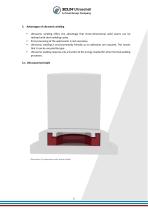
5. Advantages of ultrasonic welding Ultrasonic welding offers the advantage that three-dimensional weld seams can be realized with short welding cycles. Post-processing of the weld seams is not necessary. Ultrasonic welding is environmentally friendly as no adhesives are required. This means that it can be recycled by type. Ultrasonic welding requires only a fraction of the energy needed for other thermal welding processes. Illustration 4 Components with article hold
Open the catalog to page 5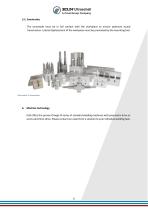
5.2. Sonotrodes The sonotrode must be in full contact with the workpiece to ensure optimum sound transmission. Lateral displacement of the workpiece must be prevented by the mounting tool. 6. Machine technology KLN offers the proven Omega III series of standard welding machines with pneumatic drive or servo-electronic drive. Please contact our experts for a solution to your individual welding task.
Open the catalog to page 6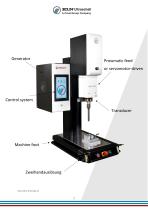
Pneumatic feed or servomotor-driven Control system Transducer Machine foot
Open the catalog to page 7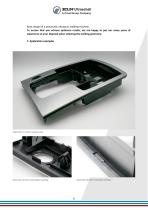
Basic design of a pneumatic ultrasonic welding machine. To ensure that you achieve optimum results, we are happy to put our many years of experience at your disposal when selecting the welding geometry. 7. Application examples Illustration 7 Center console cover Illustration 8 Rivet head after welding Illustration 9 Rivet head before welding
Open the catalog to page 8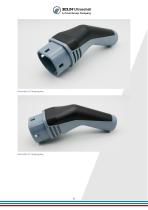
Illustration 10 Charging plug Illustration 11 Charging plug
Open the catalog to page 9All KLN Ultraschall AG catalogs and technical brochures
 Plastic assembly techniques
6 Pages
 Ultrasonic tanks
4 Pages
 Ultrasonic riveting
6 Pages
 Modular machine
2 Pages
 PWA
PWA2 Pages
 Solvent cleaning machines
2 Pages
 Ultrasonic
6 Pages
 Batch-Inline Cleaning System
2 Pages
 spray unit
2 Pages
 Spin welding
6 Pages
 Compact units
2 Pages
 Laser
Laser4 Pages
 Toolmaster heating element
4 Pages
 Infrared welding
4 Pages
 Linear Vibration Welding
6 Pages

- Automatic welding machine
- Automatic cleaning system
- Drying system
- Industrial cleaning system
- Stainless steel cleaning system
- Laser sealer
- Precision welding machine
- Plastic welding machine
- Ultrasonic washing machine
- Process cleaning system
- Spray cleaning system
- Parts cleaning system
- Resistance welding machine
- Ultrasonic transducer
- Standalone welding machine
- Manual cleaning system
- Compact cleaning system
- Solvent cleaning system
- Integrated welding machine