

PRODUCT Catalogue

PRODUCT Catalogue
Klimawent S.A. specializes in improving air quality across various environments, including enterprises, public buildings, and private homes. With over 25 years of experience, the company offers innovative solutions and a wide range of products such as air cleaners, fans, and exhaust systems, emphasizing continuous development and advanced technologies.
Klimawent adheres to the ISO 9001:2015 standard, focusing on producing efficient, silent, environmentally friendly, and aesthetically pleasing ventilation devices to improve air quality.
- Fans: Includes radial, axial, duct, roof, high-pressure, chemically resistant, and explosion-proof fans.
- Air Cleaners: Tobacco smoke absorbers and smoking boxes for clean air in smoking areas.
- Local Extraction Devices: Arms and systems for contamination extraction, including explosion-proof options.
- Filtering Units and Dust Separators: Units for welding dust, oil mist, and various dust types, including high-vacuum options.
- Exhaust Extractors: Systems for general and fire department applications, including portable and stationary options.
- Installation Elements: Ducts, hoses, and accessories for system installation.
Innovative products like the SMOKE ABSORBER and SMOKING BOX use high-efficiency HEPA filters and active carbon to capture harmful substances efficiently.
Detailed technical specifications are provided for various products, including volume flow, supply voltage, fan motor rate, acoustic pressure levels, and weight, emphasizing efficiency and ease of maintenance.
The document provides technical specifications and operational guidelines for various types of radial fans used for air-supply or extraction ventilation, complying with the ErP 2009/125/EC Directive.
Fans consist of a spiral steel housing and a motor, with an aluminum radial impeller designed to reduce acoustic pressure levels. Protective grills are included for safety.
Fans can be installed on wall brackets or filtering units, compatible with rigid ducts and flexible connections. Safety switches and TK silencers are recommended for noise reduction.
Specifications include dimensions, motor rates, supply voltage, ingress protection, acoustic pressure levels, maximum volume flow, and weight. Maximum air temperature is +60°C, and dustiness should not exceed 0.3 g/m³.
For local extraction, a flexible hose with a suitable suction nozzle should be attached to the fan inlet. Portable fans can be used for drying humid rooms.
Fans come with motor starters and a five-meter-long cable with a plug. Accessories like connectors for flexible hoses and magnetic hoods are available.
This document serves as a comprehensive guide for selecting and operating radial fans, ensuring compliance with safety and performance standards.
- Radial Fans: Enclosed in sound-absorbing boxes, suitable for silent operation, with low acoustic pressure levels.
- Axial Fans: Designed for general ventilation, can be installed in wall openings or windows, operating in vertical and horizontal positions.
- Portable Fans: Used for aeration, cooling, and drying, with a two-step speed governor for flow efficiency adjustment.
Detailed technical data includes supply voltage, motor rate, ingress protection, acoustic pressure levels, maximum volume flow, and weight.
Optional sound damping sets and safety switches are available for noise reduction and safety compliance.
Fans are suitable for indoor and outdoor applications in production halls, workshops, and livestock buildings.
The document provides technical specifications and installation guidelines for WP-N radial fans and SMART-N low-pressure roof fans, designed for general ventilation purposes.
- WP-N Radial Fans: Available in different models with varying motor rates, maximum volume flow, and acoustic pressure levels.
- SMART-N Roof Fans: Handle dry air up to +60°C, with motor rates ranging from 0.37 kW to 5.5 kW and maximum volume flow up to 31,000 m³/h.
- SMART-N Fans: Feature bent steel profiles and radial aluminum impeller, mounted on sound-absorbing roof bases to reduce noise.
- Installation Recommendations: Use sound-absorbing roof bases to minimize noise, available in TPD-N and TPDC-N types.
SMART-N fans prioritize low noise levels, with additional noise reduction using TK silencers.
Sound-absorbing roof bases reduce noise by 12 to 18 dB(A), and TK silencers are available for further noise reduction.
Inverters are available for adjusting motor rotational speed, enhancing operational efficiency.
Safety switches are available to disconnect power during servicing and installation.
The document provides technical specifications and details for various types of roof fans designed for general ventilation, including fan models, applications, structural features, installation recommendations, and technical data.
Specifications for different fan models, including the BULLET-N and SMART-EC series, are detailed with parameters such as synchronous rotations, supply voltage, motor rate, ingress protection, acoustic pressure levels, maximum volume flow, and maximum vacuum.
Installation recommendations emphasize using sound-absorbing roof bases to minimize noise, with specific bases like TPD-N and TPDC-N for optimal installation.
Fans meet the requirements of the ErP 2009/125/EC Directive, ensuring compliance with energy-related product standards.
Safety switches are recommended to disconnect power during installation and maintenance, and TK silencers are suggested for further noise reduction.
Detailed tables provide dimensions, acoustic pressure levels, and other technical data for each fan model, with graphs illustrating static pressure and volume flow relationships.
Fans are designed for general ventilation, capable of handling dry air with specific temperature and dustiness limits, suitable for outdoor installation on roofs or wall brackets.
Fans feature robust construction with steel housing, radial impellers, and protective grills, with the SMART-EC series including electronic commutator motors for efficient speed adjustment.
The document provides technical specifications and applications for various types of high-pressure and chemically resistant fans produced by KLIMAWENT S.A., including details on fan construction, operational use, and chemical resistance.
- Types and Specifications: Models such as WW-2-1-1100, WW-2-3-1100, WW-3-3-3000, and WW-4-3-7500 are detailed with maximum volume flow, supply voltage, motor rate, acoustic pressure level, and weight.
- Applications: Used for transporting air in high-pressure or vacuum conditions, suitable for industrial vacuum cleaners, high-vacuum filtering units, and aeration of water reservoirs.
- Construction: Features include a housing, aluminum cast radial impeller, silencers, and a motor with direct drive, operable in horizontal and vertical positions.
- Operational Conditions: Handle air temperatures up to +40°C, should not convey viscous impurities or explosive substances.
- Purpose: Used for drying walls, firehoses, and supplying fresh air during rescue operations.
- Structure: Lightweight with a handle for portability, equipped with a high-pressure turbine and quick-connectors for hose attachment.
- Operational Use: Recommended for room drying and air supply in rescue scenarios, with hose connection for targeted air delivery.
- SMART-CHEM Series: Designed for conveying air polluted with chemically aggressive media, with a maximum dustiness concentration of 0.3 g/m³ and temperature up to +40°C.
- SPARK-CHEM/Ex Series: Suitable for areas with explosion risk, handling chemically aggressive air with similar dustiness and temperature limits.
- Construction: Made from non-plasticised polyvinylchloride and antistatic plastic, with stainless steel impellers for acid-proof resistance.
- Chemical Resistance: Detailed tables provide resistance ratings for various chemicals, indicating total, partial, or no resistance.
Flow charts and dimensional data for each fan type aid in selection and installation.
The document provides detailed technical specifications and applications for various types of chemically resistant and explosion-proof fans manufactured by Klimawent S.A., designed for use in environments with chemically aggressive media and potential explosive atmospheres.
- Materials: Fans are constructed from antistatic plastic (PEEL) and non-plasticised polyvinyl chloride for chemical resistance.
- Explosion Proof: Fans prevent ignition in explosive atmospheres, complying with directives such as 94/9/EC and 2014/34/EC.
- Temperature Resistance: Fans handle conveyed media temperatures up to +60°C.
- SPARK-CHEM/Ex Series: Models with synchronous rotations of 1500 rpm, supply voltage of 3x400 V, and motor rates ranging from 0.12 kW to 0.75 kW, with maximum volume flow from 670 m³/h to 5000 m³/h.
- WPA-CHEM Series: Models with synchronous rotations of 1000 to 3000 rpm, supply voltage of 3x400 V, and motor rates from 0.25 kW to 2.2 kW, with maximum volume flow from 1100 m³/h to 12,200 m³/h.
- BOX-CHEM Series: Designed for duct installation, with synchronous rotations of 1500 rpm, supply voltage of 230 V, and motor rates from 0.12 kW to 0.75 kW, with maximum volume flow from 460 m³/h to 3820 m³/h.
- Suitable for industrial, agricultural, and public service buildings like laboratories, hospitals, and schools.
- Designed to handle clean air or air with chemically aggressive media, with dustiness concentration up to 0.3 g/m³ and temperatures up to +40°C.
- Fans comply with the ErP 2009/125/EC Directive and are certified by the National Institute of Public Health.
- Explosion-proof fans meet the ATEX 137 Directive (1999/92/EC) requirements for safety in explosive atmospheres.
- Fans feature a spiral housing and radial impeller made from non-plasticised polyvinyl chloride.
- Protective grills are installed at the fan inlet and outlet for safety.
- Special rubber washers reduce vibrations.
- For optimal performance, fans should be mounted on a sound-absorbing roof base.
- Selection of fans for explosive environments should be based on specific explosion risk categories and standards.
The document provides detailed technical specifications and applications for various models of medium-pressure explosion-proof fans designed for general ventilation in areas with explosion hazards.
Each fan model is specified with parameters such as synchronous rotations (3000 [1/min]), supply voltage (3x400 V), motor rate (ranging from 0.37 kW to 16 kW), ingress protection (IP 54), acoustic pressure levels at 1m and 5m distances, maximum volume flow (ranging from 950 m³/h to 23,100 m³/h), maximum vacuum, and weight. The fans are not adapted for use with rotational speed governors.
The fans consist of a spiral steel housing, an Ex motor, and an aluminum radial impeller directly installed on the motor shaft. The impeller blades are designed to resemble an aircraft wing profile, which helps in reducing acoustic pressure levels. The fans are equipped with protective grills at the inlet and outlet for safety. They are designed to be mounted on wall brackets or vibro-absorbing frames to minimize vibration transmission.
The fans are particularly efficient in installations with local exhausts, filtering units, and systems with significant flow resistances. They can operate within a temperature range of -20°C to +40°C and are suitable for conveying dry air with a dustiness not exceeding 0.3 g/m³.
It is recommended to install TK silencers at the fan inlet and outlet to further reduce noise levels. The fans are also equipped with connectors for attaching flexible hoses, which are available as additional accessories.
The document provides detailed dimensional data for each fan model, including measurements for various components such as the housing, impeller, and mounting flanges.
Performance charts are included to illustrate the relationship between static pressure and volume flow for different fan models, helping users to select the appropriate fan based on their specific requirements.
The document provides detailed technical specifications and operational guidelines for various types of extraction arms designed for capturing dust and gases at the emission source. These devices are crucial in preventing the spread of contaminants in work environments, particularly in welding and other industrial settings.
The document outlines specifications for different models of ERGO LUX, ERGO-FLEX LUX, and ERGO/Ex extraction arms. Key specifications include:
- Supply voltage: 230V with options for analogue signal control.
- Dimensions and weight for various models, including hanging and standing versions.
- Material types, such as ABS plastic and stainless steel, used in construction.
The extraction arms are designed for wall or column installation, with options for independent operation or integration into a central exhaust system. Features include:
- Swivel and self-braking rotary hood for easy maneuverability.
- Adjustment and shut-off dampers to control airflow.
- Protective mesh to prevent entry of glowing particles.
Flow resistance charts are provided for different arm lengths and configurations, illustrating the performance of straight and bent arms under various volume flow conditions.
Optional equipment includes shut-off dampers and halogen spotlights for enhanced functionality.
The ERGO/Ex models are designed for use in explosive environments, complying with ATEX 95 (94/9/EC) directive, ensuring safety in areas with explosive atmospheres.
These extraction arms are suitable for use in industrial settings, welding schools, and any environment where space is limited and contamination control is critical.
The extraction arm is composed of several key elements: a swivel, a suction hood with a shut-off damper, and telescopic pipe segments made of stainless steel. The swivel is made from aluminum cast elements, and the nominal diameter of the arms is 160 mm. A frictional joint near the swivel enhances maneuverability.
Installation requires a wall bracket, which can also support the extraction fan or connection fitting. The telescopic design allows segments to slide and rotate for optimal positioning of the suction hood. The frictional joint facilitates easy movement, and the shut-off damper adjusts air volume flow. The TELERGO-L-3-3000 model includes a gas spring for improved maneuverability.
Various models of the TELERGO series are detailed with specifications such as nominal diameter, recommended volume flow, number of pipe segments, work range, and weight. For example, the TELERGO-L-2-2000 has a work range of 1.6 to 2.0 meters and weighs 11.5 kg.
Acid-proof extraction arms ERGO-MINI are designed for removing dust and gas impurities in industries like chemical, pharmaceutical, and electronics. They are available in diameters of Ø50 and Ø75 and are constructed from acid-proof materials.
The ERGO-MINI arm includes a swivel with a vertical pipe, adjustable pipe segments, elbow joints, and replaceable hoods. It can be mounted directly or with a clamp holder. The arm can rotate fully around the vertical axis.
Rotational arms enhance the work range of ERGO LUX extraction arms. They consist of a bearing swivel and a steel duct, with minimal torsion resistance for easy maneuvering. Different models are available, such as RO-1.5-E-L/X and RO-4-E-L/Y, each with specific connection diameters and maximum torque capacities.
This system is designed for dust-gas extraction at mobile workplaces and can handle exhaust from vehicles with vertical or horizontal exhaust pipes. It includes two rotational arms, a vertical telescopic duct, and a suction hood. The system can be connected to a fan and a collecting ductwork.
Developed for capturing welding fumes at mobile workplaces, this system includes a self-tightening suction duct, a trolley, and an ERGO LUX or ERGO-FLEX LUX extraction arm. The system allows for easy maneuvering and adjustment of the hood during welding operations.
Detailed technical data is provided for various components, including extraction arms, rotational arms, and hoods. Accessories such as connection ferrules, duct hangers, and terminal stoppers are also listed with their specifications.
- Purpose: Designed for capturing dust, fumes, and gases during thermal cutting processes (gas and plasma) to protect the environment and worker health.
- Structure: Composed of a table body, replaceable grate, waste container, and pneumatic shut-off damper system. The table is modular, allowing for customization based on cutting needs.
- Efficiency: Recommended extraction efficiencies are 2000 m³/h for gas cutting and 4000 m³/h for plasma cutting per square meter of grate surface.
- Purpose: Captures dust and gas particles during grinding and welding activities.
- Structure: Includes a worktable with a grate, housing, suction chamber, and adjustable shut-off damper. Features swinging doors for accommodating larger elements.
- Purpose: Extracts air polluted with dry dust from welding and other processes like wood processing and metal trimming.
- Structure: Features a chamber with a grate top and a vertical suction wall. Equipped with a drawer for dust collection.
- Additional Equipment: Replaceable grates for adapting to different extraction needs.
- Purpose: Extracts mist during spray painting of small elements.
- Structure: Consists of one or two filtration segments with pleated filters and spunbond filters for high-efficiency air filtration.
- Connection: Requires connection to an extraction fan with a minimum volume flow of 3000 m³/h per wall segment.
- Purpose: Designed for cleaning air from dust and gas impurities during production processes, particularly welding.
- Structure: Includes a steel sheet housing, radial fan, spark catcher, and high-efficiency cartridge filters. Features automatic filter regeneration using compressed air.
- Versions: Available in mobile and stationary versions, with options for air recirculation or discharge outside the building.
- Maintenance: Requires periodic replacement of cartridge filters and optional activated carbon filters for gas contamination.
- Purpose: Designed for stationary use to filter dry fine dust, particularly effective during grinding processes. Suitable for air temperatures up to 60°C.
- Structure: Composed of a steel sheet housing, radial fan, high-efficiency cartridge filters, compressed air regeneration system, sparks catcher, waste container, and control unit.
- Operational Use: Requires firm installation and connection to an external compressed air system. Features automatic filter cleaning and a waste container with a viewing hole for monitoring.
- Purpose: Developed for capturing dry coarse dust above 5 μm, suitable for grinding and other dust-emitting processes.
- Structure: Includes a steel sheet housing, radial fan, cartridge filter, manual filter cleaner, sparks catcher, and silencer.
- Operational Use: Equipped with connection fittings for extraction arms or hoses. Manual filter cleaning is necessary to maintain flow capacity.
- Purpose: Designed for wood dust extraction and removal of impurities from non-sparking materials.
- Structure: Consists of a cylindrical housing with a fan, filtration bag, and waste collecting bag. Controlled by an electrical unit with a fill-up state sensor.
- Purpose: Efficient in wood dust extraction and removal of impurities from similar processes.
- Structure: Features a housing with a motor and impeller, waste bag, and cartridge filter or filtration bag. Equipped with various hose connectors.
- Purpose: Used for cleaning air contaminated with dry dust particles above 5 µm. Can serve as a final filtration stage or pre-filter.
- Structure: Includes a supporting frame, conic cyclone, waste container, and optional fan and silencer assembly.
- Operational Use: Requires connection to dust discharge points and, if used as a final filter, a silencer assembly at the fan outlet.
- Models: STORM-1000-H, STORM-2000-H, STORM-5000-H, and their SOFT-H variants.
- Specifications: Include maximum volume flow, vacuum pressure, supply voltage, motor rate, acoustic pressure levels, and weight.
- Applications: Used for capturing dry and coarse dust, spark neutralization, and protecting final filters from overload and fire risk.
- Purpose: Serve as pre-filters for capturing dry and coarse dust, spark neutralization, and protecting final filters.
- Structure: Composed of a rectangular housing with partition walls, inflow and outlet chambers, and a waste container.
- Models: SEP-4-M-1, SEP-4-M-2, SEP-4-M-3, SEP-UFO-A-5000, SEP-UFO-A-10000, SEP-UFO-A-15000, SEP-UFO-A-20000.
- Function: Utilizes humid filtration to clean dusty air, capturing dry dust, humid dust, and viscous substances.
- Structure: Includes a mixing chamber, hopper, drainage valve, fan chamber, and control unit.
- Specifications: Maximum volume flow, vacuum pressure, supply voltage, motor rate, acoustic pressure levels, and water chamber capacity.
- Purpose: Designed for cleaning air from dust-gas contamination, suitable for various industrial processes.
- Structure: Comprises a steel sheet housing, radial fan, pre-filter, pocket filter, HEPA filter, gas absorber, and control unit.
- Models: HARD-1000-S, HARD-2000-S, HARD-5000-S.
- Operational Use: Includes guidelines for installation, filter replacement, and maintenance.
- Detailed flow charts and pressure characteristics for each model are provided, illustrating the relationship between volume flow and pressure.
- Specifications include dimensions, weight, and filtration efficiency for various components and filters.
- Purpose: The BiG/Ex filtering units are designed to clean dust-laden air in explosion-hazard areas, complying with the ATEX 94/9/EC Directive. They are suitable for environments with powdery materials and dust of ST1 explosion class.
- Structure: The system comprises a filtration unit, fan chamber, and control unit. Key components include a pre-separator, cartridge filters, and decompression panels for explosion relief.
- Specifications: The maximum air temperature is +40°C, with a filtering efficiency of 99.9%. The system includes automatic filter cleaning via compressed air impulses.
- Additional Accessories: Non-return valves and rotary-cell valves are available for enhanced safety and functionality.
- Purpose: MISTOL separators are used to remove oil mist from air, particularly in metal machining processes. They are available in three sizes: MISTOL-1000, MISTOL-2000, and MISTOL-5000.
- Structure: Each separator includes a steel housing, radial fan, pre-filter, HEPA filter, sedimentation chamber, and silencer. The system is designed for efficient oil drainage and minimal maintenance.
- Operational Use: The separators require minimal supervision and are not intended for continuous operation. Regular maintenance involves emptying the sedimentation chamber and replacing filters as needed.
- Flow Characteristics: The document includes flow charts illustrating fan pressure, disposable pressure, and internal resistances as functions of volume flow for different systems.
- Dimensions and Specifications: Detailed dimensions and specifications for various models, including inlet/outlet sizes, weight, and acoustic pressure levels, are provided.
- Explosion Safety: The systems are designed to reduce explosion risks, with decompression panels and non-return valves to manage pressure and blast effects.
- Installation Recommendations: It is advised to install the filtering units outside buildings to mitigate explosion hazards.
- MISTOL MIX Series: Available in three models (1000, 2000, 5000), these units are designed to clean air from oil mist and dust impurities. They feature a multi-stage filtration system including a pre-filter, pocket filter (F8), and HEPA filter with 99.95% efficiency.
- SPLENDID VAC 200: A high-vacuum unit for dry welding dust, featuring a cylindrical steel housing, suction turbine, and a high-efficiency cartridge filter. It offers manual and automatic control options.
- DRAGON VAC 200: Designed for viscous welding dusts, this unit includes a compact filter (F9) and a high-vacuum suction turbine.
- MISTOL MIX: Requires periodic oil drainage and filter replacement. Equipped with control lamps to signal filter maintenance needs.
- SPLENDID VAC 200: Connects to external compressed air and requires periodic filter regeneration and waste container emptying.
- DRAGON VAC 200: Designed for single local exhaust use, requires filter replacement when efficiency decreases.
The document provides detailed information on various exhaust extraction systems designed for capturing exhaust fumes from vehicles during engine tests, adjustments, and diagnostics. These systems are applicable in garages, workshops, car service stations, and emergency vehicle depots.
- Global Hanging Exhaust Extractors: Designed for stationary use, these extractors capture exhaust fumes emitted by vehicle exhaust pipes. They are installed at a height of 2 to 3 meters and consist of a wall bracket, flange type fan, and coupling for flexible hoses. The selection of hose diameter and fan size depends on the engine capacity and speed.
- GEPARD Portable Exhaust Extractors: These are portable systems designed for cars (GEPARD-1000) and trucks (GEPARD-2000). They feature a rotary suction tube and are equipped with motor protective switches.
- SSAK Exhaust Extraction System: This system is ideal for fire departments, providing high efficiency and comfort. It includes a specially shaped suction funnel and a 160 mm diameter hose with high-temperature resistance.
- KOS-L/SSAK Rail Extraction System: Designed for emergency units, this system captures exhaust fumes from vehicles with stable stationing places. It includes a self-tightening suction duct and an electromagnet assembly.
- Various models are available with different supply voltages, motor rates, and weights. The document provides detailed tables listing part numbers, specifications, and compatible fans for each model.
- Hoses are available in different diameters and temperature resistances, with options for external helix and various coatings.
- Nozzles are available in different materials and designs, including rubber and polyethylene, with manual or automatic disconnection features.
- For standard applications, hoses with a thermal resistance of 150°C are recommended. For diesel engines with high exhaust temperatures, hoses with increased thermal resistance are advised.
- Before selecting an extractor, it is recommended to contact Klimawent S.A. for guidance on the appropriate model and specifications.
- Ventilation accessories such as roof bases and silencers are available on demand.
- Additional equipment includes suction nozzles, suction stands, and quick-connectors for adapting nozzle diameters.
This document provides technical specifications and applications for three types of flexible hoses: StX, HT-450, and HT-650, designed for conveying hot gases, vapours, and exhaust gases from vehicle exhaust pipes. Each hose type is tailored for different temperature ranges and applications.
- Application: Suitable for temperatures up to +170°C, used in exhaust extraction systems.
- Structure: Reinforced with a fabric coating and steel wire for floor protection.
- Characteristics: Hardly flammable, friction-resistant.
- Specifications: Available in diameters from 100mm to 200mm, with a temperature range from -30°C to +170°C (short-term up to +220°C).
- Application: Suitable for temperatures up to +500°C, used in reel exhaust extractors and suction ducts.
- Structure: High-temperature resistant fabric with stainless-steel fibres and an external zinc-coated steel spiral.
- Characteristics: Hardly flammable, friction-resistant, high mechanical strength.
- Specifications: Available in diameters from 100mm to 200mm, with a temperature range from -20°C to +450°C (short-term up to +500°C).
- Application: Suitable for temperatures up to +750°C, used in similar applications as HT-450.
- Structure: High-temperature resistant fabric with temperature stabilisers and stainless-steel fibres, reinforced with an external steel spiral.
- Characteristics: Resistant to vibrations, hardly flammable, friction-resistant.
- Specifications: Available in diameters from 100mm to 200mm, with a temperature range from -20°C to +650°C (short-term up to +750°C).
Each hose type includes detailed technical data such as internal diameter, unit weight, temperature range, maximum vacuum, and bending radius. Flow charts are provided to illustrate volume flow and pressure drop characteristics.
Catalog excerpts
About us Quality Policy of Klimawent S.A. We are an enterprise producing and selling ventilation appliances. We are obliged to meet the requirements according to ISO 9001:2015 Standard and the Quality Manual and to keep improving our Management System. Our target is to become the leader on the market of ventilation devices, dedicated to Customers expecting clean air in the room. To reach this goal, we intend to present a complex range of high quality ventilation appliances, based on our own design solutions. We aspire to produce devices with lower level of acoustic pressure (noise), compared...
Open the catalog to page 2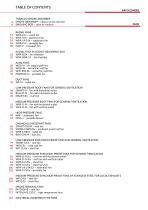
TOBACCO SMOKE ABSORBER SMOKE ABSORBER – tobacco smoke absorber SMOKING BOX – cabin for smokers RADIAL FANS WPA-E-N – stand fan WPA-S-N – stationary fan WPA-14-S-N – stationary fan WPA-P-N – portable fan FAST-P – transport fan RADIAL FANS IN SOUND-ABSORBING BOX WPA-BOX – fan chamber WPA-BOX-14 – fan chamber AXIAL FANS WOK-N – air-supply wall fans WOK-W – extraction wall fan WW-302-KL – extraction wall fan PODRYW-N – portable fan DUCT FANS WP-N – radial fan LOW-PRESSURE ROOF FANS FOR GENERAL VENTILATION SMART-N – fan with horizontal outlet BULLET-N – fan with horizontal outlet SMART-EC – roof fan...
Open the catalog to page 3
local extraction DEVICES FOR CONTAMINATION EXTRACTION ERGO LUX – extraction arms ERGO-FLEX LUX – extraction arms ERGO/Ex – explosion proof extraction arms TELERGO – telescopic extraction arms ERGO-MINI – extraction arms RO – rotational arm ROL-TP – point extraction set ROL-GOL – hood extraction set ERGO-KOS-AL – rail extraction system SCT – flame cutting table UES-N – grinding-welding stand SLOT – welding-grinding station FPS – mist extraction wall for spray painting Filtering units and dust separator STAND FILTERING UNIT FOR WELDING DUST EXTRACTION BIG-1000 – single stand extraction unit for...
Open the catalog to page 4
Table of contents Filtering units and dust separators 230 232 234 236 high-vacuum filtering units SPLENDID VAC 200 – filtration of dry welding dusts DRAGON VAC 200 – filtration of viscous welding dusts TENDER VAC 200 – filtration of dry dusts and gases RAPID VAC 200 – filtration of dry dusts exhaust extractors exhaust extractors for general application ALAN-N – reel exhaust extractor ALAN-HD-N – reel exhaust extractor OBS/P – stationary extractor with balancer KOS-AL, OBP/P-AL – rail extraction systems KOS-L, OBP/P – rail extraction systems ZS-OBP – radio control for rail extraction systems KOS-L-N...
Open the catalog to page 5
tobacco smoke absorber
Open the catalog to page 6
tobacco smoke absorber Arrangement example of the SMOKE ABSORBER in a special space within a building SMOKE ABSORBER is an innovative solution of a tobacco smoke absorber, designed for installing in a specially arranged room for smokers, providing sufficient space for 20 people enjoying smoking without harm to environment. The efficiency of the SMOKE ABSORBER and its design along with the stylish and modern decor, make an ideal equipment of companies, universities, hotels, gastronomy- and entertainment facilities and service spaces for travellers. The system does not need to be integrated within...
Open the catalog to page 7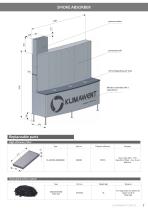
smoke absorber pressure outlet perforated wall self-extinguishing ash-trays filtration assembly with a silenced fan Replaceable parts High-efficiency filter Part no. Filtration efficiency FA-SMOKE ABSORBER Class of the filter – H13. Quantity of filters – 3 pc in one appliance. For replacement we deliver the carbon in bulk in 25 kg bags. Granulated active carbon
Open the catalog to page 8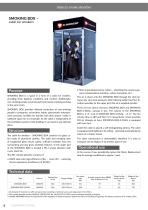
tobacco smoke absorber Purpose SMOKiNG BOX is a space in a form of a cabin for smokers, providing them hygienic conditions and comfort. Additionally, non-smoking people are protected from passive smoking working in the same room. SMOKING BOX provides efficient protection of non-smoking people in companies, universities, hotels, gastronomic-entertainment premises, facilities for tourists and other spaces. Inside is sufficient space for 4 or 8 people. As the cabin is independent of the ventilation system of the building, it can stand in any optional place. The cabin for smokers - SMOKiNG BOX consists...
Open the catalog to page 9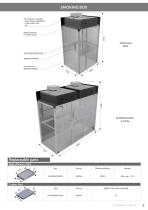
smoking box PD-1 Filtration assembly: – high-efficiency HEPA filter – active carbon filter – fan lighting operated by motion sensor SMOKING BOX self-extinguishing ashtray ergonomic handrail construction of aluminium profiles Replaceable parts High-efficiency filter 150 Filtration efficiency Weight of the active carbon [kg] Carbon filter
Open the catalog to page 10
radial fans
Open the catalog to page 12
radial fans Commonly, these fans have been designed for local ventilation. They are installed on wall brackets inside the buildings (indoor application). As they can overcome significant air flow resistances, they are particularly efficient within the systems of local exhausts. The appliances meet the requirements of the ErP 2009/125/EC Directive. The fan consists of a spiral steel housing, motor. The aluminium radial impeller is directly installed at the motor shaft. The impeller blades cross-section reminds the profile of an aircraft wing, providing low acoustic pressure level. The fan inlet...
Open the catalog to page 13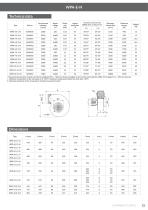
Technical data Type * Measurement has been carried out with the additional TK L = 500 mm silencer installed at the fan inlet and outlet (for WPA-3-E-N apply TK L = 370 mm silencer). 1. Maximum temperature of the conveyed air is +60°C. Maximum temperature within the work area +40°C. 2. Maximum dustiness of the conveyed air should not exceed 0,3 g/m3. Dimensions type
Open the catalog to page 14
radial fans Purpose Principally, designed for air-supply- or extraction ventilation of rooms and workplaces, are recommended especially for use with system of local exhausts. They can be installed stationary in a ventilation rooms or other technical rooms. They meet the requirements of the ErP 2009/125/EC Directive. The fan consists of a steel spiral housing, and a motor. Its aluminium radial impeller is directly installed on the motor shaft (direct drive). The cross-section of the impeller blades reminds the profile of an aircraft wing, providing low acoustic pressure level of the fan. Outlet...
Open the catalog to page 15All KLIMAWENT catalogs and technical brochures
 PODRYW-N
1 Page
 WW-302-KL
1 Page
 WOK-W
WOK-W2 Pages
 WOK-N
WOK-N2 Pages
 WPA-P-N
2 Pages
 fast-p
2 Pages
 WPA-14-S-N
2 Pages
 WPA-S-N
2 Pages
 WPA-E-N
2 Pages
 AIRCARE
2 Pages
 catalogue 2016
256 Pages
 Catalogue 2015
221 Pages
 SMOKING BOX
2 Pages
 Filtering unit — RAK-M
2 Pages
 Filtering unit — MATRIX 1000
2 Pages
 Filtering unit — UFO-N
2 Pages
 Roof fans — BULLET
2 Pages
 Extraction arms — ERGO/Ex
3 Pages
 Filtering unit UFO-4-M/N
4 Pages
 Extension arms — RO
4 Pages
 Roof Fans
13 Pages
 product catalogue
136 Pages

