
- Catalogs
- KLASCHKA Sensor & Motion Technologies
- Monitoring of Tool Changing Couplings

Monitoring of Tool Changing Couplings
Monitoring of Tool Changing Couplings
Catalog excerpts
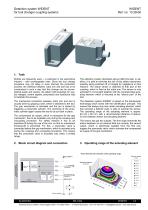
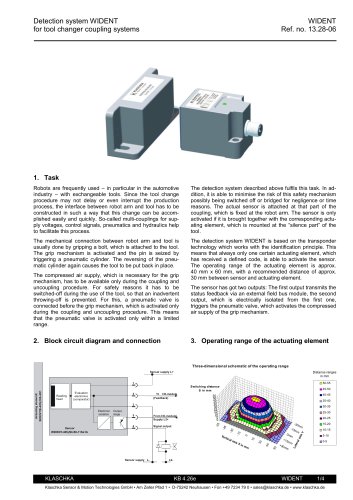
Detection system WIDENT for tool changer coupling systems 1. Task Robots are frequently used – in particular in the automotive industry – with exchangeable tools. Since the tool change procedure may not delay or even interrupt the production process, the interface between robot arm and tool has to be constructed in such a way that this change can be accomplished easily and quickly. So-called multi-couplings for supply voltages, control signals, pneumatics and hydraulics help to facilitate this process. The detection system described above fulfils this task. In addition, it is able to minimise the risk of this safety mechanism possibly being switched off or bridged for negligence or time reasons. The actual sensor is attached at that part of the coupling, which is fixed at the robot arm. The sensor is only activated if it is brought together with the corresponding actuating element, which is mounted at the “silence part” of the tool. The mechanical connection between robot arm and tool is usually done by gripping a bolt, which is attached to the tool. The grip mechanism is activated and the pin is seized by triggering a pneumatic cylinder. The reversing of the pneumatic cylinder again causes the tool to be put back in place. The detection system WIDENT is based on the transponder technology which works with the identification principle. This means that always only one certain actuating element, which has received a defined code, is able to activate the sensor. The operating range of the actuating element is approx. 40 mm x 60 mm, with a recommended distance of approx. 30 mm between sensor and actuating element. The compressed air supply, which is necessary for the grip mechanism, has to be available only during the coupling and uncoupling procedure. For safety reasons it has to be switched-off during the use of the tool, so that an inadvertent throwing-off is prevented. For this, a pneumatic valve is connected before the grip mechanism, which is activated only during the coupling and uncoupling procedure. This means that the pneumatic valve is activated only within a limited range. 2. Block circuit diagram and connection The sensor has got two outputs: The first output transmits the status feedback via an external field bus module, the second output, which is electrically isolated from the first one, triggers the pneumatic valve, which activates the compressed air supply of the grip mechanism. 3. Operating range of the actuating element Three-dimensional schematic of the operating range Sensor supply L+ Signal output From I/O-module/ Supply L2+ Output stage Electrical isolation I/O-module (Feedback) Evaluation electronics (comparator) Reading head Klaschka Sensor & Motion Technologies GmbH • Am Zeller Pfad 1 • D-75242 Neuhausen • Fon +49 7234 79 0 • [email protected] •
Open the catalog to page 1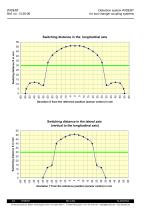
Detection system WIDENT for tool changer coupling systems Switching distance in the longitudinal axis 55 0 Deviation X from the reference position (sensor centre) in mm Switching distance in the lateral axis (vertical to the longitudinal axis) 55 Switching distance S in mm 0 Deviation Y from the reference position (sensor centre) in mm H Klaschka Sensor & Motion Technologies GmbH • Am Zeller Pfad 1 • D-75242 Neuhausen • Fon +49 7234 79 0 • [email protected] • www.klas
Open the catalog to page 2All KLASCHKA Sensor & Motion Technologies catalogs and technical brochures
 Detection system WIDENT
9 Pages
 Position Recognition
9 Pages
 Product Overview
6 Pages
 Klaschka_Measuring Relays_ALME
17 Pages
 Catalog ALSEN TK2
45 Pages
 Catalog ALSEN TK1
93 Pages
 Catalog ALSEN TK9
11 Pages


Archived catalogs
 Seam Detection
2 Pages
- Proximity switch
- Cylindrical proximity sensor
- Inductive proximity sensor
- Frequency inverter
- Distance sensor
- Monitoring relay
- Threaded proximity sensor
- Compact detector
- Rectangular proximity sensor
- Signal converter
- DIN rail monitoring relay
- Magnetic speed sensor
- Rotational speed sensor
- Analog distance sensor
- Non-contact proximity sensor
- M30 proximity sensor
- Voltage monitoring relay
- Capacitive proximity sensor
- Cylindrical distance sensor
- DIN rail signal converter