
- Catalogs
- KLASCHKA Sensor & Motion Technologies
- Detection system WIDENT

Detection system WIDENT
Detection system WIDENT
Catalog excerpts
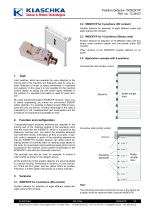
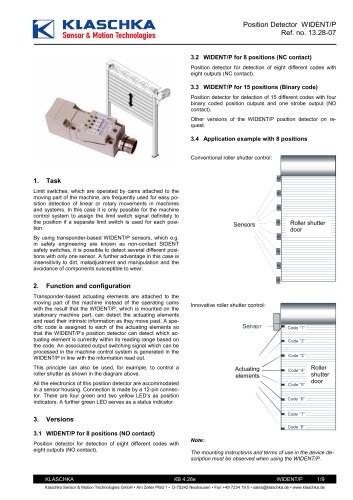
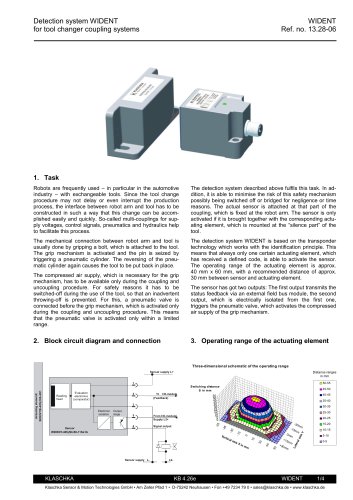
Position Detector WIDENT/P Ref. no. 13.28-07 3.2 WIDENT/P for 8 positions (NC contact) Position detector for detection of eight different codes with eight outputs (NC contact). 3.3 WIDENT/P for 15 positions (Binary code) Position detector for detection of 15 different codes with four binary coded position outputs and one strobe output (NO contact). Other versions of the WIDENT/P position detector on request. 3.4 Application example with 8 positions Conventional roller shutter control: Limit switches, which are operated by cams attached to the moving part of the machine, are frequently used for easy position detection of linear or rotary movements in machines and systems. In this case it is only possible for the machine control system to assign the limit switch signal definitely to the position if a separate limit switch is used for each position. Roller shutter Rolltor door By using transponder-based WIDENT/P sensors, which e.g. in safety engineering are known as non-contact SIDENT safety switches, it is possible to detect several different positions with only one sensor. A further advantage in this case is insensitivity to dirt, maladjustment and manipulation and the avoidance of components susceptible to wear. Transponder-based actuating elements are attached to the moving part of the machine instead of the operating cams with the result that the WIDENT/P, which is mounted on the stationary machine part, can detect the actuating elements and read their intrinsic information as they move past. A specific code is assigned to each of the actuating elements so that the WIDENT/P’s position detector can detect which actuating element is currently within its reading range based on the code. An associated output switching signal which can be processed in the machine control system is generated in the WIDENT/P in line with the information read out. Innovative roller shutter control: Code “1” Code “2” Code “3” This principle can also be used, for example, to control a roller shutter as shown in the diagram above. Actuating Betätigungselements elemente All the electronics of this position detector are accommodated in a sensor housing. Connection is made by a 12-pin connector. There are four green and two yellow LED’s as position indicators. A further green LED serves as a status indicator. Roller Rolltor shutter door 3.1 WIDENT/P for 8 positions (NO contact) Position detector for detection of eight different codes with eight outputs (NO contact). Note: The mounting instructions and terms of use in the device description must be observed when using the WIDENT/P. Klaschka Sensor & Motion Technologies GmbH • Am Zeller Pfad 1 • D-75242 Neuhausen • Fon +49 7234 7
Open the catalog to page 1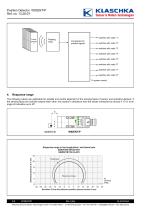
Position Detector WIDENT/P Ref. no. 13.28-07 Reading Lesekopf head schaltet bei Code “1”"1" switches with code Vergleicherfor für Comparator Positionssignale position signals schaltet bei Code “2”"2" switches with code switches with code schaltet bei Code “3”"3" switches with code schaltet bei Code “4”"4" switches with code schaltet bei Code “5”"5" switches with code schaltet bei Code “6”"6" switches with code schaltet bei Code “7”"7" switches with code schaltet bei Code “8”"8" To control zursystem Anlagensteuerung Response range The following values are applicable for parallel and central alignment...
Open the catalog to page 2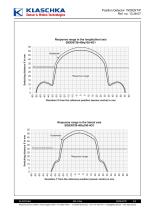
Position Detector WIDENT/P Ref. no. 13.28-07 Klaschka Sensor & Motion Technologies GmbH • Am Zeller Pfad 1 • D-75242 Neuhausen • Fon +49 7234 79 0 • [email protected] • www.kla
Open the catalog to page 3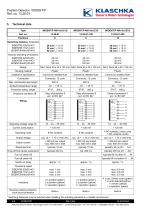
Switching distance, hysteresis Assured switching-off distance Housing material Installation specification Cannot be installed flush Cannot be installed flush Cannot be installed flush Max. permissible lead length Ambient temperature range Protection rating, weight Operating voltage range UL Current consumption Operating mode 4 NO contacts, binary code 1 NO contacts, strobe Output voltage Output current < 400 mA per output max. 800 mA in total < 400 mA per output max. 800 mA in total Response time typically 10 ms Drop-off time (pulse expansion) Switch-on delay Traversing speed 4 x position (green)...
Open the catalog to page 4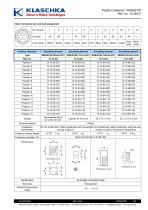
Sensor & Technologies Position Detector WIDENT/P Ref. no. 13.28-07 Table: Connector pin and lead assignment Actuating element Actuating element Position detection Type Ref. no. Position 1 Position 2 Position 3 Position 4 Position 5 Position 6 Position 7 Position 8 Position 9 Position 10 Position 11 Position 12 Position 13 Position 14 Position 15 Housing material Protection rating, weight Do not install flush; attach preferably with one-way screws or glue in Do not install flush; attach preferably with one-way screws or glue in to prevent manipulation Ambient temperature range Klaschka Sensor...
Open the catalog to page 5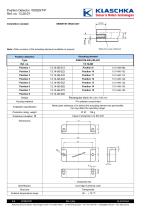
Position Detector WIDENT/P Ref. no. 13.28-07 16mm Installation example: Metal-free area (bilateral) Note: Other versions of the actuating elements available on request. Position detection Actuating element Housing material Installation specification Metal parts sideways of or behind the actuating element are permissible, but may affect the operating range. Protection rating, weight Protective insulation Ambient temperature range Klaschka Sensor & Motion Technologies GmbH • Am Zeller Pfad 1 • D-75242 Neuhausen • Fon +49 7234 79 0 • [email protected] • www.kl
Open the catalog to page 6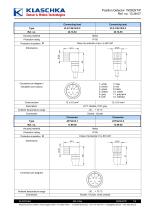
Position Detector WIDENT/P Ref. no. 13.28-07 Connecting lead Connecting lead Housing material Protection rating Connector pin diagram / Insulated core colours 1: white 2: brown 3: green 4: yellow 5: grey 6: pink 7: blue 8: red 9: black 10: violett 11: grey/pink 12: red/blue 12 x 0.5 mm² LIYY, flexible, PVC grey Ambient temperature range Housing material Protection rating Protective insulation Dimensions Ambient temperature range Connection KLASCHKA - 30 ... + 70 °C Socket, 12-pole, crimp contact КB 4.26e Klaschka Sensor & Motion Technologies GmbH • Am Zeller Pfad 1 • D-75242 Neuhausen • Fon +49...
Open the catalog to page 7All KLASCHKA Sensor & Motion Technologies catalogs and technical brochures
 Position Recognition
9 Pages
 Product Overview
6 Pages
 Klaschka_Measuring Relays_ALME
17 Pages
 Catalog ALSEN TK2
45 Pages
 Catalog ALSEN TK1
93 Pages
 Catalog ALSEN TK9
11 Pages

Archived catalogs
 Seam Detection
2 Pages
- Proximity switch
- Cylindrical proximity sensor
- Inductive proximity sensor
- Frequency inverter
- Distance sensor
- Monitoring relay
- Threaded proximity sensor
- Compact detector
- Rectangular proximity sensor
- Signal converter
- DIN rail monitoring relay
- Magnetic speed sensor
- Rotational speed sensor
- Analog distance sensor
- Non-contact proximity sensor
- M30 proximity sensor
- Voltage monitoring relay
- Capacitive proximity sensor
- Cylindrical distance sensor
- DIN rail signal converter