
- Catalogs
- Kipp & Zonen
- Solar Radiation Meausrements in Solar Energy


- Products
- Catalogs
- News & Trends
- Exhibitions
Solar Radiation Meausrements in Solar Energy

Solar Radiation Meausrements in Solar Energy
The document highlights the significance of solar energy, which accounts for 99.98% of Earth's energy, with the sun primarily composed of hydrogen and helium. It underscores the importance of solar radiation for life on Earth.
The solar constant, approximately 1,367 W/m², represents the solar radiation flux reaching Earth's atmosphere. Accurate solar radiation measurements are crucial for photovoltaic (PV) and concentrating solar power (CSP) systems, aiding in technology research, quality control, site optimization, system selection, investment decisions, efficiency maximization, maintenance scheduling, and performance monitoring.
As solar radiation traverses the atmosphere, it undergoes scattering and absorption, affecting the spectrum reaching Earth's surface. The document explains how atmospheric components influence these processes and their impact on radiation intensity.
Accurate solar radiation data is essential for the solar energy sector, aiding in PV technology verification, quality control, site selection, and system type decisions. Reliable data reduces uncertainty, enhancing project bankability and investment decisions.
The document emphasizes the necessity of high-quality solar radiation data to optimize solar energy systems, improve efficiency, and ensure reliability. It highlights the importance of understanding real-time variations and micro-climate impacts on solar energy potential.
The document provides an overview of solar radiation, emphasizing its role as Earth's primary energy source. The solar constant is 1,367 W/m², with Earth's orbit causing radiation fluctuations, including a 6.6% increase at perihelion compared to aphelion.
Atmospheric processes like scattering and absorption affect solar radiation reaching Earth. Rayleigh scattering causes blue skies, while longer wavelengths result in red skies at sunrise and sunset. The document defines short-wave (300 nm to 4,000 nm) and long-wave radiation (4,500 nm to over 40 µm), highlighting the greenhouse effect.
Solar energy resource maps often lack precision for investment decisions. High-quality, on-site solar radiation measurements over at least a year are crucial for evaluating potential sites, independent of power generation technology.
Investors require low uncertainty in solar resource data and equipment performance. Accurate data is essential for project bankability, plant efficiency assessment, maintenance scheduling, and performance monitoring.
Solar radiation is scattered and absorbed by atmospheric components, affecting the spectrum reaching Earth's surface. Atmospheric depth varies with the sun's position, influencing absorption and scattering effects.
High-quality ground-based measurements use radiometers with a flat spectral response, typically employing a thermopile detector. Global horizontal irradiance (GHI) includes diffuse horizontal irradiance (DHI) and direct normal irradiance (DNI), all within the short-wave radiation spectrum.
GHI is measured using a pyranometer, while DNI is measured with a pyrheliometer. DHI can be measured by a second pyranometer with a shading assembly. These instruments are standardized by the World Meteorological Organisation (WMO) and the International Standards Organisation (ISO).
As solar radiation passes through the atmosphere, it can be scattered or absorbed by molecules, aerosols, and clouds, affecting the spectrum reaching Earth's surface. Rayleigh scattering causes blue skies, while increased scattering at low sun angles results in red skies at sunrise and sunset.
Solar radiation includes short-wave (300 nm to 4,000 nm) and long-wave radiation (4,500 nm to more than 40 µm). The Earth's surface reflects or absorbs this radiation based on its albedo, with snow and ice being high reflectors.
The document includes a schematic representation of Earth's energy budget, showing how solar energy is absorbed, reflected, and emitted by the Earth and its atmosphere. The greenhouse effect is explained as the absorption of emitted infrared radiation by atmospheric gases.
The sun provides 99.98% of Earth's energy, with the rest being geothermal. The sun's composition and energy emission are detailed, emphasizing its role in sustaining life on Earth.
Solar radiation reaching Earth's atmosphere is quantified as the Solar Constant, approximately 1,367 W/m². This value can fluctuate slightly due to solar activities like sunspots and flares, but changes are minimal, around 0.1%. Earth's elliptical orbit causes variations in solar radiation, with a 6.6% increase at Perihelion compared to Aphelion.
The solar radiation spectrum includes ultraviolet (UV), visible, and near-infrared (NIR) wavelengths, with maximum intensity in the visible range (400-700 nm). Ground-based measurements use radiometers with thermopile detectors to capture this radiation. Global Horizontal Irradiance (GHI) is the sum of Diffuse Horizontal Irradiance (DHI) and Direct Normal Irradiance (DNI), adjusted by the solar zenith angle.
GHI is measured using a pyranometer, while DNI is measured with a pyrheliometer, both requiring precise alignment with the sun. DHI is measured with a shaded pyranometer. These instruments are standardized by the World Meteorological Organisation (WMO) and the International Standards Organisation (ISO) for consistent data across various platforms.
As solar radiation passes through the atmosphere, it is scattered and absorbed by molecules, aerosols, and clouds, affecting the radiation spectrum reaching the surface. Rayleigh scattering causes the sky to appear blue, while increased scattering at low sun angles results in red skies at sunrise and sunset.
Solar radiation is partly reflected and absorbed by the Earth's surface, influenced by surface albedo. Snow and ice reflect more radiation, while darker surfaces absorb more. Absorbed radiation is re-emitted as infrared radiation, contributing to the greenhouse effect.
Solar monitoring stations use a combination of pyranometers, pyrheliometers, and pyrgeometers to measure various components of solar radiation. Data is recorded and analyzed using data loggers, with advanced systems allowing real-time data transmission.
Solar radiation measurements are crucial for understanding the energy balance of the Earth. High-quality ground-based measurements are made using radiometers with a flat spectral response, typically achieved using a thermopile detector. The global horizontal irradiance (GHI) is composed of diffuse horizontal irradiance (DHI) and direct normal irradiance (DNI), all of which are short-wave radiation.
GHI is measured by a pyranometer, which is protected by glass domes. DNI is measured using a pyrheliometer, which requires a high-accuracy sun tracker to maintain alignment with the sun. DHI can be measured with a second pyranometer equipped with a shading assembly.
The World Meteorological Organisation (WMO) and the International Standards Organisation (ISO) define the specifications and calibration methods for these instruments. Compliance with these standards ensures accurate measurements across different weather conditions and locations.
Solar power plants require various instruments depending on the technology and purpose. Reference instruments quantify solar energy at a location, while pyranometers check the efficiency of PV panels. High-quality weather stations often accompany these setups to provide data for forecasting models.
Pyranometers like the CMP 3 and SMP3 have replaced traditional reference cells due to their broad spectral response, which allows for accurate efficiency calculations. PV panels and CSP systems have different requirements due to their design and operational principles.
Accurate solar radiation measurement is essential for solar energy research and power generation. The use of standardized instruments ensures reliable data collection, which is critical for optimizing solar energy systems and comparing data across different sites and technologies.
This document discusses the measurement and monitoring of solar radiation using various instruments, primarily focusing on pyranometers and pyrheliometers. It highlights the importance of accurate solar radiation data for photovoltaic (PV) systems and solar site prospecting.
The document details the use of pyranometers for measuring Global Horizontal Irradiance (GHI), Direct Normal Irradiance (DNI), and Diffuse Horizontal Irradiance (DHI). Pyrheliometers are used for DNI measurements and require high accuracy sun trackers. The instruments comply with World Meteorological Organisation (WMO) and International Standards Organisation (ISO) classifications, ensuring accurate measurements under all weather conditions.
Maintenance of radiometers involves keeping domes and windows clean and replacing desiccants. Regular calibration is recommended every two years to maintain accuracy, with certificates providing uncertainty calculations and traceability to the World Radiation Centre standards.
A solar monitoring station typically includes instruments for GHI, DNI, and DHI measurements. Additional equipment like pyrgeometers can measure long-wave radiation. These stations are crucial for solar energy research and site prospecting, providing high accuracy and reliable data.
PV modules are characterized under Standard Test Conditions, but real-world conditions can affect performance. Pyranometers are preferred over reference cells for efficiency calculations due to their broad spectral response, allowing for accurate measurement of solar irradiance.
Challenges include spectral mismatch between different PV panels and reference cells, which can lead to efficiency miscalculations. The document emphasizes the need for high-quality instruments to ensure data accuracy and reliability.
Accurate solar radiation measurement is essential for optimizing PV system performance and site prospecting. Kipp & Zonen provides comprehensive solutions for solar monitoring, ensuring high-quality data collection and analysis.
The document discusses the importance of measuring solar radiation to assess the efficiency of photovoltaic (PV) panels. It highlights the use of pyranometers and pyrheliometers for accurate solar radiation measurements, which are essential for monitoring PV system performance.
International standards like IEC 61724 specify the use of pyranometers for efficiency calculations. These instruments are crucial for providing accurate data that can be compared across different sites and systems.
The document explains the components of solar radiation: Global Horizontal Irradiance (GHI), Diffuse Horizontal Irradiance (DHI), and Direct Normal Irradiance (DNI). GHI is measured by pyranometers, while DNI is measured by pyrheliometers.
Pyranometers and pyrheliometers are calibrated according to standards set by the World Meteorological Organisation (WMO) and the International Standards Organisation (ISO). These instruments are used in solar monitoring stations to ensure accurate measurements under various weather conditions.
Solar energy plants require high-quality instruments to monitor solar radiation and panel efficiency. These include pyranometers for GHI, DNI, and DHI measurements, as well as reference instruments for data comparison and historical analysis.
The document introduces the latest generation of 'Smart' radiometers by Kipp & Zonen, which feature integrated digital processing, temperature correction, and enhanced communication capabilities. These advancements improve measurement accuracy and system integration.
Accurate solar radiation measurement is critical for optimizing the performance of solar energy systems. Kipp & Zonen provides a range of instruments and solutions to meet these needs, ensuring compliance with international standards and facilitating efficient energy production.
Kipp & Zonen is renowned globally for its quality, reliability, and support in solar radiation measurement instruments, offering a standard two-year warranty with options for extension. Their products are crucial in accurately assessing photovoltaic (PV) module performance.
PV modules are often tested under Standard Test Conditions using solar simulators, which can overestimate performance due to factors like temperature variations and dirt accumulation. Reference cells, which age and get dirty at the same rate as PV modules, often show unrealistic efficiency levels of 100%.
With various types of PV panels and reference cells, comparing them is challenging due to differing spectral responses, leading to potential spectral mismatches and efficiency miscalculations. Pyranometers, with their broad spectral response, provide a more accurate measure of solar irradiance and panel efficiency.
Standards like IEC 61724 mandate the use of pyranometers for efficiency calculations. These instruments are essential for monitoring solar energy availability and performance in PV plants.
Different instruments are required based on the power generation technology and measurement purpose. High-quality instruments provide data for site comparison and historical analysis. Automatic weather stations often complement these instruments for forecasting models.
Pyranometers are used to check panel efficiency in PV plants, often replacing reference cells. They are mounted to have the same view as PV panels and are crucial for calculating system efficiencies.
Various configurations exist for solar monitoring, from basic setups for fixed panels to advanced systems for tracking installations. Recommended instruments include models like CMP 3, SMP3, CMP 11, and others.
Several IEC and EN standards are relevant for PV panel testing and pyranometer specifications, ensuring accurate and reliable measurements.
All Kipp & Zonen instruments are traceable to the World Radiometric Reference in Davos, Switzerland, ensuring their accuracy and reliability.
For more information, visit Kipp & Zonen's website or contact them directly at their Delft, Netherlands office.
Catalog excerpts

Solar Radiation Measurements for Solar Energy Applications Precision Monitoring of Solar Radiation for Photovoltaic and Thermal Concentrating Solar Energy Systems technology research • quality control • optimise locations • select system type • inform investment decisions • maximise operating eciency • schedule maintenance • monitor performance • output forecasting
Open the catalog to page 1
Why is Accurate Solar Radiation Measurement Critical for Solar Energy? Good quality, reliable radiation data is extremely important for all activities in the solar energy sector. Photovoltaic (PV) and concentrating solar power (CSP) thermal systems may have slightly diering requirements, but they need accurate solar radiation information for the same reasons. and the scale is too large, to provide a reliable basis on which to make technology and investment decisions. Due to micro-climate and topographical dierences, changes in location of a few hundred kilometers can result in a change of hundreds...
Open the catalog to page 2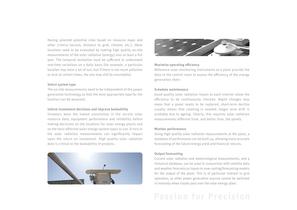
Having selected potential sites based on resource maps and other criteria (access, distance to grid, climate, etc.), these locations need to be evaluated by making high quality on-site measurements of the solar radiation (energy) over at least a full year. The temporal resolution must be sucient to understand real-time variations on a daily basis (for example, a particular location may have a lot of sun, but if there is too much pollution or dust at certain times, the site may still be unsuitable). Select system type The on-site measurements need to be independent of the power generation technology...
Open the catalog to page 3
Introduction to Solar Radiation The sun provides 99.98 % of the energy for our planet (the rest is geothermal) and it is responsible, directly or indirectly, for the existence of life on Earth. The sun is a star that consists of 71 % Hydrogen, 27 % Helium and 2 % solid matter. Near the sun’s core the temperature is approximately 16 million degrees and at its outer layer (the Photosphere) it is about 5,770 Kelvin. The energy emitted by the sun is approximately 63 MW for every m² of its surface, about 3.72 x 10²⁰ MW in total. The SI unit for the measure of irradiance (radiative ux) is Watts per...
Open the catalog to page 4
When passing through the atmosphere some solar radiation reaches the Earth’s surface undisturbed and some is scattered or absorbed by air molecules, aerosol particles, water droplets or ice crystals in clouds and ice in aircraft contrails. Gaseous molecules and aerosols cause most of the absorption. Scattering of solar radiation by water droplets and ice crystals takes place over the whole spectral range, whereas molecules predominantly scatter short wavelengths and aerosol particles mainly scatter longer wavelengths. Response [arbitrary units] figure 2: the wavelength bands of radiation, where...
Open the catalog to page 5
The solar radiation reaching the Earth’s surface is partly reected and partly absorbed, depending on the reectivity (albedo) of the surface. Snow and ice are good reectors (high albedo), dark and/or rough surfaces in general reect less eciently (except rad i clou ated t ds a o spa nd atm ce from osp her e For observations of radiation at the Earth’s surface, two wavelength regions are dened; short-wave radiation, of wavelengths from 300 nm to 4,000 nm, and long-wave radiation from 4,500 nm (4.5 µm) to more than 40 µm. The short-wave radiation includes the ultraviolet, visible and near infrared...
Open the catalog to page 6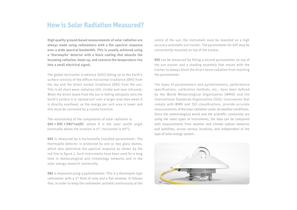
How is Solar Radiation Measured? High quality ground-based measurements of solar radiation are always made using radiometers with a at spectral response over a wide spectral bandwidth. This is usually achieved using a ‘thermopile’ detector with a black coating that absorbs the incoming radiation, heats up, and converts the temperature rise into a small electrical signal. The global horizontal irradiance (GHI) falling on to the Earth’s surface consists of the diuse horizontal irradiance (DHI) from the sky and the direct normal irradiance (DNI) from the sun. This is all short-wave radiation (UV,...
Open the catalog to page 8
This combination of instruments, for GHI, DNI and DHI makes a ‘solar monitoring station’, to which a horizontally mounted pyrgeometer may be added to measure the FIR long-wave radiation to WMO specications. A pyrgeometer is similar in principle to a pyranometer but the spectral response, shown by the pink line in gure 2, is determined by a silicon window (or dome) that transmits far infrared radiation and has a special internal coating to block the short-wave radiation. The low level millivolt analogue outputs from the radiometers are normally connected to a data logger that records and stores...
Open the catalog to page 9
What Instruments are Needed for Research or Prospecting? As previously described, measurements from WMO/ISO type pyranometers and WMO compliant pyrgeometers can be compared directly across sites anywhere in the world, with data from meteorological networks, with satellite information, and with solar radiation prediction algorithms. They are technology independent and can be used for any type of solar thermal energy or PV system and are therefore the ideal solution for solar energy research and site prospecting. The basic requirement is always a horizontally mounted pyranometer to measure global...
Open the catalog to page 10
Traditional photovoltaic (PV) semi-conductor materials are mainly sensitive in the visible and near-infrared parts of the spectrum, from approximately 400 to 1100 nm with a peak just beyond the visible radiation, as shown by the green line in gure 2. However, depending upon the sky conditions, there can be signicant energy available from the ultraviolet radiation below 400 nm and also from near infrared radiation beyond 1100 nm. Therefore, materials development is pushing to make use of this resource. Increasingly, in PV research, a Kipp & Zonen CUV 5 ‘total UV’ radiometer is being included to...
Open the catalog to page 11
What Instruments are Needed for Particular Solar Energy Plants? Several types of solar radiation measurement instruments may be required within a single plant, depending upon the power generation technology in use and the purpose of the measurement within the plant operation and process ow. One requirement is for ‘reference’ instruments that are used to quantify the solar energy available at the location. These are high quality, high accuracy instruments that can provide the data for comparison with other sites and other measurement sources, such as satellite data, and to build-up a historical,...
Open the catalog to page 12All Kipp & Zonen catalogs and technical brochures
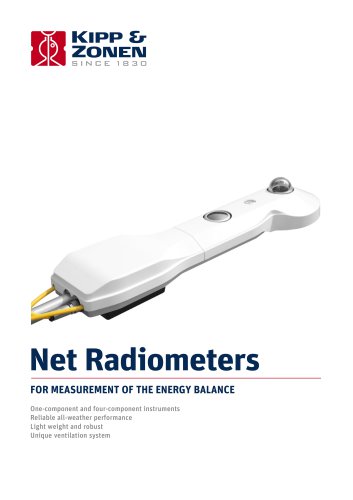 Net Radiometers
4 Pages
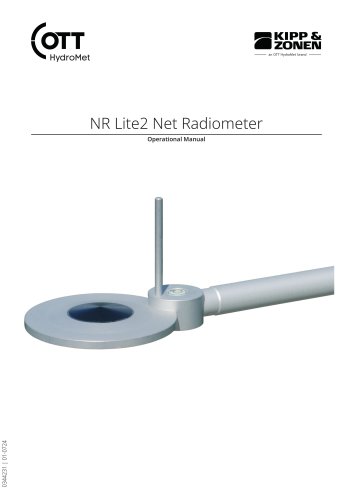 NR Lite2 Net Radiometer
20 Pages
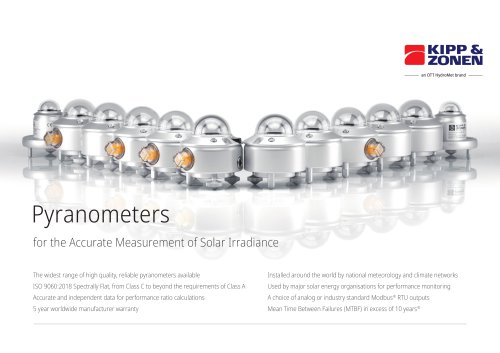 Pyranometers
8 Pages
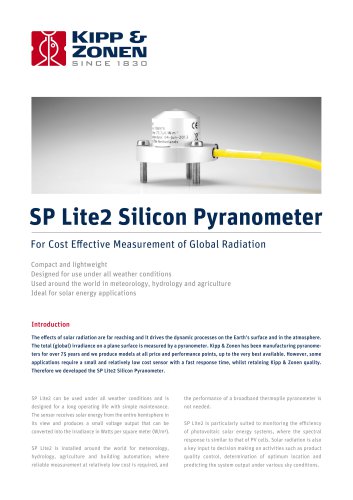 SP Lite2 Silicon Pyranometer
2 Pages
Archived catalogs
 SP Lite2 Silicon Pyranometer
2 Pages
 CGR Pyrgeometers
4 Pages
 UV Radiometers
4 Pages
 Brewer MKIII
4 Pages
 Sun Trackers
2 Pages
 RaZON+
4 Pages
 RT1
RT12 Pages
 Pyranometers
8 Pages
 SP Lite2
2 Pages
 AirShield Handout
2 Pages
 AMPBOX
2 Pages
 Pyrgeometers
4 Pages
 CM 121 Shadow Ring
2 Pages
 Albedometers
2 Pages
 SMP10 Pyranometer
2 Pages
 RaZON
RaZON4 Pages
 AirShield® DNI
2 Pages
 Newsletter 44
16 Pages
 CNR series
2 Pages
 Solar Monitoring Stations
24 Pages
 METEON 2.0
1 Page
 Albedometers
2 Pages
 CM 4 Pyranometer
2 Pages
 CMA Albedometers
2 Pages
 Net Radiometers
4 Pages
 Data Loggers
4 Pages
 LAS MkII
4 Pages
 AMPBOX Signal Amplifier
2 Pages
 Ventilation Unit - CVF4
2 Pages
 PV soiling monitoring
2 Pages
 PQS 1 PAR Quantum Sensor
2 Pages
 KippZonen_RT1_hand-out
2 Pages
 Kipp & Zonen Product Catalogue
92 Pages
 KippZonen Sun Trackers
4 Pages
 CA 2 Laboratory Thermopile
2 Pages
 Pyrheliometers
4 Pages
 Broadband UV Radiometers
4 Pages
 SP Lite2 Silicon Pyranometer
2 Pages
 LAS MkII Scintillometer
4 Pages
 The New CMP10
2 Pages
 SOLYS Gear Drive sun tracker
2 Pages
 Newsletter 45
8 Pages
 Newsletter 43
12 Pages
 DustIQ - Brochure
2 Pages
 KZ Sun Tracker
2 Pages
 CNR 1 Net Radiometer
2 Pages


- Connector
- Electrical cable
- Data connector
- Temperature probe
- Data logger
- Resistance temperature sensor
- Measuring machine
- Temperature datalogger
- Electrical data cable
- Flexible cable
- Flexible electrical cable
- USB datalogger
- Waterproof temperature sensor
- IEC electrical cable
- Current connector
- Data-logger with screen
- Signal amplifying integrated circuit
- Wireless datalogger
- Flame-retardant cable
- Datalogger without display