
- Catalogs
- Kipp & Zonen
- Pyrheliometers for direct solar radiation meausrement


- Products
- Catalogs
- News & Trends
- Exhibitions
Pyrheliometers for direct solar radiation meausrement

Pyrheliometers for direct solar radiation meausrement
Solar radiation is crucial for biological and geophysical processes. The sun's average intensity at the earth's atmosphere is 1367 W/m². As solar rays pass through the atmosphere, they are absorbed and scattered, resulting in direct and diffuse components reaching the earth's surface.
Pyrheliometer Overview
Pyrheliometers measure direct beam solar irradiance with a 5° field of view, known as Direct Normal Incidence (DNI). They use a collimation tube with precision apertures and a quartz window to filter solar radiation between 200 nm and 4000 nm. These instruments include rain shields and alignment aids.
CHP 1 Pyrheliometer
The CHP 1 is a passive pyrheliometer that offers reliability and durability without power requirements. It uses a detector similar to high-level pyranometers, minimizing temperature fluctuation effects and providing fast response times. It includes Pt-100 and 10 kΩ thermistor temperature sensors and meets ISO and WMO criteria for First Class Normal Incidence Pyrheliometers.
SHP1 Pyrheliometer
The SHP1 combines CHP 1 design with smart interface advantages, offering digital signal processing and optimized interfaces for industrial systems. It features improved response time, integrated temperature sensors, and digital polynomial functions for temperature sensitivity correction. The SHP1 operates on low power and a wide voltage range, making it suitable for power-critical applications.
Applications
The SHP1 is ideal for renewable energy applications, particularly in solar energy data acquisition and control systems. It provides accurate solar irradiance data for photovoltaic research and solar farm site prospecting.
Interfacing and Outputs
The SHP1 offers analogue outputs (0 to 1 V or 4 to 20 mA) and a 2-wire RS-485 interface with Modbus® protocol. It supports easy connection to data loggers and industrial networks. Users can access measurement data, instrument settings, calibration history, and status information.
Specifications
Both CHP 1 and SHP1 exceed ISO and WMO performance criteria. They have a spectral range of 200 to 4000 nm, a full viewing angle of 5°, and can operate in temperatures from -40 °C to +80 °C. The SHP1 has a response time of less than 2 seconds and low power consumption.
Conclusion
Kipp & Zonen pyrheliometers are designed for high-performance solar radiation monitoring, suitable for meteorological stations and concentrated solar energy applications. They offer reliable, accurate measurements with easy installation and maintenance.
Catalog excerpts

FOR UNATTENDED DIRECT NORMAL INCIDENCE SOLAR RADIATION MEASUREMENT Classical passive model with mV output, or Smart version with Enhanced performance by digital signal processing RS-485 serial data interface with Modbus® protocol
Open the catalog to page 1
Introduction Solar radiation is the driving force behind biological and geophysical processes in meteorology, climate and our environment. The sun irradiates the top of the earth’s atmosphere at an average intensity of 1367 W/m². As the solar rays travel through our atmosphere they are absorbed and scattered. This results in different components of solar radiation reaching the earth’s surface. The direct component travels in a straight beam from the sun, whilst a diffuse component comes from all directions, due to the atmospheric scattering process. A pyrheliometer is an instrument designed specifically...
Open the catalog to page 2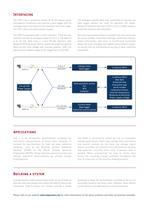
Interfacing The CHP 1 has a maximum output of 25 mV output under atmospheric conditions and requires a data logger with an analogue input of at least 12 bits resolution over that range. The CHP 1 does not need a power supply. The analogue outputs allow easy connection to virtually any data logger without the need for sensitive mV inputs. Modbus® interfaces directly to RTU’s, PLC’s, SCADA systems, industrial networks and controllers. The SHP1 is equipped with a smart interface. There are two versions, one has an analogue output of 0 to 1 V, the other of 4 to 20 mA. Both have a 2-wire RS-485 interface...
Open the catalog to page 3
First Class First Class Zero offsets due to temperature change (5 K/hr) Non-stability (change/year) Temperature dependence of sensitivity Analogue output Analogue output range Digital output Operating temperature Full viewing angle Maximum irradiance Spectral range (50 % points) Required sun tracker accuracy Other specications Weight (excluding cable) Slope angle Temperature sensor Both Pt-100 and 10k thermistor as standard (2) Supply voltage Expected daily uncertainty Calibration certicate traceable to WRR, multi-language instruction sheet, manual on CD-ROM Recommended applications High performance...
Open the catalog to page 4All Kipp & Zonen catalogs and technical brochures
 Net Radiometers
4 Pages
 NR Lite2 Net Radiometer
20 Pages
 Pyranometers
8 Pages
 SP Lite2 Silicon Pyranometer
2 Pages
Archived catalogs
 SP Lite2 Silicon Pyranometer
2 Pages
 CGR Pyrgeometers
4 Pages
 UV Radiometers
4 Pages
 Brewer MKIII
4 Pages
 Sun Trackers
2 Pages
 RaZON+
4 Pages
 RT1
RT12 Pages
 Pyranometers
8 Pages
 SP Lite2
2 Pages
 AirShield Handout
2 Pages
 AMPBOX
2 Pages
 Pyrgeometers
4 Pages
 CM 121 Shadow Ring
2 Pages
 Albedometers
2 Pages
 SMP10 Pyranometer
2 Pages
 RaZON
RaZON4 Pages
 AirShield® DNI
2 Pages
 Newsletter 44
16 Pages
 CNR series
2 Pages
 Solar Monitoring Stations
24 Pages
 METEON 2.0
1 Page
 Albedometers
2 Pages
 CM 4 Pyranometer
2 Pages
 CMA Albedometers
2 Pages
 Net Radiometers
4 Pages
 Data Loggers
4 Pages
 LAS MkII
4 Pages
 AMPBOX Signal Amplifier
2 Pages
 Ventilation Unit - CVF4
2 Pages
 PV soiling monitoring
2 Pages
 PQS 1 PAR Quantum Sensor
2 Pages
 KippZonen_RT1_hand-out
2 Pages
 Kipp & Zonen Product Catalogue
92 Pages
 KippZonen Sun Trackers
4 Pages
 CA 2 Laboratory Thermopile
2 Pages
 Pyrheliometers
4 Pages
 Broadband UV Radiometers
4 Pages
 SP Lite2 Silicon Pyranometer
2 Pages
 LAS MkII Scintillometer
4 Pages
 The New CMP10
2 Pages
 SOLYS Gear Drive sun tracker
2 Pages
 Newsletter 45
8 Pages
 Newsletter 43
12 Pages
 DustIQ - Brochure
2 Pages
 KZ Sun Tracker
2 Pages
 CNR 1 Net Radiometer
2 Pages


- Connector
- Electrical cable
- Data connector
- Data logger
- Resistance temperature sensor
- Measuring machine
- Temperature datalogger
- Electrical data cable
- Flexible cable
- Flexible electrical cable
- USB datalogger
- Waterproof temperature sensor
- IEC electrical cable
- Current connector
- Data-logger with screen
- Signal amplifying integrated circuit
- Wireless datalogger
- Flame-retardant cable
- Datalogger without display