
- Catalogs
- Kipp & Zonen
- CA 2 Laboratory Thermopile


- Products
- Catalogs
- News & Trends
- Exhibitions
CA 2 Laboratory Thermopile

CA 2 Laboratory Thermopile
The CA 2 Laboratory Thermopile is designed to measure the intensity of radiant fluxes across a wide wavelength range from 0.2 to 50 µm. It features a 20° field of view, capturing 90% of received radiation, making it suitable for targeted measurements from specific sources.
Specifications
- Spectral Range: 0.2 to 50 µm without window; 0.35 to 2.8 µm with window.
- Sensitivity: 7 to 20 µV/W/m².
- Impedance: 20 to 200Ω.
- Output Range: 0 to 30mV for irradiance levels from 0 to 1500 W/m².
- Maximum Operational Irradiance: 2000 W/m².
- Response Time: Less than 6 seconds for 63% response, less than 18 seconds for 95% response.
- Non-linearity: Less than 1.5% for irradiance levels between 100 to 1000 W/m².
- Field of View: 20° for 90% of received radiation.
- Mounting Rod: 170 mm long x 10 mm Ø.
- Detector Type: Thermopile.
- Temperature Range: -40°C to +80°C for both storage and operation.
- Humidity Range: 0 to 100% non-condensing.
Design and Functionality
The thermopile detector is coated with a spectrally non-selective black material, allowing it to respond to the total absorbed power. The output is a voltage proportional to the received radiation. A removable glass window can limit the spectral range to 0.3 to 3 µm, reducing environmental interference.
Applications
The CA 2 is ideal for control applications such as ovens, educational demonstrations, and reference measurements in optical laboratories. It can be easily mounted using standard optical bench clamps, and connections can be made via bare wires or 4 mm banana plugs.
Additional Information
The device is intended for use in clean indoor conditions only, with an ingress protection rating suitable for such environments. Kipp & Zonen B.V. reserves the right to alter specifications without prior notice.
Catalog excerpts

CA 2 Laboratory Thermopile for the measurement of radiant fluxes Sensitive to radiation from 0.2 to 50 µm Field of view of 20° Ideal for control or demonstrations Introduction The CA 2 laboratory thermopile can be used to measure the intensity of radiant fluxes in the wavelength range from 0.2 to 50 µm. The field of view is 20 ° for 90 % of the received radiation and is determined by the cylindrical brass housing that contains a conical reflector. This is ideal to measure fluxes coming from a specific locati
Open the catalog to page 1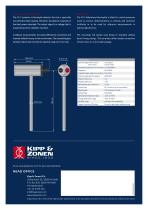
The CA 2 contains a thermopile detector that has a spectrally non-selective black coating. Therefore, the detector responds to the total power absorbed. The output signal is a voltage that is proportional to the radiation received. Irradiance measurements are easily affected by convection and thermal radiation losses to the environment. The removable glass window reduces but restricts the spectral range to 0.3 to 3 pm. The CA 2 laboratory thermopile is ideal for control purposes (such as ovens), demonstrations in schools and technical institutes or to be used for reference measurements in optical...
Open the catalog to page 2All Kipp & Zonen catalogs and technical brochures
 Net Radiometers
4 Pages
 NR Lite2 Net Radiometer
20 Pages
 Pyranometers
8 Pages
 SP Lite2 Silicon Pyranometer
2 Pages
Archived catalogs
 SP Lite2 Silicon Pyranometer
2 Pages
 CGR Pyrgeometers
4 Pages
 UV Radiometers
4 Pages
 Brewer MKIII
4 Pages
 Sun Trackers
2 Pages
 RaZON+
4 Pages
 RT1
RT12 Pages
 Pyranometers
8 Pages
 SP Lite2
2 Pages
 AirShield Handout
2 Pages
 AMPBOX
2 Pages
 Pyrgeometers
4 Pages
 CM 121 Shadow Ring
2 Pages
 Albedometers
2 Pages
 SMP10 Pyranometer
2 Pages
 RaZON
RaZON4 Pages
 AirShield® DNI
2 Pages
 Newsletter 44
16 Pages
 CNR series
2 Pages
 Solar Monitoring Stations
24 Pages
 METEON 2.0
1 Page
 Albedometers
2 Pages
 CM 4 Pyranometer
2 Pages
 CMA Albedometers
2 Pages
 Net Radiometers
4 Pages
 Data Loggers
4 Pages
 LAS MkII
4 Pages
 AMPBOX Signal Amplifier
2 Pages
 Ventilation Unit - CVF4
2 Pages
 PV soiling monitoring
2 Pages
 PQS 1 PAR Quantum Sensor
2 Pages
 KippZonen_RT1_hand-out
2 Pages
 Kipp & Zonen Product Catalogue
92 Pages
 KippZonen Sun Trackers
4 Pages
 Pyrheliometers
4 Pages
 Broadband UV Radiometers
4 Pages
 SP Lite2 Silicon Pyranometer
2 Pages
 LAS MkII Scintillometer
4 Pages
 The New CMP10
2 Pages
 SOLYS Gear Drive sun tracker
2 Pages
 Newsletter 45
8 Pages
 Newsletter 43
12 Pages
 DustIQ - Brochure
2 Pages
 KZ Sun Tracker
2 Pages
 CNR 1 Net Radiometer
2 Pages


- Connector
- Electrical cable
- Data connector
- Temperature probe
- Data logger
- Resistance temperature sensor
- Measuring machine
- Temperature datalogger
- Electrical data cable
- Flexible cable
- Flexible electrical cable
- USB datalogger
- Waterproof temperature sensor
- IEC electrical cable
- Current connector
- Data-logger with screen
- Signal amplifying integrated circuit
- Wireless datalogger
- Flame-retardant cable
- Datalogger without display