

KHK Miter Gear Catalogue

1 / 28 PagesView full catalog
KHK Miter Gear Catalogue
Product catalog summary
Overview: The document provides comprehensive guidelines for selecting and using miter gears, a type of bevel gear with intersecting shafts at 90° and a 1:1 gear ratio. It discusses various miter gear types, including spiral and straight tooth designs, and covers material composition, manufacturing processes, and application considerations.
Specifications: Miter gears are categorized by material type, module size, number of teeth, and spiral direction. Key materials include SCM415, S45C, SUS303, and MC901, each offering distinct properties like corrosion resistance or high strength. The document specifies precision grades, pressure angles, and heat treatment processes such as carburizing for enhanced durability. It also details specifications for other gear types, including spur, helical, internal gears, racks, and pinions, focusing on gear ratios, module numbers, and dimensional accuracy.
Procedures and Recommendations: The document emphasizes selecting gears based on application requirements, such as torque and speed demands. It advises on secondary operations like reboring and keyway cutting, stressing precision to avoid issues like noise and wear. Proper assembly techniques are crucial, with recommendations to minimize mounting distance errors and ensure correct shaft alignment. For plastic gears, it highlights the effects of temperature and humidity on dimensional changes and recommends pairing with steel gears to prevent heat generation.
Standards and Calculations: Gear strength calculations are based on JGMA specifications, with assumptions for bending strength and surface durability. Users are encouraged to compute values based on actual conditions, referencing technical sections on bending and surface strength.
Special Characteristics and Cautions: The document includes cautionary notes on product characteristics, such as the need for identical module and teeth numbers in miter gear sets, and the production of axial thrust forces. It warns about potential non-interchangeability of products with the same module and teeth number due to spiral hand differences.
Application Hints: Detailed guidance is provided for performing secondary operations and assembling miter gears. The document stresses the importance of proper bearing selection to handle thrust forces and advises on securing gears to shafts to prevent loosening during operation.
Conclusion: The document serves as a comprehensive guide for selecting, using, and maintaining miter gears, with a focus on ensuring optimal performance and longevity through careful consideration of material properties, manufacturing processes, and application-specific requirements. It also provides technical details on gear specifications, tolerances, and recommendations for handling and using plastic and metal gears, emphasizing environmental factors and proper material pairing.
See more
All KHK catalogs and technical brochures
 BB
BB1 Page
 DS
DS2 Pages
 LS
LS1 Page
 SSAY series
1 Page
 Steel Spur Gears
16 Pages
 NSU
NSU5 Pages
 SUKB
SUKB1 Page
 PS / PSA
5 Pages
 SUSL
SUSL2 Pages
 SUS / SUSA
3 Pages
 MSGA / MSGB
6 Pages
 SSGS
SSGS1 Page
 SSG
SSG7 Pages
 SSY
SSY2 Pages
 SSA
SSA3 Pages
 SSR series
1 Page
 SSS series
1 Page
 SSAY/K
2 Pages
 SS series
16 Pages
 PS series
5 Pages
 BSS series
3 Pages
 DSL series
2 Pages
 MSGA ・ MSGB
6 Pages
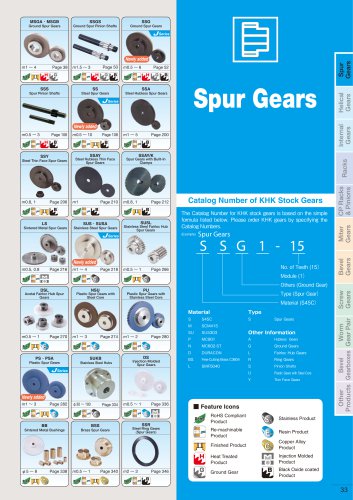 Spur gears
560 Pages

Archived catalogs
 KHK Spur Gear Catalogue
224 Pages
 KHK New Catalogue (2009, April)
48 Pages
 KHK Helical Gear Catalogue
18 Pages
 KHK Internal Gear Catalogue
6 Pages
 KHK Rack Gear Catalogue
28 Pages
 KHK CP Rack Catalogue
18 Pages
 KHK Bevel Gear Catalogue
42 Pages
 KHK Screw Gear Catalogue
14 Pages
 KHK Worm Gears Catalogue
56 Pages
 KHK Gearbox Catalogue
16 Pages
 KHK Other Products Catalogue
14 Pages
Related Searches
*Prices are pre-tax. They exclude delivery charges and customs duties and do not include additional charges for installation or activation options. Prices are indicative only and may vary by country, with changes to the cost of raw materials and exchange rates.
About DirectIndustry
DirectIndustry is a marketplace that offers B2B players a complete experience, from product sourcing to purchase. DirectIndustry is an entity of VirtualExpo Group.
Are you a buyer?
Are you a supplier?