

KHK Gearbox Catalogue

1 / 16 PagesView full catalog
KHK Gearbox Catalogue
Product catalog summary
Catalog Numbering System
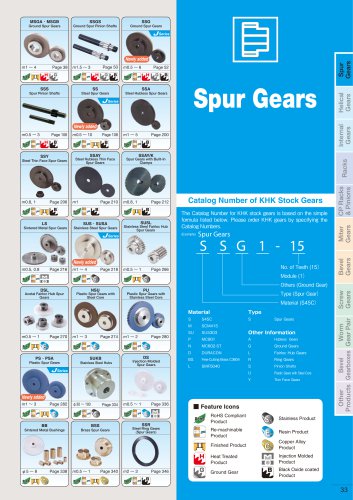
The catalog number for KHK stock gears is determined by a formula that includes housing material, model type, gear ratio, shaft diameter, and gearbox type. For example, 'PBX-041L' indicates a plastic housing, bevel gearbox, 1:1 gear ratio, 4mm shaft diameter, and L model.
The catalog number for KHK stock gears is determined by a formula that includes housing material, model type, gear ratio, shaft diameter, and gearbox type. For example, 'PBX-041L' indicates a plastic housing, bevel gearbox, 1:1 gear ratio, 4mm shaft diameter, and L model.
Miniature Bevel Gearboxes (PBX)
- Features: Lightweight, compact, maintenance-free, and allows flexible installation. Speed ratio is 1:1.
- Environmental Conditions: Suitable for temperatures -10℃ to 40℃, humidity 80% or less, indoors in a well-ventilated, dust-free environment.
- Mounting Methods: Must be bolted or screwed on a flat surface. No secondary operations like adding bolt holes are allowed.
- Connection with Mating Machinery: Use flexible couplings, ensure shaft alignment, no keyways on shafts; use clamping type couplings.
- Operating Precautions: Avoid touching rotating parts, stop operation if noise or temperature rises abnormally, do not disassemble or modify the unit.
Bevel Gearboxes (KBX)
- Features: Compact, low noise, high efficiency, maintenance-free, available in gear ratios of 1:1 or 1:2.
- Environmental Space: Similar to PBX, avoid corrosive gases and steam.
- Mounting and Connection: Similar to PBX, with emphasis on accurate alignment and avoiding interference with oil seals.
- Lubrication: Pre-sealed with high-grade grease containing Li Extreme Pressure additive.
Performance and Specifications
Both PBX and KBX series have performance charts indicating allowable power, torque, and efficiency at various RPMs. PBX is more economical, while KBX is recommended for high precision and strength applications.
Both PBX and KBX series have performance charts indicating allowable power, torque, and efficiency at various RPMs. PBX is more economical, while KBX is recommended for high precision and strength applications.
Special Characteristics and Cautions
Emphasizes not exceeding allowable values, ensuring proper alignment, and avoiding sudden reversals of rotation. KBX highlights keeping load torque and overhang load within allowable ranges.
Emphasizes not exceeding allowable values, ensuring proper alignment, and avoiding sudden reversals of rotation. KBX highlights keeping load torque and overhang load within allowable ranges.
Overview: The document provides detailed specifications and operational guidelines for various types of bevel gearboxes, including spur gears, helical gears, internal gears, racks, and pinions. It includes information on design, features, lubrication, performance, and mounting options.
Specifications: Lists specifications for different models of bevel gearboxes, such as the CBX series, with details on speed ratios, allowable power, torque, overhang load (O.H.L.), and efficiency. Includes dimensions and weight for each model.
Features: Key features of the CBX bevel gearboxes include high strength due to cast iron housing and tapered roller bearings, low noise and high efficiency from spiral bevel gears, flexibility in installation orientation, maintenance-free operation with pre-added high-grade oil, and selectable speed ratios of 1:1 or 1:2.
Lubrication: Specifies the volume of lubricant required for different CBX models and the type of oil to be used, which is JIS Gear oil Industrial Type 2.
Operating Preconditions: Advises on adhering to specified shaft orientations and rotation codes, with cautionary notes on mounting and lubrication methods, especially when the input shaft is oriented upwards or mounted on non-horizontal surfaces.
Performance Charts: Provides detailed performance charts for different CBX models, showing allowable power, torque, O.H.L., and efficiency at various RPMs. Highlights differences in performance between 1:1 and 1:2 speed ratio units.
Selection Procedure: Outlines the procedure for selecting the appropriate gearbox based on load torque, type of prime mover, input speed, speed ratio, running time, coupling method, and frequency of start and stop. Includes service factors for different loading conditions and operational durations.
Mounting Options: Provides information on standard and additional oil plug locations for different mounting orientations, with specific instructions for units mounted on ceilings or walls.
Overview: Guidelines for selecting and analyzing gearbox models based on load torque, overhang load (O.H.L.), and coupling methods. Includes service factors, model selection examples, and moments of inertia for various gearbox types.
Specifications: Emphasizes correcting load torque using service factors from Table 1, selecting an appropriate shaft layout, and checking for overhang load space, crucial when using chains, belts, or gears.
Procedures: Involves calculating the corrected load torque applied to the gearbox shaft and determining the O.H.L. using specific formulas. Adjusts corrected load torque by factors depending on the coupling method (K1) and the position of the load (K2).
Norms and Recommendations: Recommends ensuring calculated O.H.L. is less than allowable O.H.L. values on the X and Y axes as shown in the performance table. Provides service factors for different coupling methods and load positions.
Model Selection: Provides examples for selecting gearbox models that meet design conditions, including torque and O.H.L. requirements. Lists specific models like CBX-322LB, CBX-401TB, CBX-321TB, and CBX-251LB based on different application scenarios.
Data Tables: Includes tables for service factors, coupling methods, load positions, and moments of inertia for KBX and CBX bevel gearboxes. Provides reference values for calculating load torque and selecting appropriate gearbox models.
Critical Information: Key parameters include the service factor (Sf), corrected load torque (TLE), and factors K1 and K2. Stresses the importance of selecting models that satisfy all design conditions and provides cautionary notes regarding the use of reference values for moments of inertia.
See more
All KHK catalogs and technical brochures
 BB
BB1 Page
 DS
DS2 Pages
 LS
LS1 Page
 SSAY series
1 Page
 Steel Spur Gears
16 Pages
 NSU
NSU5 Pages
 SUKB
SUKB1 Page
 PS / PSA
5 Pages
 SUSL
SUSL2 Pages
 SUS / SUSA
3 Pages
 MSGA / MSGB
6 Pages
 SSGS
SSGS1 Page
 SSG
SSG7 Pages
 SSY
SSY2 Pages
 SSA
SSA3 Pages
 SSR series
1 Page
 SSS series
1 Page
 SSAY/K
2 Pages
 SS series
16 Pages
 PS series
5 Pages
 BSS series
3 Pages
 DSL series
2 Pages
 MSGA ・ MSGB
6 Pages
 Spur gears
560 Pages

Archived catalogs
 KHK Spur Gear Catalogue
224 Pages
 KHK New Catalogue (2009, April)
48 Pages
 KHK Helical Gear Catalogue
18 Pages
 KHK Internal Gear Catalogue
6 Pages
 KHK Rack Gear Catalogue
28 Pages
 KHK CP Rack Catalogue
18 Pages
 KHK Miter Gear Catalogue
28 Pages
 KHK Bevel Gear Catalogue
42 Pages
 KHK Screw Gear Catalogue
14 Pages
 KHK Worm Gears Catalogue
56 Pages
 KHK Other Products Catalogue
14 Pages
Related Searches
- Sleeve coupling
- Rack and pinion
- Straight-toothed sprocket wheel
- Straight-toothed gear
- Gear coupling
- Metal gear
- Metal shaft
- Hub sprocket wheel
- Precision rack and pinion
- Helical-toothed gear
- Straight-toothed rack and pinion
- Steel gear
- Hub gear
- Ground rack and pinion
- Plastic gear
- Sleeve and shear pin coupling
- Shaft gear
*Prices are pre-tax. They exclude delivery charges and customs duties and do not include additional charges for installation or activation options. Prices are indicative only and may vary by country, with changes to the cost of raw materials and exchange rates.
About DirectIndustry
DirectIndustry is a marketplace that offers B2B players a complete experience, from product sourcing to purchase. DirectIndustry is an entity of VirtualExpo Group.
Are you a buyer?
Are you a supplier?