
- Catalogs
- KERN & SOHN
- Microscopes & Refractometers 2017


Microscopes & Refractometers 2017

Microscopes & Refractometers 2017
- Microscopes: Includes compound, metallurgical, polarising, stereomicroscopes, and more.
- Refractometers: Offers analogue, digital, and Abbe refractometers.
- Optical System: Infinity optical system with quintuple nosepiece.
- Illumination: Options include halogen and epi-fluorescence units, with configurations for transmitted and epi-fluorescence illumination.
- Mechanical Features: Siedentopf head inclined at 30° or 45°, with 360° rotation, and diopter adjustment on both sides. Mechanical stages with coaxial coarse and fine focusing knobs are standard.
- Condenser: Abbe N.A. 1.25 or 0.3 with aperture diaphragm, suitable for bright field and phase contrast applications.
- KERN OBN-14: Professional line fluorescence microscope with a sextuple filter wheel, suitable for challenging samples.
- KERN OCM-1: Inverted microscope with ergonomic design, suitable for cell culture analysis, featuring a strong halogen illumination unit and a special Abbe condenser.
- KERN OCL-2: Inverted microscope with a large working distance, available in left or right-handed configurations, featuring a modular construction system for easy integration of additional components.
- KERN OCO-2: Professional line inverted microscope with a robust design, suitable for high-level requirements, featuring a trinocular connection and modular options.
- All models include a dust cover and user instructions.
- Options for eyepieces, objectives, specimen holders, and phase contrast units are available for customization.
- Some models offer price reductions while stocks last.
- Optical System: Infinity optical system with plan achromatic objectives for long working distances.
- Eyepieces: Various options including WF 10×/∅ 18 mm and HWF 10×/∅ 22 mm, some with reticules.
- Objectives: Range from 4×/0.13 to 100×/1.25, with options for long working distances and spring-loaded designs.
- Tubes: Binocular and trinocular options with Siedentopf design, inclined at 30° or 45°, with interpupillary distance adjustments.
- Stages: Mechanical stages with varying sizes and travel distances, some with specimen holders for microtitre plates and culture dishes.
- Illumination: Options include 6 V/30 W halogen and 12 V/50 W or 100 W halogen for incident and transmitted light, with color filters available.
- Strong, dimmable halogen illumination for high-contrast images.
- Integrated filter wheels for quick color filter changes.
- Polarising units included for enhanced contrast.
- Large selection of accessories, including eyepieces, objectives, and C-mount adapters for camera connections.
- Protective dust covers and multilingual user instructions included.
- OKM Series: Prices range from €1850 to €1940, featuring strong halogen illumination and large mechanical stages.
- OKN and OKO Series: Professional models with options for 50 W or 100 W illumination, priced from €2470 to €3260.
- OLE and OLF Series: Compact inverted microscopes with LED illumination, priced from €1310 to €1390.
- OLM Series: Ergonomic inverted microscopes with 50 W halogen illumination, priced at €3250.
- Microscope Models: The document covers models such as KERN OLM-1, OPE-1, OPM-1, OPN-1, OPO-1, OSE-4, and OSF-4.
- Optical Features: Includes details on magnification levels, working distances, and optical systems like Greenough optics and Infinity optical systems.
- Illumination: Various models feature halogen and LED illumination, with options for transmitted and reflected light.
- Stage and Tube Design: Information on mechanical stages, trinocular and monocular tubes, and interpupillary distance adjustments.
- Applications: Suitable for mineralogy, material testing, training, and observation of crystals and isotropic materials.
- Sample Types: Designed for both simple and complex samples with polarising properties.
- Accessories: Includes options like quartz wedges, mechanical stage attachments, and various eyepieces.
- Cleaning Sets: A 7-piece cleaning set is available for maintaining microscopes and other optical instruments.
- Polarising Microscopes: Equipped with features like Bertrand lenses, λ + ¼ λ Slips, and revolving stages.
- Stereomicroscopes: Notable for their robust design, ergonomic construction, and precise focusing capabilities.
The document provides detailed specifications for various models of KERN stereo zoom microscopes, including the OZL-46, OZL-45, OZL-45R, and OZM-5 series. These microscopes are designed for applications such as in vitro fertilization, detection of parasites, zoology, botany, tissue preparation, and quality control. They feature Greenough optics, adjustable brightness, and a magnification ratio ranging from 6.4:1 to 6.7:1. The microscopes offer continuous magnification, with the OZL-46 series ranging from 7× to 45× and the OZL-45 series from 7.5× to 50×.
Models and Configurations:
The document outlines various models, including binocular and trinocular versions, with options for integrated LED or halogen illumination. The OZL-46 series is available with a pillar stand for flexibility, while the OZL-45R features an integrated LED ring illumination for shadow-free lighting. The OZM-5 series offers both binocular and trinocular models, with or without illumination, and includes a strong 3 W LED illumination.
Accessories and Options:
A wide range of accessories is available, including eyepieces, auxiliary objectives, external illumination units, and C-mount adapters for camera connection. The document also mentions the availability of protective dust covers, eye cups, and multi-lingual user instructions.
Applications and Samples:
The microscopes are suitable for examining samples with a focus on three-dimensional impressions and variable magnification, such as insects, seeds, circuit boards, and components. They are ideal for use in laboratories, training centers, quality control, and the electronics and semiconductor industries.
Technical Data:
The microscopes have an interpupillary distance range of 52–76 mm, diopter adjustment on both sides, and overall dimensions varying by model. The net weight of the microscopes is approximately 4 to 5 kg, depending on the model.
- Optical System: Parallel optics for excellent image quality, depth of field, and contrast.
- Magnification: Adjustable ranges from 8x to 80x, depending on the model.
- Illumination: Options include LED reflected and transmitted light, with some models offering coaxial illumination for enhanced depth of focus.
- Design: Trinocular models for camera attachment, ergonomic stands, and modular construction for flexibility.
- Accessories: A wide range of eyepieces, stands, darkfield kits, and external illumination units are available.
- In vitro fertilization, parasite detection, zoology, botany, tissue preparation, quality control, electronics, and semiconductor industries.
- Jewelry and gem industry for examining precious stones and minerals.
- Interpupillary Distance: 52-76 mm.
- Diopter Adjustment: Both-sided.
- Dimensions: Vary by model, e.g., 305x300x540 mm for some models.
- Weight: Approximately 5.5 kg to 6.6 kg, depending on the model.
- Fatigue-free working due to high-quality optics.
- Trinocular design for documentation and quality reporting.
- Flexible and sturdy stands for ergonomic use.
- Protective dust cover and multilingual user instructions included.
- Optical System: Greenough optics with adjustable brightness and a tube inclined at 45°.
- Interpupillary Distance: 55–75 mm with both-sided diopter adjustment.
- Models: OZG 493 and OZG 497, with magnification ratios of 5.1:1 and 6.7:1 respectively.
- Dimensions and Weight: OZG 493 measures 310×170×350 mm and weighs approximately 5 kg, while OZG 497 measures 340×235×480 mm and weighs approximately 11.5 kg.
- Standard configurations include binocular and trinocular options with various illumination types such as halogen and fluorescence.
- Stand styles include pillar and arm curved designs, with options for transmitted and incident illumination.
- Various eyepiece options are available, including WF and HWF types with different magnifications and field of view diameters.
- Working distances and total magnifications are specified for different eyepiece and objective combinations.
- The document outlines a modular system for stereomicroscopes, allowing for customization with different heads, stands, and illumination units.
- Universal stands and holders are available to enhance flexibility and adaptability for various applications.
- Options for ring illumination and cold light sources are provided, with specifications on illuminance, inner diameter, and color temperature.
- A range of microscope cameras is available, including C-mount cameras with USB 2.0 connectivity, suitable for various operating systems.
- Universal Microscope Cameras: These cameras can be connected to microscopes and computers via USB 2.0 or 3.0. They are powered through the USB cable, eliminating the need for an additional power supply. The cameras are compatible with all microscopes that have the appropriate C-mount adapter.
- Features: The cameras offer high frame rates, stable image performance, and are suitable for demanding applications like darkfield and fluorescence due to improved light sensitivity. They come with KERN Microscope VIS software, a USB cable, and an object micrometer for calibration.
- Models and Specifications: Various models are listed with details such as resolution, interface, sensor type, supported operating systems, and pricing. For example, the ODC 851 model offers 2 MP resolution with HDMI and USB 2.0 interfaces.
- Analogue Refractometers: These are maintenance-free handheld devices used for measuring the refractive index in various applications such as sugar content in food and monitoring lubricants in the industry.
- Features: They have multiple selectable scales to avoid manual calculation errors, are equipped with eyepieces for easy adjustment, and some models include automatic temperature compensation.
- Applications: The refractometers are used in the food industry, agriculture, and beekeeping, among others. Specific models are designed for measuring sugar content, salt concentration, and alcohol potential in fruits.
- Technical Data: The document provides details on measurement temperature ranges, housing materials, and dimensions for different models.
- KERN Microscope VIS Software: This multi-lingual software supports streaming, image snapshots, video functions, and various measurement tools. It is compatible with Microsoft Windows XP through Windows 10 and offers features like automatic white balance and contrast adjustment.
- Urine Analysis: Models are designed for measuring specific gravity, serum protein in urine, and refractive index. Applications include hospitals, sports medicine, and veterinary.
- Automotive and Industry: Suitable for measuring AdBlue, glycol concentration, battery fluid, urea, and thermal exchange systems. Applications include car workshops, chemical industry, and solar industry.
- Expert Applications: Models with large measuring ranges for universal applications, including gemmology and jewellery.
- Food and Beverage Industry: Models for measuring sugar content (Brix value) in food and beverages, and monitoring lubricants in machines.
- Salt and Wine Industry: Models for determining NaCl concentration in water and sugar content in fruit for wine production.
- Analogue Refractometers: KERN ORA models with various scales and measuring ranges, suitable for expert applications and jewellery industry.
- Digital Refractometers: KERN ORD models with features like automatic temperature compensation, large display, and multiple scales for diverse applications.
- Abbe Refractometers: KERN ORT-1, robust and accurate, suitable for sugar, pharmacy, and chemical industries.
- Automatic Temperature Compensation (ATC) for digital models.
- Robust design for easy and efficient use.
- Wide range of applications across different industries.
- Compound Microscope: Used for transparent or translucent preparations.
- Stereo Microscope: Suitable for surface observation with 3D optics and slow to medium magnification.
- Phase Contrast Microscope: Ideal for preparations with minimal contrast or very translucent samples.
- Fluorescence Microscope: Used for observing fluorescent structures.
- Polarisation Microscope: For preparations with refraction, such as crystals.
- Metallurgical Microscope: For surface observation of components, materials, and minerals.
- Inverted Microscope: Primarily used for cell culture and thick preparations.
- Eyepiece Tube Options: Monocular, binocular, trinocular, and digital eyepiece tubes are available, with considerations for camera adaptation.
- Illumination Types: Options include halogen and LED transmitted illumination, halogen reflecting illumination, LED incident illumination, and external illumination.
- Köhler Illumination: Options range from no Köhler illumination to full Köhler illumination with adjustable condensers and diaphragms.
- Objective Magnification: Available objectives range from 4x to 100x, with additional phase contrast objectives and various quality standards such as achromatic and infinity-corrected objectives.
- Eyepiece Specifications: Options for eyepiece diameter and magnification, including dioptre adjustments and scale features.
- Camera Requirements: Considerations for document saving and camera specifications, including the need for a C-mount adapter with trinocular microscopes.
- Additional Functions: Options for dark field units, polarisation units, fluorescent units, phase-contrast units, and colour filters.
- Optical Systems: Greenough and parallel/ABBE beam paths.
- Illumination Options: Incident, transmitted, coaxial, and external illumination.
- Magnification Types: Rotation objective and zoom options.
- Working Distance and Field of View: Specifications for minimum and maximum working distances and field of view sizes.
Catalog excerpts

Printed in Germany by KERN & SOHN GmbH z-co-gb-kp-20171 KERN – Tradition and Innovation for over 170 years An independent family business, KERN since already 7 generations is synonymous with quality and reliability in customer service. MICROSCOPES & REFRACTOMETERS for laboratory, industry and food ▸ 2009 Approval for the manufacture and sale of height rods (DIN EN 13485 and 93/42/EEC) ▸ 1863 A proud Gottlieb Kern with his staff ▸ 2012 Verification point for non-automatic balances and test weights. New customer portal www.kern-sohn.com goes live ▸ 1880 Pharmaceutical balance with Aesculap ▸ 2002 Existing QM system certification in accordance with DIN EN ISO 9001:2000 standards ▸ 2014 Expansion of the product range to include optical instruments (microscopes and refractometers) ▸ 1923 Inflation – KERN wages are paid with self printed currency ▸ 2007 f Approval for the manu ac ture of medical pro ucts d (DIN EN 13485 and 93/42/EEC) ▸ 1980 The electronic balance ousts mechanical devices ▸ 2008 Authorisation for initial verification by the manu facturer (2009/23/EC) ▸ 2015 Inauguration of Ziegelei 2.0 with computer-controlled high-bay warehouse MICROSCOPES & REFRACTOMETERS – for laboratory, industry and food ▸ 1844 KERN is founded – precision balances are produced Do you have questions about our products? Our customer consultants will be pleased to assist you: Special questions for the OPTICS product management: UK, IE, MT, Scandinavia Marietta Diener Tel. +49 [0] 7433 9933 - 288 Fax +49 [0] 7433 9933 - 29288 [email protected] Manager KERN Optics Daniel Junger Tel. +49 [0] 7433 9933 - 155 Fax +49 [0] 7433 9933 - 149 [email protected] BeNeLux, SLO, HR, BA, RS, MK, Germany (PC 4) Taras Mikitisin Tel. +49 [0] 7433 9933 - 143 Fax +49 [0] 7433 9933 - 29143 Mobil +49 [0] 171 5590115 [email protected] Technical Sales & Product Management KERN Optic Samuel Haasis Tel. +49 [0] 7433 9933 - 173 Fax +49 [0] 7433 9933 - 29173 [email protected] BG, HU, PL, RO Fabienne Kolbus Tel. +49 [0] 7433 9933 - 305 Fax +49 [0] 7433 9933 - 29305 [email protected] EE, LT, LV, AUS, NZ, USA, CAN, Middle East, Africa, Oceania Matthias Huget Tel. +49 [0] 7433 9933 - 118 Fax +49 [0] 7433 9933 - 29118 [email protected] CZ, SK, Germany (PC 5, 6) Katharina Wilhelm Tel. +49 [0] 7433 9933 - 218 Fax +49 [0] 7433 9933 - 29218 Mobil +49 [0] 151 46142894 [email protected] KERN & SOHN GmbH Microscopes and Refractometers Ziegelei 1 72336 Balingen Germany GUS Inna Wandler Tel. +49 [0] 7433 9933 - 167 Fax +49 [0] 7433 9933 - 29167 [email protected] KERN Models A – Z South East Asia, Germany (PC 3) Corinna Klaass Tel. +49 [0] 7433 9933 - 215 Fax +49 [0] 7433 9933 - 29215 Mobil +49 [0] 171 3060086 [email protected] Product specialist for optical instruments Ralf Gutbrod Tel. +49 [0] 7433 9933 - 306 Fax +49 [0]
Open the catalog to page 1
360° rotatable microscope head Monocular Microscope For the inspection with one eye Binocular Microscope For the inspection with both eyes Parallel optical system For stereomicroscopes, enables fatigue-proof working Integrated scale In the eyepiece USB 2.0 digital camera For direct transmitting of the picture o a PC t Trinocular Microscope For the inspection with both eyes and the additional option for the connection of a camera USB 3.0 digital camera For direct transmitting of the picture to a PC Abbe Condenser With high numerical aperture for the c oncentration and the focusing of light...
Open the catalog to page 2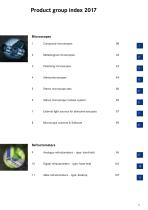
5 Stereo microscope sets 6 Stereo microscope modular system 7 External light sources for stereomicroscopes 8 Microscope cameras & Software Refractometers 9 Analogue refractometers - type: hand-held 10 Digital refractometers - type: hand-held 11 Abbe refractometers - type: desktop
Open the catalog to page 3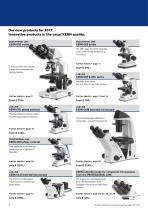
Our new products for 2017: Innovative products in the usual KERN quality: EDUCATIONAL LINE EDUCATIONAL LINE KERN OBE series Our OBE range has been expanded with further model variants (e.g. trinocular). The new school microscope. The perfect companion for biology lessons Further details ▸ page 11 KERN OBF & OBL series Available from today: Our Lab Line in trinocular version Further details ▸ page 9 Further details ▸ page 14 and 16 KERN OBL phase contrast Phase contrast procedure made easy through powerful features KERN OCM Inverted microscope The inverted biological laboratory microscope – also...
Open the catalog to page 4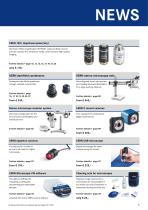
KERN 100× objectives (water/dry) Generate 1000x magnification WITHOUT using oil. Water and air are then used as the immersion media, which ensures high-quality imaging. KERN darkfield condensers KERN stereo microscope sets Professional darkfield application through cardioid construction Preconfigured stereo microscope set including stand and illumination for a large working distance Further details ▸ page 80 Stereo microscope modular system KERN C-mount cameras Universal configuration for the very best level of flexibility and individual work Your assistant for professional digital observations...
Open the catalog to page 5
Compound microscopes Compound, Phase contrast, Digital, Fluorescence and Inverted icroscopes m Metallurgical microscopes Polarising microscopes Stereo, Stereo-Zoom, Coaxial and Gem microscopes Stereo microscope sets Stereo microscope modular system External light sources for stereomicroscopes Ring illumination and cold light sources Microscope cameras & Software Daniel Junger Manager KERN Optics Tel. +49 [0] 7433 9933 - 155 Fax +49 [0] 7433 9933 - 149 daniel.junger@ke
Open the catalog to page 7All KERN & SOHN catalogs and technical brochures
 Measuring Technology 2025
106 Pages
 BALANCES & TEST SERVICE_2025
236 Pages
 Microscopes & Refractometers 2025
114 Pages
Archived catalogs
 BALANCES & TEST SERVICE_2024
238 Pages
 Microscopes & Refractometers 2022
114 Pages
 MEDICAL SCALES 2023
66 Pages
 Balances & Test service 2022
218 Pages
 KERN Medical Scales 2014
58 Pages
 Measuring Technology 2017
66 Pages
 MEDICAL SCALES 2018
66 Pages
 MEDICAL SCALES
58 Pages
 BALANCES & TEST SERVICE_2021
226 Pages
 Microscopes & Refractometers
122 Pages
 Medical Scales 2017
58 Pages
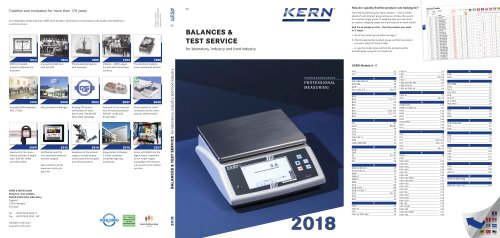 BALANCES & TEST SERVICE 2018
194 Pages
 Measuring Technology
58 Pages
 Balances & Test Service 2017
206 Pages
 Balances & Test Services_2015
194 Pages
 Sauter SB 12K0.1
1 Page
 ModelSD 10N70
1 Page
 Model SD 100N100
1 Page
 TB 1000-0.1 F
1 Page
 HBA 100-0
1 Page
 Catalogue Balances 2011
154 Pages
 Catalogue Medical scales 2011
58 Pages





- Visible imager
- CMOS camera module
- KERN & SOHN test bench
- Full-color camera system
- Indentation hardness tester
- USB camera module
- KERN & SOHN digital scale
- Pallet jack
- KERN & SOHN optical microscope
- Image processing camera module
- KERN & SOHN stainless steel scale
- KERN & SOHN platform scale
- Automated test bench
- Digital display hardness tester
- KERN & SOHN kilogram scale
- KERN & SOHN scale with LCD display
- KERN & SOHN thickness gauge