
- Catalogs
- Keppel Seghers
- Waste-to-Energy


Waste-to-Energy

Waste-to-Energy
Waste incineration plants have evolved to minimize environmental impact while recovering energy from waste. The Keppel Seghers Boiler Prism is a key component in this process, enhancing energy recovery and reducing corrosion risks.
The Boiler Prism addresses high-temperature corrosion, a major issue in waste-to-energy plants, by acting as a dynamic mixer at the transition from the combustion chamber to the boiler. It is water-cooled, refractory-lined, and integrated with the boiler's natural circulation system.
The Boiler Prism is suitable for medium to large waste-to-energy plants and can be installed in new or existing facilities. It divides the flue gas flow, allowing for uniform secondary air injection, which improves process control and efficiency.
The prism-shaped component contains collectors with nozzles for secondary air injection, ensuring optimal flue gas mixing and post-combustion. This results in a shorter burn-out time and improved temperature and oxygen distribution. A temperature measurement gadget helps maintain consistent flue gas temperatures.
- Optimized secondary air injection for uniform flue gas distribution.
- Customizable design using computational fluid dynamics (CFD).
- Proven technology against high-temperature corrosion.
- Increases plant throughput and operation time between cleanings.
- Available for retrofit installations.
Catalog excerpts

Waste-to-Energy Keppel Seghers BOILER PRISM Process Overview Waste incineration plants have evolved from pure incineration plants to state-of-the-art installations with minimal environmental impact. The interest is no longer exclusively on the thermal treatment of solid waste, but also the recovery of energy available in the waste. In the energy recovery process, the steam boiler transfers heat present in the flue gas to the water/steam circuit. When leaving the furnace the flue gas flows through the empty passages of the boiler, releasing heat so that the temperature at the inlet of the convection section (final superheater) is less than 650°C. In the convection section, the flue gas further releases its heat such that its temperature at the outlet of the boiler is 200°C or less. Meanwhile, the water inside the boiler pipes is converted into superheated steam. Principle Flue gas from waste incineration contains very aggressive components. The combination of these pollutants and the temperature result in a high risk for corrosion. Therefore, one of the major problems with boilers of waste-to-energy plants is high-temperature corrosion. Since its first installation in 1997, the Keppel Seghers Boiler Prism has proved to be an excellent primary measure against high-temperature corrosion in the empty boiler passages. The Boiler Prism is located at the transition of the combustion chamber to the first boiler passage and acts as a dynamic mixer due to the injection of secondary air. The device is water-cooled, refractorylined and integrated with the natural circulation system o
Open the catalog to page 1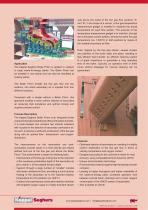
feeding chute first boiler gass Just above the outlet of the two gas flow sections “A” and “B”, in the shape of a venturi, a flue gas temperature measurement gadget is installed to measure the actual temperature for each flow section. The purpose of this temperature measurement gadget is to maintain, through the combustion control system, almost the same flue gas temperature (ca. 1.000°C) in both sections by means of the variable secondary air flow. ← Boiler Prism Combustion chamber combustion grate Application The Keppel Seghers Boiler Prism is applied in medium to large waste-to-energy plants. The...
Open the catalog to page 2All Keppel Seghers catalogs and technical brochures
 Desalination
2 Pages
 Water Reuse
2 Pages
 Keppel Seghers Dry Scrubber
2 Pages
 Energy Recovery Systems
2 Pages
 Pre-treatment System
2 Pages


- Sorting machine
- Filtration unit
- VOC-free liquid filtration unit
- Superheated water boiler
- Absorption filtration unit
- Small wastewater treatment plant
- Incinerator
- Waste incinerator
- Scrubber System
- Desalinator
- Chemical gas scrubber
- Waste sorting machine
- Membrane filtration unit
- Reverse osmosis desalinator
- Activated sludge sewage treatment plant
- Seawater desalinator
- Wastewater filtration unit
- Heat-recovery boiler
- Dry gas scrubber