
- Catalogs
- Kennametal
- Kennametal Stellite Alloys


Kennametal Stellite Alloys

Kennametal Stellite Alloys
- Nistelle™ Alloys: Known for corrosion resistance in aggressive environments.
- Stelcar™ Alloys: Composed of carbide particles and nickel- or cobalt-based powders, available in powder form.
- Jet Kote™ Powder: Used for thermal spraying, consisting of carbide-metal combinations or Stellite™ alloys.
- Delcrome™ Alloys: Iron-based, developed for abrasive wear resistance at lower temperatures.
- Stellite™ Alloys: Cobalt-based, offering excellent mechanical wear resistance and good corrosion resistance, suitable for high temperatures.
- Deloro™ Alloys: Nickel-based, suitable for spray/fuse or powder welding applications.
- Tribaloy™ Alloys: Developed for extreme wear and high temperatures with corrosive media.
Catalog excerpts
ALLOYS HARDFACING ALLOYS
Open the catalog to page 1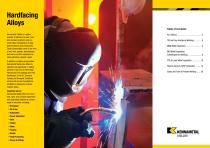
Kennametal Stellite is a global provider of solutions to wear, heat, and corrosion problems and is a world-class manufacturer of alloy-based materials and components. These consumables come in the form of rod, wire, powder, and electrode and can be custom engineered to meet individual customer needs. In addition to welding consumables, Kennametal Stellite also offers its expertise and experience in coating services in the form of HVOF (High-Velocity Oxy Fuel) coatings and weld hardfacings. In the UK, Germany, Canada, and Shanghai, hardfaced components can be manufactured complete to drawing by...
Open the catalog to page 2
Hardfacing Alloys At a Glance Hardfacing Alloys At a Glance Hardfacing Alloys Nistelle Alloys Stellite Alloys Deloro Alloys The cobalt-based Stellite™ alloys are our most wellknown and successful alloys, with the best “all-round” properties. They combine excellent mechanical wear resistance, especially at high temperatures, with very good corrosion resistance. The Stellite™ alloys are mostly cobalt based with additions of Cr, C, W, and/or Mo. They are resistant to cavitation, corrosion, erosion, abrasion, and galling. The lower carbon alloys are generally recommended for cavitation, sliding wear,...
Open the catalog to page 3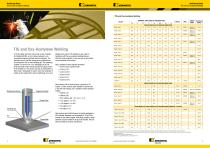
Hardfacing Alloys TIG and Oxy-Acetylene Welding TIG and Oxy-Acetylene Welding ■ TIG and Oxy-Acetylene Welding In TIG (Tungsten Inert Gas), also known as Gas Tungsten Arc Welding (GTAW), an arc is drawn between a nonconsumable tungsten electrode and the workpiece. The electrode, the arc, and the weld-pool are protected from the atmosphere with an inert shielding gas. The hardfacing material is in the form of a rod. Advantages of the TIG process include simple manual operation and good control of the welding arc. The process can also be mechanised, in which case a manipulator is used to move the...
Open the catalog to page 4
Hardfacing Alloys Manual Metal Arc Weld Deposition KENNAMETAL KENNAMETAL Hardfacing Alloys Manual Metal Arc Weld Deposition Manual Metal Arc (MMA) Weld Deposition In this process, an arc is drawn between a coated consumable electrode and the workpiece. The metallic core is melted by the arc and is transferred to the weld pool as molten droplets. The electrode coating also melts to form a gas shield around the arc and the weld pool as well as a slag on the surface of the weld pool, thus protecting the cooling weld-pool from the atmosphere. The slag must be removed after each layer. MMA welding...
Open the catalog to page 5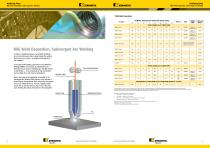
Hardfacing Alloys MIG Weld Deposition, Submerged Arc Welding Hardfacing Alloys MIG Weld Deposition, Submerged Arc Welding Hardfacing Wire MIG Weld Deposition, Submerged Arc Welding In these arc welding processes, consumable hardfacing wire is fed continuously from a spool through the welding torch into the arc, where it is melted and transferred to the workpiece. In the case of MIG welding, also known as Gas Metal Arc Welding (GMAW), the weld pool is protected from the atmosphere by a stream of shielding gas. The MIG process is very flexible — it can be partially or fully mechanised and is suitable...
Open the catalog to page 6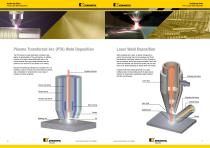
Hardfacing Alloys PTA & Laser Weld Deposition Hardfacing Alloys PTA & Laser Weld Deposition Plasma Transferred Arc (PTA) Weld Deposition Laser Weld Deposition The PTA process is easily automated, providing a high degree of reproducibility of the weld overlays. In addition, because of the highly concentrated heat source, this process benefits from high powder utilization and can achieve a very low level of iron dilution in the overlay. When overlaying with a laser, an optical arrangement is used to focus the laser beam on the workpiece and heat it. Simultaneously, hardfacing material in the form...
Open the catalog to page 7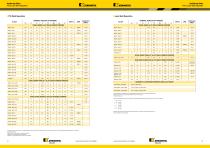
Hardfacing Alloys PTA & Laser Weld Deposition Hardfacing Alloys PTA & Laser Weld Deposition PTA Weld Deposition ALLOY Laser Weld Deposition NOMINAL ANALYSIS OF POWDER1 W COBALT-BASED TRIBALOY™ ALLOYS (GAS-ATOMIZED POWDERS) Tribaloy™ alloy T-400 NICKEL-BASED SUPERALLOYS (GAS-ATOMIZED POWDERS) Nistelle™ alloy “Super C” IRON-BASED HARDFACING ALLOYS (GAS-ATOMIZED POWDERS) Depends on 27 — 2.9 — — Bal. <1.0 0.5%Mn — treatment heat CARBIDES IN A CORROSION-RESISTANT HARD ALLOY MATRIX Super Stelcar™ alloy 9365 Super Stelcar™ alloy 50 plus WC in a Deloro™ 50 alloy matrix Super Stelcar™ alloy 60 plus WC...
Open the catalog to page 8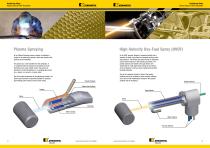
Hardfacing Alloys Plasma Spray & HVOF Deposition Hardfacing Alloys Plasma Spray & HVOF Deposition Plasma Spraying High-Velocity Oxy-Fuel Spray (HVOF) In the Plasma Spraying process, powder is softened or melted in the plasma gas stream, which also transfers the particles to the workpiece. In the HVOF process, powder is introduced axially into a chamber in which a gas flame is constantly burning under high pressure. The exhaust gas exits through an expansion nozzle which produces a high-velocity gas stream. The powder particles are heated in this gas stream and transferred by it with high kinetic...
Open the catalog to page 9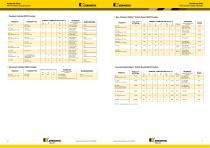
KENNAMETAL KENNAMETAL Hardfacing Alloys HVOF & Plasma Spray Deposition ■ Tungsten Carbide HVOF Powders ■ Gas-Atomized Stellite™ Cobalt-Based HVOF Powders ■ Chromium Carbide HVOF Powders ■ Gas-Atomized Tribaloy™ Cobalt-Based HVOF Powders *ULTIMET™ is a registered trademark of Haynes International. KKkennametal STELLITE www.kennametal.com/stellite www.kennametal.com/stellite KK KENNAMETAL STELLITE
Open the catalog to page 10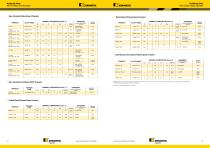
Hardfacing Alloys HVOF & Plasma Spray Deposition KENNAMETAL KENNAMETAL Hardfacing Alloys HVOF & Plasma Spray Deposition ■ Gas-Atomized Nickel-Based Powders ■ Nickel-Based Plasma Spray Powders PRODUCT ■ Cobalt Based Plasma Spray Powders PRODUCT KKkennametal STELLITE
Open the catalog to page 11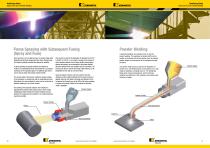
Hardfacing Alloys Spray and Fuse & Powder Welding Hardfacing Alloys Spray and Fuse & Powder Welding Flame Spraying with Subsequent Fusing (Spray and Fuse) Spray and fuse is a two-stage process, the powder alloy being deposited first by flame spraying and then fused. During fusing, the deposit is partially remelted and allowed to resolidify. In flame-spraying, the powder particles are softened or melted in an oxyacetylene flame and transferred to a prepared workpiece by the expanding gases. An additional gas stream can be used to assist with powder particle transfer. The second stage of the process,...
Open the catalog to page 12All Kennametal catalogs and technical brochures
 Underground Mining
182 Pages
 Conforma Clad X2™
2 Pages
 Oilfield Radial Bearings
2 Pages
 ROCTEC ecoline
1 Page
Archived catalogs
 INNOVATIONS 2020
84 Pages
 KMT_Wear Solutions_Brochure
12 Pages
 Composite Rods
1 Page
 Alloys Brochure Direct
28 Pages
 General Conveyance Equipment
4 Pages
 Mill Roll Brochure
8 Pages
 Snowplow Blades
1 Page
 KenCast Wear Protection
20 Pages
 Solid Carbide Drills
112 Pages
 Modular Drills
62 Pages
 Combination Tools
28 Pages
 Indexable Drills
108 Pages
 Hole Finishing
214 Pages
 Taps
Taps194 Pages
 Solid End Milling
118 Pages
 Face Mills
138 Pages
 Shoulder Mills
96 Pages
 Slotting Cutters
56 Pages
 Copy Mills
118 Pages
 Thread Mills
20 Pages
 ISO / ANSI Inserts
132 Pages
 PCD / PCBN Inserts
66 Pages
 O.D. / I.D. Toolholders
162 Pages
 Threading
108 Pages
 Holemaking Taps (metric)
118 Pages
 Surface Mining Catalog
42 Pages
 Abrasive Blast Nozzles Catalog
60 Pages
 Railroad Brochure
24 Pages
 Master Catalog 2013 Complete - metric
2122 Pages
 KMT KBH20 metric
18 Pages
 Kennametal Innovations 2014
630 Pages
 INNOVATIONS CATALOGUE 2015
260 Pages
 Tooling Systems 2013 Catalog Sections
1576 Pages
 Specialty Carbide Catalog
16 Pages
 Milling grades
4 Pages
 Milling geometries quick
9 Pages
 Indexable Milling Index
8 Pages
 Tool Selection
3 Pages
 7690VA09
3 Pages
 EDM Blocks Brochure
8 Pages
 Twin-Screw
2 Pages
 Cladding Formulas Oilfield
2 Pages
 Tooling Systems News 2018
60 Pages
 INNOVATIONS 2019
156 Pages
 Road Rehabilitation • Road King
24 Pages
 Grader Blades
40 Pages
 Grinder Tips
16 Pages
 CB11 Stack-On
2 Pages




- Kennametal milling cutter
- Chuck
- Kennametal solid milling cutter
- Kennametal drill bit
- Steel milling cutter
- Milling tool with replaceable insert
- Kennametal solid drill bit
- Kennametal metal milling cutter
- Kennametal clamping milling cutter
- Kennametal milling cutter with cylindrical shank
- Grade
- Kennametal end mill
- Cast iron milling cutter
- Kennametal face milling cutter
- Kennametal shell-end milling cutter
- Solid carbide milling cutter
- Kennametal indexable insert milling cutter
- Ball nose milling cutter
- Multi-purpose drilling tool
- Kennametal cutting milling cutter