
- Catalogs
- Kennametal
- INNOVATIONS 2019


INNOVATIONS 2019

INNOVATIONS 2019
- Through Coolant Capability: Many tools are designed with through coolant systems to direct coolant precisely to the cutting zone, enhancing tool life and process safety.
- Vibration-Free Design: Tools are engineered to minimize vibration, ensuring precision and stability during machining operations.
- Versatile Applications: The catalog covers a wide range of applications, including turning, facing, profiling, and cut-off operations.
- HARVI ULTRA 8X Tools: The document lists various models of HARVI ULTRA 8X tools, including helical mills and shell mounts, with specifications such as diameter, length, and maximum RPM.
- Inserts: Details on insert types, including dimensions and recommended applications, are provided. The inserts are categorized by material group and machining type (light, general, heavy).
- Starting Speeds and Feeds: Recommended starting speeds (SFM) and feeds (IPT) are provided for different material groups and machining conditions. The document emphasizes using general-purpose values as starting points and adjusting as necessary.
- Material Groups: The document categorizes materials into groups (P, M, K, N, S, H) and provides specific recommendations for each group regarding tool selection and machining parameters.
- Tool Selection Guide: A guide for selecting hydraulic chucks and adapters based on application requirements and connection sizes is included.
- Speed and Feed Tables: Tables provide detailed speed and feed recommendations for various materials and tool geometries, highlighting first-choice starting speeds in bold.
- Product Specifications: Tables list product numbers, dimensions, and weights for various HARVI ULTRA 8X tools and adapters.
- Maximum RPM: Users are advised not to exceed the maximum RPM specified for each tool to ensure safety and performance.
- Insert Compatibility: Specific inserts are compatible with certain tool models, and modifications may be required for some configurations.
Catalog excerpts

kennametal.com KENNAMETAL kennametal.com KENNAMETAL
Open the catalog to page 1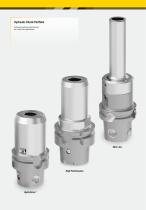
Hydraulic Chuck Portfolio Achieving optimum performance for round-tool applications. Slim Line High Performance
Open the catalog to page 2
Get Fast and Reliable Answers to Your Toughest Problems Our CAS Team is the metalworking industry's leading help desk resource for tooling application solutions and problem resolution. Easy Access to Proven Metalworking Expertise! Kennametal Application Engineers assist customers and engineering groups throughout the world with expert tool selection and application recommendations for the entire range of Kennametal tooling. Numbers shown only serve the originating country listed.
Open the catalog to page 4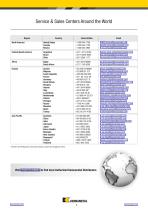
'Vietnam and Philippines individuals should contact the Singapore office. Visit kennametal.com to find local Authorized Kennametal Distributors.
Open the catalog to page 5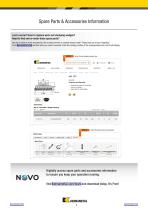
Lost a screw? Have to replace worn-out clamping wedges? Need to find and re-order those spare parts? Are you in need of some accessories, like a torque wrench or coolant shower plate? These tools are at your fingertips! Go to kennametal.com and find what you need in seconds. Enter the catalog number of the corresponding tool, and it will display. Digitally access spare parts and accessories information to ensure you keep your operation running. Visit kennametal.com/novo and download today. It’s Free!KENNAMETAU kennametal.com
Open the catalog to page 6
Can’t find your paper copy of our catalog anymore? No worries. Go to catalogs.kennametal.com to see what’s out there. Search for what you need, watch a video, and share pages with others, all from one site! Go to catalogs.kennametal.com, and if you want to check it out on your mobile device, just download the FREE app for iOS or Android™. m Search for what you need Watch videos Share with others Heading: KNS-Kennametal Narrow Slotting ... KENNAMETAL COM KENNAMETAL COM 36 INDEXABLE Ml LUNG KNSTHE DOUBLE v’‘.Score* 29 ' TOUGHNESS COATING .-Score: 47 Check out our new catalog app. Available in the...
Open the catalog to page 7
Turning N^VO Materials M Applications Boring Back Boring Chamfering kennametal.com/Vibration-FreeBoringBars Coupled with our bolt-on heads, the Vibration-Free boring bars provide stability and rigidity when boring at extended overhangs up to 10 x D. Vibration-Free boring bars are a plug-and-play solution designed to work out of the box with no manual adjusting required or possible. The internal dampening package is designed to provide process stability by increasing the stiffness of the bar and dampening out chatter. These Vibration-Free boring bars utilize a new portfolio of bolt-on heads that...
Open the catalog to page 8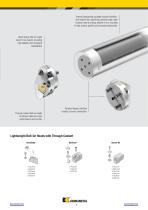
Internal dampening package ensures vibrationand chatter-free machining, allowing high metal removal rates and large depths-of-cut, resulting in high surface quality and increased productivity. Short design bolt-on heads result in low weight, providing high stability and consistent repeatability. Through coolant bolt-on heads to achieve optimum insert performance and tool life. Serrated design interface creates a secure connection. Lightweight Bolt-On Heads with Through Coolant Kenclamp™ H-DCLN 95° H-DDUN 93° H-DTFN 90° H-DVUN 93° H-DWLN 95° H-PCLN 95° H-PDUN 93° H-PTFN 90° H-SCLC 95° H-SDPC 62.5°...
Open the catalog to page 9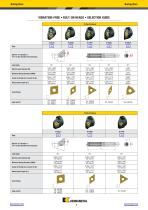
Boring Bars Boring Bars VIBRATION-FREE • BOLT-ON HEADS • SELECTION GUIDE D-Style Clamping H-DCLN Page Bolt-On “D” diameter = “D1” on the vibration-free boring bar Lead Angle Bolt-On Head Diameter [D] Minimum Boring Diameter [DMIN] Center of Boring Bar to Insert Tip [F] Boring Head Length [L1] Insert Shape Gage Inserts P-Style Clamping Bolt-On Head Diameter [D] Minimum Boring Diameter [DMIN] Center of Boring Bar to Insert Tip [F] Boring Head Length [L1]
Open the catalog to page 10
Boring Bars VIBRATION-FREE • BOLT-ON HEADS • SELECTION GUIDE Each character in our catalog number signifies a specific trait of that product. Use the following key columns and corresponding images to easily identify which attributes apply. KENNAMETAU kennametal.com kennametal.com
Open the catalog to page 11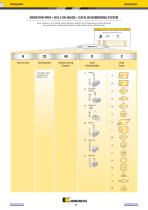
Boring Bars Boring Bars VIBRATION-FREE • BOLT-ON HEADS • CATALOG NUMBERING SYSTEM Each character in our catalog number signifies a specific trait of that product. Use the following key columns and corresponding images to easily identify which attributes apply. Boring Bars Boring Bars VIBRATION FREE • BOLT-ON HEADS • KENCLAMP™ • DCLN 95° Detail Detail catalogue number Bolt-On Head Head Diameter Minimum Boring Diameter Insert Holding Method Insert Shape A two-digit number indicates the bar diameter in mm.
Open the catalog to page 12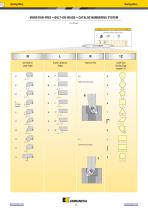
Boring Bars Boring Bars VIBRATION-FREE • BOLT-ON HEADS • CATALOG NUMBERING SYSTEM (continued) Boring Bars Boring Bars VIBRATION FREE • BOLT-ON HEADS • KENCLAMP™ • DCLN 95° Detail Detail catalogue number Bar Style or Lead Angle Insert Clearance Angle Insert Size Cutting Edge Length L10
Open the catalog to page 13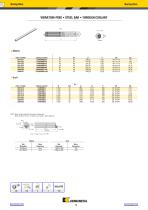
Boring Bars Boring Bars
Open the catalog to page 14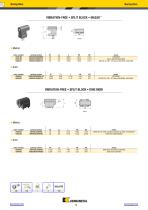
Boring Bars Boring Bars VIBRATION-FREE • SPLIT BLOCK • MAZAK™
Open the catalog to page 15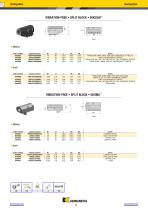
Boring Bars Boring Bars Boring Bars Boring Bars VIBRATION-FREE • SPLIT BLOCK • DOOSAN™ II "
Open the catalog to page 16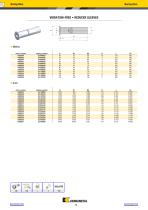
Boring Bars Boring Bars ■ Metric order number
Open the catalog to page 17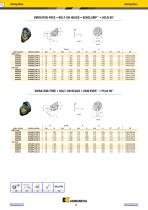
Boring Bars VIBRATION-FREE • BOLT-ON HEADS • KENCLAMP™ • DCLN 95° order number catalog number left hand
Open the catalog to page 18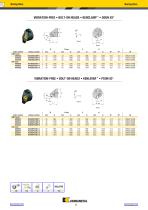
Boring Bars VIBRATION-FREE • BOLT-ON HEADS • KENCLAMP™ • DDUN 93°
Open the catalog to page 19
Boring Bars VIBRATION-FREE • BOLT-ON HEADS • KENCLAMP™ • DTFN 90° order number_catalog number
Open the catalog to page 20
Boring Bars VIBRATION-FREE • BOLT-ON HEADS • KENCLAMP™ • DVUN 93° order number catalog number left hand VIBRATION-FREE • BOLT-ON HEADS • KENCLAMP • DWLN 95° order number right hand 6550652 left hand 6550653 catalog number
Open the catalog to page 21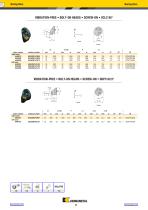
Boring Bars VIBRATION-FREE • BOLT-ON HEADS • SCREW-ON • SCLC 95° order number catalog number order number right hand 6549413 left hand 6549412 catalog number
Open the catalog to page 22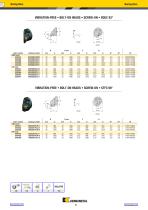
Boring Bars Boring Bars VIBRATION-FREE • BOLT-ON HEADS • SCREW-ON • SDUC 93° Boring Bars Boring Bars order number catalog number left hand
Open the catalog to page 23All Kennametal catalogs and technical brochures
 Underground Mining
182 Pages
 Conforma Clad X2™
2 Pages
 Oilfield Radial Bearings
2 Pages
 ROCTEC ecoline
1 Page

Archived catalogs
 INNOVATIONS 2020
84 Pages
 KMT_Wear Solutions_Brochure
12 Pages
 Composite Rods
1 Page
 Kennametal Stellite Alloys
15 Pages
 Alloys Brochure Direct
28 Pages
 General Conveyance Equipment
4 Pages
 Mill Roll Brochure
8 Pages
 Snowplow Blades
1 Page
 KenCast Wear Protection
20 Pages
 Solid Carbide Drills
112 Pages
 Modular Drills
62 Pages
 Combination Tools
28 Pages
 Indexable Drills
108 Pages
 Hole Finishing
214 Pages
 Taps
Taps194 Pages
 Solid End Milling
118 Pages
 Face Mills
138 Pages
 Shoulder Mills
96 Pages
 Slotting Cutters
56 Pages
 Copy Mills
118 Pages
 Thread Mills
20 Pages
 ISO / ANSI Inserts
132 Pages
 PCD / PCBN Inserts
66 Pages
 O.D. / I.D. Toolholders
162 Pages
 Threading
108 Pages
 Holemaking Taps (metric)
118 Pages
 Surface Mining Catalog
42 Pages
 Abrasive Blast Nozzles Catalog
60 Pages
 Railroad Brochure
24 Pages
 Master Catalog 2013 Complete - metric
2122 Pages
 KMT KBH20 metric
18 Pages
 Kennametal Innovations 2014
630 Pages
 INNOVATIONS CATALOGUE 2015
260 Pages
 Tooling Systems 2013 Catalog Sections
1576 Pages
 Specialty Carbide Catalog
16 Pages
 Milling grades
4 Pages
 Milling geometries quick
9 Pages
 Indexable Milling Index
8 Pages
 Tool Selection
3 Pages
 7690VA09
3 Pages
 EDM Blocks Brochure
8 Pages
 Twin-Screw
2 Pages
 Cladding Formulas Oilfield
2 Pages
 Tooling Systems News 2018
60 Pages
 Road Rehabilitation • Road King
24 Pages
 Grader Blades
40 Pages
 Grinder Tips
16 Pages
 CB11 Stack-On
2 Pages




- Kennametal solid milling cutter
- Kennametal drill bit
- Steel milling cutter
- Milling tool with replaceable insert
- Kennametal solid drill bit
- Kennametal metal milling cutter
- Kennametal clamping milling cutter
- Kennametal milling cutter with cylindrical shank
- Grade
- Cast iron milling cutter
- Kennametal face milling cutter
- Kennametal shell-end milling cutter
- Solid carbide milling cutter
- Kennametal indexable insert milling cutter
- Ball nose milling cutter
- Multi-purpose drilling tool
- Kennametal cutting milling cutter