
- Catalogs
- Keller Pyrometer Systems
- TR Panorama-Pyrometer_201508_de

TR Panorama-Pyrometer_201508_de

TR Panorama-Pyrometer_201508_de
Pyrometers measure thermal radiation to determine temperature. Traditional pyrometers have a round field of view, but new designs offer a rectangular measurement area, improving reliability for moving objects. This innovation addresses challenges like oscillating objects that don't fully fill the measurement area.
Design and Operation
The panorama pyrometer uses a high-precision aperture and sensor system to create a rectangular measurement area without special lenses. This design ensures accurate alignment and temperature readings, even for small or moving targets.
Optical Options and Alignment
The modular design allows for various lens configurations, enhancing flexibility in measurement distance and area size. The rectangular field of view simplifies alignment, especially for portable devices, improving operational reliability.
Applications
Panorama pyrometers are ideal for processes where the position and size of hot objects change, such as in tube production or glass bottle manufacturing. They offer reliable measurements even when the target moves or changes shape.
Limitations
The two-colour measuring principle limits applications to temperatures above 600°C. Factors like emissivity and partial illumination affect measurement accuracy. The device requires at least 25% field of view coverage for reliable readings.
Conclusion
For high-temperature processes with challenging alignment conditions, panorama pyrometers provide superior reliability and ease of use compared to traditional models, justifying their higher cost.
Pyrometer Models
Available in stationary (CellaTemp PA) and portable (CellaTemp PT) versions, these pyrometers feature through-the-lens sighting and optional video monitoring for precise alignment and measurement.
Catalog excerpts
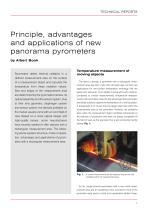
TECHNICAL REPORTS Principle, advantages and applications of new panorama pyrometers by Albert Book Pyrometers detect thermal radiation in a Temperature measurement of moving objects defined measurement area on the surface of a measurement object and calculate the temperature from these radiation values. Size and shape of the measurement area are determined by the pyrometer's lenses, its The idea to develop a pyrometer with a rectangular measurement area was born more than 30 years ago, as there are applications for non-contact temperature metrology that are easier and, above all, more reliably to solve with such a feature. Compared to contact measurements, temperature measure- optical assembly and the sensor system. Due ments with pyrometers have the big advantage that pyrometers to their lens geometry, diaphragm system are ideally suited to capture the temperature of a moving object. and sensor system, the devices available on the market usually come with a round field of A prerequisite is of course that the target object lies within the measurement area of the pyrometer. However, the problems arise when the measurement object oscillates transversely to view. Based on a novel optical design and the direction of production and does not always completely fill high-quality lenses, some manufacturers the field of view, as the example from a wire production facility have recently started to offer devices with a rectangular measurement area. The following article explains structure, mode of operation, advantages and applications of pyrometers with a rectangular measurement area. Fig. 1 correct measurement can be made as long as the wire A oscillates within the measurement area. So far, single-channel pyrometers with a very small measurement area and an oscillating mirror mounted in front of the pyrometer were used to solve such application-related meas-
Open the catalog to page 1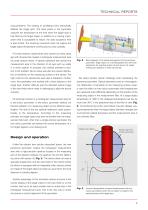
TECHNICAL REPORTS uring problems. The rotating or oscillating mirror periodically deflects the target spot. The peak picker in the pyrometer captures the temperature at the time when the target spot is fully filled by the target object. In addition to a moving mechanism that is susceptible to failure, the data acquisition time is also limited. The scanning movement does not capture the target object temperature continuously but only cyclically. For these reasons, experiments were carried out many years ago with devices that created a rectangular measurement area by purely optical means. A special...
Open the catalog to page 2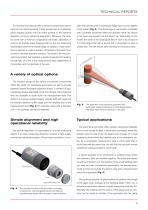
TECHNICAL REPORTS To minimize this physical effect, precision lenses were devel- ident that devices with a rectangular target spot can be aligned oped for the optical systems. These lenses have a consistently much easier (Fig. 5). This advantage is particularly noticeable good imaging quality over the entire surface of the entrance with a portable pyrometer when the operator holds the device aperture (minimum spherical aberration). Moreover, the lens- in his hand and targets it at the object, as, depending on the es come with a minimum longitudinal chromatic aberration to model, the width of...
Open the catalog to page 3
TECHNICAL REPORTS Fig. 6 Reliable temperature measurement even when the position of the welding seam is varying. Fig. 7 portable panorama pyrometer measures the temperature A during the pouring process. transparent glass. This influence is greatly reduced by the ratio measuring method of the panorama pyrometer. Due to the two-colour measuring principle the range of appliWires in wire drawing plants are undergoing a subsequent cations is limited to temperatures above 600 °C. Another limit heat treatment as the wire runs with high speed through an In- is given by the degree of partial illumination...
Open the catalog to page 4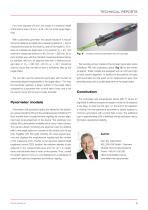
TECHNICAL REPORTS For a wire diameter of 5 mm, this results in a maximum width of the field of view of 5 mm ÷ 0.25 = 20 mm at the range beginning. With a panorama pyrometer, the optical resolution is indicated by the distance-to-target ratio (measuring distance ÷ size of measurement area) for the width DW and for the height DH. In relation to a distance-to-target ratio of, for example, DW = 40 : 1 the maximum measuring distance is 40 x 20 mm = 800 mm. Or, to Fig. 8 Compact panorama pyrometer with LED spot light. put it another way: with the intended measuring distance being, for example, 500...
Open the catalog to page 5All Keller Pyrometer Systems catalogs and technical brochures
 BR CellaTemp PX_ID2007_202312_en
20 Pages
 BR CellaTemp PA_ID2004_202403_en
20 Pages
 KITS App - Digital Service
6 Pages
 AN_Bar mill_ID2533_202202_en
4 Pages
 AN Furnace_ID2529_202201_en
4 Pages
 Software CellaView
8 Pages
 BR CellaPort PT_201905_en
16 Pages
 AN CellaInduction_201604_en
4 Pages
 AN CellaCast_201811_en
8 Pages
 TR Emissivity_201604_en
4 Pages
 Flyer IO-Link_201810_en
2 Pages
 BR Mikro PV 11_201512_en
4 Pages
 TR IO-Link_201610_en
7 Pages
 AN Metal sheets_201608_en
4 Pages




- Temperature probe
- Automation software solution
- Analysis software solution
- Keller ITS measuring system
- Real-time software
- Windows software
- Control software
- Keller ITS digital thermometer
- Monitoring software solution
- Measurement software
- Keller ITS industrial thermometer
- Waterproof temperature sensor
- Keller ITS °C thermometer
- Stainless steel temperature transducer
- Keller ITS infrared thermometer
- Keller ITS waterproof thermometer
- Keller ITS stainless steel thermometer
- Keller ITS portable thermometer
- Automatic measurement system
- Keller ITS optical measuring system