
- Catalogs
- Keller Pyrometer Systems
- TR Optical Influences_201609_en

TR Optical Influences_201609_en

TR Optical Influences_201609_en
Non-contact temperature measurements rely on optical procedures, where the optical properties of pyrometers significantly affect measurement accuracy. This report discusses optical aberrations and specifications of pyrometer lenses, providing guidance on assessing lens quality.
Optical Aberrations
Spherical Aberration: Light rays near the lens edge refract differently than those near the center, causing image blur. This can be mitigated by combining multiple lens surfaces.
Chromatic Aberration: Different wavelengths focus at different points, creating colored rings around images. This can be reduced using achromat or apochromat lenses that correct for multiple wavelengths.
Optical Specifications of Pyrometers
Pyrometers specify either the target spot size or the distance ratio. The target spot size relates to a percentage of maximum energy received, typically 90%, 95%, or 98%. Manufacturers may not account for lens tolerances, affecting accuracy.
Effects of Optical Errors
Pyrometers with focusable or fixed systems require correct focal adjustment for accurate measurements. Errors arise from incorrect focal adjustments, especially with small targets. The Size-of-Source Effect (SSE) causes errors due to optical aberrations and stray light, which can be minimized by correcting aberrations and using non-reflective components.
Checking Imaging Qualities
To verify pyrometer accuracy, the radiation surface should be larger than the measurement area. Adjusting the iris diaphragm and comparing results with manufacturer data sheets can reveal lens errors.
Conclusion
When selecting pyrometers, optical characteristics should be scrutinized alongside measurement parameters. Users should verify specifications and lens quality to ensure accurate readings.
Author
Dipl.-Ing. Albert Book, KELLER HCW GmbH, Germany. Contact: [email protected]
Catalog excerpts
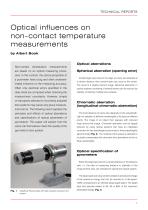
TECHNICAL REPORTS Optical influences on non-contact temperature measurements by Albert Book are based on an optical measuring procedure. In this context, the optical properties of a pyrometer have a big and often underestimated influence on the measuring accuracy. Often only electrical errors specified in the data sheet are compared when checking the Optical aberrations Spherical aberration (opening error) Incident light rays close to the edge of a lens are refracted at a shorter distance than incident light rays close to the centre. The result is a slightly blurred image. Spherical aberration in optical systems consisting of several lenses can be reduced by suitably combining multiple lens surfaces. measurement uncertainty. However, simple or improperly selected or incorrectly adjusted lens systems may cause very grave measurement errors. The following report explains the Chromatic aberration (longitudinal-chromatic-aberration) principles and effects of optical aberrations The focal distance of a lens also depends on the wavelength. and specifications of optical parameters of Light or radiation of different wavelengths is focused at different pyrometers. This paper will explain how the users can themselves check the quality of the pyrometer‘s lens system. points. The image of an object then appears with coloured rings around the image. Chromatic aberration can be largely reduced by using optical systems that have an integrated correction for two wavelengths (achromat) or three wavelengths (apochromat) (Fig. 2). The material of the lenses is selected to mutually compensates the chromatic lens aberrations at two or three wavelengths. Optical specification of pyrometers Either the target spot size for a certain distance or the distance ratio, i.e. the ratio of measuring distance to diameter of the measurement area, are indicated to specify the optical system. The target spot size of pyrometers relates to a fixed percentage of the maximum energy that can be received in a half-space. 100% corresponds to an infinitely large target object. The target spot size typically relates to 90, 95 or 98% of the maximum Fig. 1 CellaTemp PA pyrometer with high-resolution precision lens system.
Open the catalog to page 1
TECHNICAL REPORTS Deviation of focal distance [%] 4.00 Individual lens, not colour-corrected, made of crown glass Achromat colour-corrected for the visible range Achromat colour-corrected for the visible and infrared range Focal deviation due to longitudinal chromatic aberration for uncorrected and colour-corrected lenses. The measurement area increases when the proportion of radia- ment area in their data sheets, being fully aware that another tion relates to 95 % instead of 90 %. Therefore, data for the size definition would result in a significantly higher value. In addition. of the measurement...
Open the catalog to page 2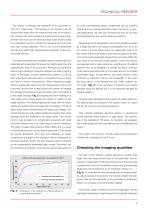
TECHNICAL REPORTS This affects in particular the calibration of the pyrometer in by using non-reflecting optical components and by avoiding front of a “black body”. The opening of the furnace must be stray light or by avoiding reflections within the device. In prac- several times larger than the measurement area of the pyrom- tical applications, the user can minimise this error by an exact eter. Devices with basic-quality lens systems and a large meas- focal adjustment to the correct measuring distance. urement area must use an extremely large-scale radiation body as a calibration source to reduce...
Open the catalog to page 3
TECHNICAL REPORTS Making the test with pyrometers with spot light, video camera or through-the-lens-sighting reveals at the same time whether the distance of focal point to target area and from the field of view is identical and whether the target marker actually matches with the position and size of the measurement area of the pyrometer. Radiation source Iris diaphragm Fig. 6 Arrangement to check optical properties. It is recommendable to especially check and compare the value. The aperture diameter of the iris diaphragm then corre- optical characteristics and not only the measurement param-...
Open the catalog to page 4All Keller Pyrometer Systems catalogs and technical brochures
 BR CellaTemp PX_ID2007_202608_en
20 Pages
 BR CellaTemp PA_ID2004_202606_en
20 Pages
 KITS App - Digital Service
6 Pages
 AN_Bar mill_ID2533_202202_en
4 Pages
 AN Furnace_ID2529_202201_en
4 Pages
 Software CellaView
8 Pages
 BR CellaPort PT_ID2002_202609_en
16 Pages
 AN CellaInduction_201604_en
4 Pages
 AN CellaCast_201811_en
8 Pages
 TR Emissivity_201604_en
4 Pages
 Flyer IO-Link_201810_en
2 Pages
 TR IO-Link_201610_en
7 Pages
 AN Metal sheets_201608_en
4 Pages






- Temperature probe
- Automation software solution
- Analysis software solution
- Keller ITS measuring system
- Real-time software
- Windows software
- Control software
- Keller ITS digital thermometer
- Monitoring software solution
- Measurement software
- Keller ITS industrial thermometer
- Waterproof temperature sensor
- Keller ITS °C thermometer
- Stainless steel temperature transducer
- Keller ITS infrared thermometer
- Keller ITS waterproof thermometer
- Keller ITS stainless steel thermometer
- Keller ITS portable thermometer
- Automatic measurement system
- Keller ITS optical measuring system