
- Catalogs
- Keller Pyrometer Systems
- TR Metrological Errors_201604_en

TR Metrological Errors_201604_en

TR Metrological Errors_201604_en
Non-contact temperature measurement, or pyrometry, is often met with skepticism despite its documented accuracy. Proper instrument selection and consideration of material properties and ambient influences are crucial for reliable results. This report identifies common sources of error in pyrometry and provides strategies to minimize them.
Pyrometers measure thermal radiation, which depends on the object's emissivity. Incorrect emissivity settings can lead to significant errors, especially at longer wavelengths or higher temperatures. For metallic surfaces with variable emissivities, measuring at shorter wavelengths reduces error potential.
The total infrared energy detected by a pyrometer includes emitted, transmitted, and reflected radiation. Errors from background radiation are minimized with higher target emissivity and when the target is much hotter than the ambient temperature. Proper alignment and blocking filters can reduce errors from extraneous radiation sources.
Optical aberrations and stray light can introduce errors. High-grade lenses and focusable optics help minimize these errors. The "Size of Source Effect" is reduced when the pyrometer is focused correctly and the target is larger than the measurement spot.
Obstructions like dust or smoke can affect measurements by reflecting or absorbing emitted energy. Regular cleaning and air purge accessories can mitigate these effects. Some pyrometers feature contamination detection to alert users when cleaning is needed.
These devices measure temperature based on the ratio of radiant flux at two spectral ranges, making them less sensitive to emissivity fluctuations. However, if emissivities differ at both wavelengths, errors can increase. Two-colour pyrometers are advantageous in environments with transmissivity loss due to dust or smoke.
Proper understanding and handling of pyrometers, including considerations of emissivity, optical alignment, and environmental conditions, are essential for accurate temperature measurements. Innovative pyrometers offer flexibility in measurement methods to enhance accuracy.
Catalog excerpts

Metrological Errors in Non-contact Temperature Measurement Applications by Albert Book Practitioners of metrology are often skeptical of non-contact temperature measurement methods, also known as pyrometry. The technical data provided by pyrometer manufacturers, however, document that these instruments do indeed provide very accurate and precise temperature readings. Aside from the importance of selecting an instrument best suited to the particular application, it is crucial to allow for material specific properties and ambient influences in order to obtain a reliable result. Measuring errors can be avoided if pyrometers are used in a skilled manner. This article exposes the most common sources of error and explains how to minimize or prevent them. Emissivity Pyrometers measure the thermal radiation which an object emits. The amount of infrared energy which is radiated will depend on the material properties and surface characteristics of the object. This ability to radiate thermal energy is referred to as “emissivity” (e). For precise temperature measurement, the pyrometer must be adjusted for the measurand’s specific emissivity. Selecting an incorrect emissivity setting can result in considerable errors. The table (Fig. 1 demonstrates the temperature deviations (AT) when a pyrometer is incorrectly adjusted for 80% emissivity rather than the true 90% emissivity. This error increases when measuring at longer wavelengths or at higher temperatures. Therefore one should always chose a pyrometer which operates at the shortest possible wavelength but is still feasible for the temperature range of the application. Fig. 1 Measurement errors depending on wavelength and temperature at a 10% deviation in emissivity (e. . . = 0.8 and e , = 0.9) Instrument real Especially in the case of metallic surfaces whose emissivities are either extremely variable or uncertain, measuring at shorter wavelengths will greatly minimize the potential for error. The emissivities of metals tend to increase at shorter wavelengths, and at the same time, the likelihood of error - in the event the emissivity was misadjusted - will tend to decrease.
Open the catalog to page 1
TECHNICAL REPORTS Transmission loss Background and incident radiation In ideal conditions, the atmosphere between the pyrometer The displayed temperature reading will depend on the total and the target will be unobstructed. If gases or particles such as amount of infrared energy detected by the pyrometer’s sensor dust, vapour, smoke, or other media such as protective lenses (ΦΣ). As the equation below shows, the total incident radiation is or opaque materials are in the sensor’s sighting path, a portion the sum of the thermal energy emitted from the target plus extra- of the energy emitted from...
Open the catalog to page 2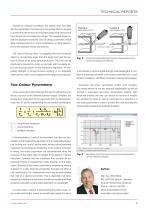
TECHNICAL REPORTS Caused by physical conditions, the optical error increases with the wavelength. Therefore, an even greater effort is required to correct the optical error for long-wave measuring devices and thus devices for low measuring ranges. The negative impact is, that the displayed measured value of cheap pyrometers, which allow measurements from room temperature, is highly dependent on the selected measuring distance. The „Size of Source Effect” is negligible when the measured object is considerably larger than the target spot and the surface is almost at the same temperature level....
Open the catalog to page 3All Keller Pyrometer Systems catalogs and technical brochures
 BR CellaTemp PX_ID2007_202312_en
20 Pages
 BR CellaTemp PA_ID2004_202403_en
20 Pages
 KITS App - Digital Service
6 Pages
 AN_Bar mill_ID2533_202202_en
4 Pages
 AN Furnace_ID2529_202201_en
4 Pages
 Software CellaView
8 Pages
 BR CellaPort PT_201905_en
16 Pages
 AN CellaInduction_201604_en
4 Pages
 AN CellaCast_201811_en
8 Pages
 TR Emissivity_201604_en
4 Pages
 Flyer IO-Link_201810_en
2 Pages
 BR Mikro PV 11_201512_en
4 Pages
 TR IO-Link_201610_en
7 Pages
 AN Metal sheets_201608_en
4 Pages




- Temperature probe
- Automation software solution
- Analysis software solution
- Keller ITS measuring system
- Real-time software
- Windows software
- Control software
- Keller ITS digital thermometer
- Monitoring software solution
- Keller ITS industrial thermometer
- Measurement software
- Waterproof temperature sensor
- Keller ITS °C thermometer
- Stainless steel temperature transducer
- Keller ITS infrared thermometer
- Keller ITS waterproof thermometer
- Keller ITS stainless steel thermometer
- Keller ITS portable thermometer
- Automatic measurement system
- Keller ITS optical measuring system