
- Catalogs
- Keller Pyrometer Systems
- TR Emissivity_201604_en

TR Emissivity_201604_en

TR Emissivity_201604_en
In non-contact temperature measurement, a pyrometer detects infrared radiation emitted by an object to calculate temperature based on Planck’s radiation law. Emissivity, a material's ability to emit absorbed thermal energy, significantly influences this measurement.
Definition of Emissivity
Emissivity is the ratio of infrared radiation emitted by an object to that emitted by a black body at the same temperature. It ranges from 0 to 1 and is influenced by material type and surface properties. Nonmetallic objects generally have high emissivity, while metals vary widely.
Factors Influencing Emissivity
Emissivity depends on material type, surface properties, and temperature. Metals have varying emissivity based on wavelength, with shorter wavelengths increasing emissivity. Transparent materials like glass require specific pyrometers for accurate measurement.
Atmospheric Influence
Extraneous radiation can affect measurements, such as in a furnace where reflected radiation from walls can interfere. Using a water-cooled sighting tube can help shield the pyrometer from such interference.
Determining Emissivity
Emissivity values from literature should be used cautiously as they are often idealized. Accurate readings require adjusting the pyrometer for higher emissivity than stated. Comparison measurements with contact thermometers or emissivity stickers can help determine true emissivity.
Measurement Techniques
For high temperatures or inaccessible targets, short-wavelength pyrometers are recommended. Two-colour pyrometers measure at two wavelengths, offering advantages in certain conditions but can be less accurate for metals.
Conclusion
Measurement errors in non-contact temperature detection often arise from target and ambient conditions rather than instrument flaws. Understanding emissivity and its influence is crucial for accurate temperature measurement.
Author
Dipl.-Ing. Albert Book, KELLER HCW GmbH, Germany. Contact: [email protected]
Catalog excerpts

TECHNICAL REPORTS Emissivity: Definition and Influence in Non-contact Temperature Measurement by Albert Book In non-contact temperature measurement, a pyrometer detects the thermal energy or The amount of infrared/thermal energy an object will radiate is infrared radiation emitted by an object. from not only a function of temperature, but depends on the material this detected radiation, the pyrometer calculates the temperature according to Planck’s radiation law. The amount of energy emitted itself. Emissivity describes a material’s ability to emit or release the thermal energy which it has absorbed. A perfect radiator – known as a ‘black body’ – will emit the entire amount of absorbed energy. A real body will always emit less energy than by the object largely depends on the emis- a black body at the same temperature. Emissivity ε is the ratio of infrared radiation emitted of a given object (real body) Φr and a black body Φb at the same temperature. But what exactly do we mean when we refer to emissivity, and how will it influence the temperature measurement? How can we determine the amount of emissivity, and what does it depend on? What kind of tempera- Thus, emissivity is a nondimensional quantity or factor between 0 and 1, or between 0 and 100%. ture reading errors might occur due to an incorrect emissivity setting and how can one prevent measuring errors? This article discusses these and other questions about emissivity. transmitted background radiation target object reected ambient radiation Fig. 1 Composition of radiation received by the pyrometer’s sensor. Atmospheric radiation which reaches a measurement object is reflected more or less strong, depending on the material’s reflectivity. The same laws of radiation which govern visible light also apply to thermal energy. In the case of transparent objects such as glass or plastic foil, additional thermal energy from below the object’s surface or from the background might contribute to the radiation detected. Transmissivity describes the percentage of radiation which
Open the catalog to page 1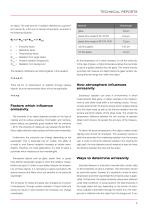
an object. The total amount of radiation detected by a pyrometer’s sensor is the sum of several components, as shown in the following equation. O = £ * O + P * O + T * O I obj amb back Oobj = Radiation from target object Oamb= Ambient radiation (foreground) O i = Radiation from background back The radiation coefficients are linked together in the equation: 1 = £ + p + T There will be no transmission of radiation through opaque objects; thus the transmissivity factor will not be applicable. 1 = £ + p Factors which influence emissivity The emissivity of an object depends primarily...
Open the catalog to page 2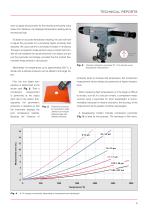
TECHNICAL REPORTS were to adjust the pyrometer for the theoretical emissivity value drawn from literature, the displayed temperature reading will be erroneously high. To obtain an accurate temperature reading, the user will have to adjust the pyrometer for a somewhat higher emissivity than declared. We could call this a simulated increase in emissivity. Through a comparison measurement using a contact thermometer we can establish the actual emissivity of an object and ad- Vergleichsstrahler Messobjekt just the pyrometer accordingly, provided that the contact thermometer measurement is very precise....
Open the catalog to page 3
TECHNICAL REPORTS ments is based on a visual colour comparison at a wavelength In particularly unfavourable or complex measuring conditions, it is recommendable to consider both the two spectral temperature values as well as the temperature reading based on the This method’s effectiveness is not dependent on the size of two-colour ratio. Depending on the result, the user can select the target object. The chart Fig. 4 demonstrates the effect of an the method which is best suited for his application and adjust incorrect pyrometer adjustment or a change in emissivity. Two-colour pyrometers measurements...
Open the catalog to page 4All Keller Pyrometer Systems catalogs and technical brochures
 BR CellaTemp PX_ID2007_202608_en
20 Pages
 BR CellaTemp PA_ID2004_202606_en
20 Pages
 KITS App - Digital Service
6 Pages
 AN_Bar mill_ID2533_202202_en
4 Pages
 AN Furnace_ID2529_202201_en
4 Pages
 Software CellaView
8 Pages
 BR CellaPort PT_ID2002_202609_en
16 Pages
 AN CellaInduction_201604_en
4 Pages
 AN CellaCast_201811_en
8 Pages
 Flyer IO-Link_201810_en
2 Pages
 TR IO-Link_201610_en
7 Pages
 AN Metal sheets_201608_en
4 Pages






- Temperature probe
- Automation software solution
- Analysis software solution
- Keller ITS measuring system
- Real-time software
- Windows software
- Control software
- Keller ITS digital thermometer
- Monitoring software solution
- Measurement software
- Keller ITS industrial thermometer
- Waterproof temperature sensor
- Keller ITS °C thermometer
- Stainless steel temperature transducer
- Keller ITS infrared thermometer
- Keller ITS waterproof thermometer
- Keller ITS stainless steel thermometer
- Keller ITS portable thermometer
- Automatic measurement system
- Keller ITS optical measuring system