
- Catalogs
- Keko Varicon
- varicons - 2008/2009

varicons - 2008/2009

varicons - 2008/2009
- ZV and ZVE Series: Rated AC and DC voltages, supply voltage, leakage current, varistor voltage, clamping voltage, and response time. The ZV series has a wide DC operating voltage range from 3 V to 170 V, while the ZVE series features a response time of less than 1 ns.
- ZVX and AV Series: Compliance with MIL-STD-883C, AEC-Q200-002, and RoHS standards. Operating voltage ranges from 3V to 38V for ZVX and 16V to 56V for AV, with a continuous operating temperature up to +125°C.
- Short response time and low clamping voltage.
- Non-sensitive to mildly activated fluxes.
- Available in various model sizes and RoHS compliant.
- Low energy varistor chips with low capacitance values to prevent data signal skewing.
- Protection of integrated circuits and components at the circuit board level.
- Suppression of inductive switching or other transient events.
- ESD protection for components sensitive to IEC 1000-4-2 and MIL-STD 883C Method 3015.7.
- Automotive applications include protection for anti-block brake systems, direct ignition systems, and airbag control systems.
Catalog excerpts
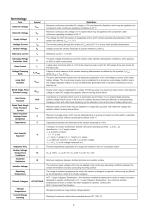
Terminology Term Maximum continuous sinusoidal AC voltage (< 5% total harmonic distortion) which may be applied to the component under continuous operating conditions at 25 °C Supply Voltage The voltage by which the system is designated and to which certain operating characteristics of the system are referred; Vrms = 1,1 x V Leakage Current The current passing through the varistor at Vdc and at 25 °C or at any other specified temperature Varistor Voltage Voltage across the varistor measured at a given reference current In Reference Current Clamping Voltage Protection Level The peak voltage developed...
Open the catalog to page 2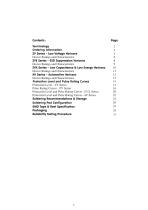
Contents: Page ZV Series - Low Voltage Varicons 5 Device Ratings and Characteristics 6 ZVE Series - ESD Suppression Varicons 8 Device Ratings and Characteristics 9 ZVX Series - Low Capacitance & Low Energy Varicons 10 Device Ratings and Characteristics 11 AV Series - Automotive Varicons 12 Device Ratings and Characteristics 13 Protection Level and Pulse Rating Curves 14 Protection Level - ZV Series 14 Pulse Rating Curves - ZV Series 16 Protection Level and Pulse Rating Curves -ZVX Series 20 Protection Level and Pulse Rating Curves -AV Series 22 Soldering Recommendations & Storage 25 SMD Tape...
Open the catalog to page 3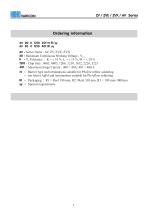
Ordering Information AV 20 K 1210 401 N R1 yy AV 20 K 1210 401 R1 yy AV - Series Name : AV, ZV, ZVE, ZVX 20 - Maximum Continuous Working Voltage - Vrms K - Vn Tolerance : K = ± 10 %, L = ± 15 %, M = ± 20 % 1210 - Chip Size : 0603, 0805, 1206, 1210, 1812, 2220, 3225 401 - Maximum Surge Current : 400 = 40A; 401 = 400 A N - Barrier type end terminations suitable for Pb-free reflow soldering - (no letter) AgPd end terminations suitable for Pb reflow soldering R1 - Packaging : R1 = Reel 180 mm, R2 =Reel 330 mm, R3 = 180 mm-1000 pcs yy - Special requirements
Open the catalog to page 4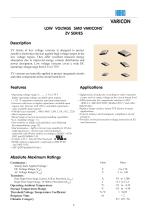
LOW VOLTAGE SAAD VARICONS ZV Series of low voltage varicons is designed to protect sensitive electronics devices against high voltage surges in the low voltage region. They offer excellent transient energy absorption due to improved energy volume distribution and power dissipation. Low voltage varicons cover a wide DC operating voltage range from 3 V to 170 V. ZV varicons are typically applied to protect integrated circuits and other components at the circuit board level. higher operating voltages available upon request. ' + 125 °C maximum continuous operating temperature ' Varicons with lower...
Open the catalog to page 5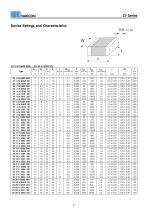
Device Ratings and Characteristics
Open the catalog to page 6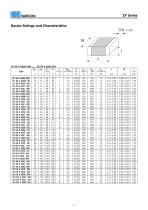
Device Ratings and Characteristics
Open the catalog to page 7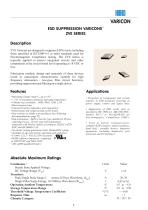
ZVE Varicons are designed to suppress ESD events, including those specified in IEC1000-4-2 or other standards used for Electromagnetic Compliance testing. The ZVE Series is typically applied to protect integrated circuits and other components at the circuit board level operating at 18 VDC or Fabrication method, design and materials of these devices result in capacitance characteristics suitable for high frequency attenuation / low-pass filter circuit functions, providing suppression and filtering in a single device. • Operating voltage range Vdc up to 18 V. ' + 125 °C maximum continuous operating...
Open the catalog to page 8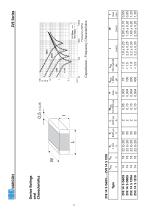
Device Ratings and Characteristics Capacitance - Frequency Characteristics
Open the catalog to page 9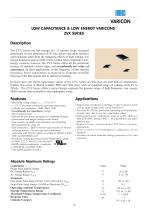
LOW CAPACITANCE & LOW ENERGY VARICONS The ZVX Series are low-energy (0.1 J) varistor chips, designed specifically for the protection of I/O line drivers and other sensitive semiconductor gates from the damaging effects of high voltage, low energy transients such as ESD events. Unlike other competitive low- energy varistors, however, the ZVX Series offers all the protection features of standard varistor chips, and exceptionally low values of capacitance. In these applications, as the frequency of data transfer increases, lower capacitance is required to eliminate possible skewing of the data signals...
Open the catalog to page 10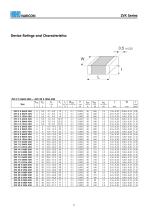
Device Ratings and Characteristics
Open the catalog to page 11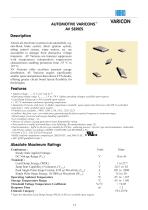
AUTOMOTIVE VARICONSÒ AV SERIES Description Almost all-electronic systems in an automobile, e.g. anti-block brake system, direct ignition system, airbag control system, wiper motors, etc. are susceptible to damage from destructive voltage transients. AV Varicons are transient suppressors with temperature independent suppression characteristics enabling protection from -55 °C to 125 °C. AV Varicons offer excellent transient energy distribution. AV Varicons require significantly smaller space and pad area than silicon TVS diodes, offering greater circuit board layout flexibility for the designer....
Open the catalog to page 12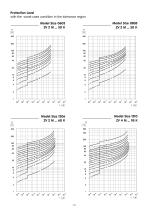
Protection Level with the worst-case condition in the tolerance region Model Size 0603 ZV 2 M ... 30 K
Open the catalog to page 14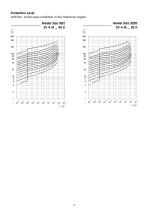
Protection Level with the worst-case condition in the tolerance region
Open the catalog to page 15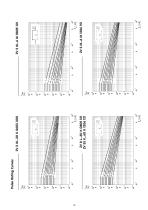
Pulse Rating Curves
Open the catalog to page 16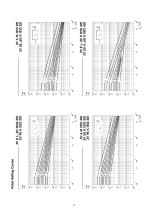
Pulse Rating Curves
Open the catalog to page 17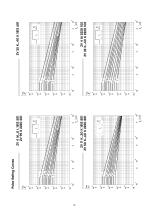
Pulse Rating Curves
Open the catalog to page 18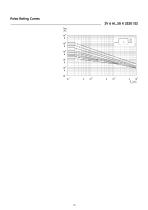
Pulse Rating Curves ZV 6 M...30 K 2220 122 I max A
Open the catalog to page 19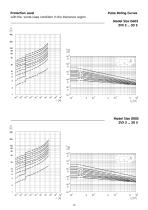
Protection Level with the worst-case condition in the tolerance region Pulse Rating Curves Model Size 0603 ZVX 2 ... 30 S
Open the catalog to page 20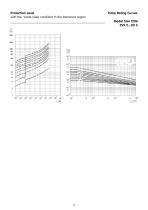
Protection Level Pulse Rating Curves with the worst-case condition in the tolerance region
Open the catalog to page 21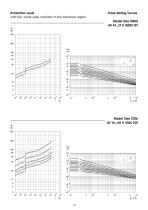
Protection Level with the worst-case condition in the tolerance region Pulse Rating Curves Model Size 0805 AV 14...17 K 0805 121
Open the catalog to page 22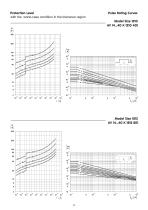
Protection Level with the worst-case condition in the tolerance region Pulse Rating Curves Model Size 1210 AV 14...40 K 1210 401
Open the catalog to page 23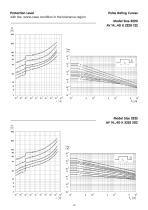
Protection Level with the worst-case condition in the tolerance region Pulse Rating Curves Model Size 2220 AV 14...40 K 2220 122
Open the catalog to page 24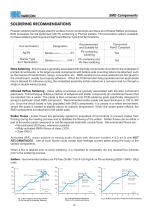
SOLDERING RECOMMENDATIONS Popular soldering techniques used for surface mount components are Wave and Infrared Reflow processes. Both processes can be performed with Pb-containing or Pb-free solders. The termination options available for these soldering techniques are AgPd and Barrier Type End Terminations. Component RoHS Compliant Pb-containing soldering Pb-contaning and Pb-free soldering End termination Ag/Pd Barrier Type End Termination Wave Soldering - this process is generally associated with discrete components mounted on the underside of printed circuit boards, or for large top-side components...
Open the catalog to page 25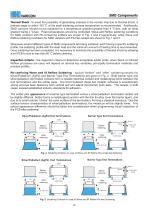
Thermal Shock - to avoid the possibility of generating stresses in the varistor chip due to thermal shock, a preheat stage to within 100 0C of the peak soldering process temperature is recommended. Additionally, SMD varistors should not be subjected to a temperature gradient greater than 4 0C/sec, with an ideal gradient being 2 0C/sec. Peak temperatures should be controlled. Wave and Reflow soldering conditions for SMD varistors with Pb-containing solders are shown in Fig. 1 and 2 respectively, while Wave and Reflow soldering conditions for SMD varistors with Pb-free solders are shown in Fig....
Open the catalog to page 26All Keko Varicon catalogs and technical brochures
 TUBE ZnO VARISTOR
2 Pages
 Product catalogue
98 Pages
 C3V series
2 Pages
 Catalogue - PROTECTIVE DEVICES
18 Pages
 capacitors 2008/2009
36 Pages
 varistors - 2008/2009
40 Pages
 Catalogues 2008 - 2009
4 Pages

