
- Catalogs
- Keithley Instruments
- Arbitrary Function Generators AFG31000 Series Datasheet


Arbitrary Function Generators AFG31000 Series Datasheet
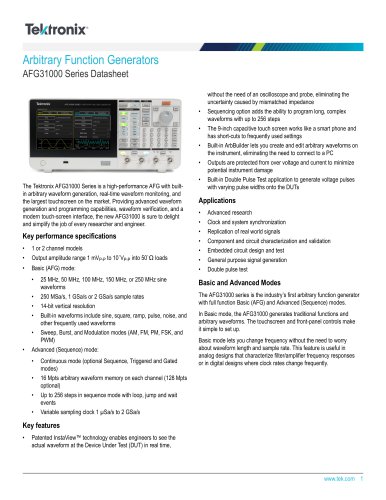
Arbitrary Function Generators AFG31000 Series Datasheet
The Tektronix AFG31000 Series is a high-performance arbitrary function generator designed for researchers and engineers. It features built-in arbitrary waveform generation, real-time waveform monitoring, and a large touchscreen interface to simplify waveform generation and verification.
Key Specifications
- Available in 1 or 2 channel models.
- Output amplitude range from 1 mVP-P to 10 VP-P into 50 Ω loads.
- Supports sine waveforms up to 250 MHz and sample rates up to 2 GSa/s in Basic mode.
- Advanced mode offers continuous, triggered, and gated modes with up to 256 steps in sequence mode.
- Variable sampling clock from 1 µSa/s to 2 GSa/s.
Key Features
- InstaView™ technology for real-time waveform monitoring at the Device Under Test (DUT).
- Sequencing option for programming complex waveforms.
- 9-inch capacitive touchscreen for intuitive operation.
- Built-in ArbBuilder for creating and editing arbitrary waveforms.
- Outputs protected from over voltage and current.
- Double Pulse Test application for generating voltage pulses with varying widths.
Applications
- Advanced research and development.
- Clock and system synchronization.
- Component and circuit characterization.
- Embedded circuit design and testing.
- General purpose signal generation.
Basic and Advanced Modes
The AFG31000 series supports both Basic and Advanced modes. Basic mode allows for traditional function generation with easy setup via touchscreen and controls. Advanced mode enables complex waveform sequences with flexible step controls, ideal for applications requiring high signal fidelity.
InstaView™ Technology
This patented technology allows users to view the actual waveform at the DUT, eliminating uncertainties caused by impedance mismatches without additional equipment.
User Interface
The large touchscreen displays all settings and parameters, allowing for easy navigation and adjustment. Frequently used functions are accessible via a swipe-up menu.
Automation and Software
Kickstart software enables remote control and automated testing, supporting common waveforms and custom arbitrary functions. It facilitates parameter alignment and synchronization across multiple channels.
ArbBuilder Tool
ArbBuilder allows for the creation and editing of arbitrary waveforms directly on the generator, supporting real-world waveform replication and CSV data file imports.
Synchronization and Double Pulse Test
The AFG31000 simplifies multi-unit synchronization with an on-screen wizard. The Double Pulse Test application supports power and semiconductor testing with varying pulse widths.
Upgradability
The AFG31000 offers upgrade options for bandwidth, memory, and sequence mode support, ensuring long-term investment protection.
Specifications and Warranty
The AFG31000 Series offers a comprehensive protection plan covering wear and tear, accidental damage, ESD, and EOS, with a 5-day turnaround time and priority customer support. The product warranty includes a three-year coverage on parts and labor. Tektronix is certified under ISO 14001:2015 and ISO 9001:2015 standards.
Accessories
Standard accessories include a BNC cable, USB cable, power cord, and a NIST-traceable calibration certificate. Recommended accessories feature additional BNC and GPIB cables, a BNC terminator, and transit cases.
Compliance and Standards
The product complies with IEEE Standard 488.1-1987, RS-232-C, and Tektronix Standard Codes and Formats. It is designed and manufactured for electronic test and measurement instruments.
Customer Support
Contact information is provided for various regions, including ASEAN, Europe, North America, and others, with toll-free numbers where applicable.
Additional Resources
Tektronix offers a range of application notes and technical resources available on their website for further information.
Catalog excerpts
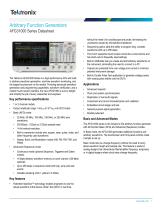
Arbitrary Function GeneratorsAFG31000 Series Datasheet The Tektronix AFG31000 Series is a high-performance AFG with built-in arbitrary waveform generation, real-time waveform monitoring, and the largest touchscreen on the market. Providing advanced waveform generation and programming capabilities, waveform verification, and a modern touch-screen interface, the new AFG31000 is sure to delight and simplify the job of every researcher and engineer. Key performance specifications • 1 or 2 channel models • Output amplitude range 1 mVP-P to 10'VP-P into 50'Q loads • 250 MSa/s, 1 GSa/s or 2 GSa/s sample rates • Built-in waveforms include sine, square, ramp, pulse, noise, and other frequently used waveforms • Sweep, Burst, and Modulation modes (AM, FM, PM, FSK, and PWM) • Advanced (Sequence) mode: • Continuous mode (optional Sequence, Triggered and Gated modes) • 16 Mpts arbitrary waveform memory on each channel (128 Mpts optional) • Up to 256 steps in sequence mode with loop, jump and wait events • Variable sampling clock 1 pSa/s to 2 GSa/s without the need of an oscilloscope and probe, eliminating the uncertainty caused by mismatched impedance • Sequencing option adds the ability to program long, complex waveforms with up to 256 steps • The 9-inch capacitive touch screen works like a smart phone and has short-cuts to frequently used settings • Built-in ArbBuilder lets you create and edit arbitrary waveforms on the instrument, eliminating the need to connect to a PC • Outputs are protected from over voltage and current to minimize potential instrument damage • Built-in Double Pulse Test application to generate voltage pulses with varying pulse widths onto the DUTs Applications • Advanced research • Clock and system synchronization • Replication of real world signals • Component and circuit characterization and validation • Embedded circuit design and test • General purpose signal generation • Double pulse test Basic and Advanced Modes The AFG31000 series is the industry's first arbitrary function generator with full function Basic (AFG) and Advanced (Sequence) modes. In Basic mode, the AFG31000 generates traditional functions and arbitrary waveforms. The touchscreen and front-panel controls make it simple to set up. Basic mode lets you change frequency without the need to worry about waveform length and sample rate. This feature is useful in analog designs that characterize filter/amplifier frequency responses or in digital designs where clock rates change frequently. Key features • Patented InstaView™ technology enables engineers to see the actual waveform at the Device Under Test (DUT) in real time,
Open the catalog to page 1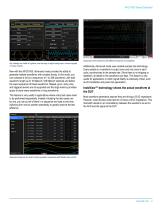
Sequenced sine waveforms with different frequency and amplitude. Key settings are visible at a glance, and are easy to adjust using touch, numeric keypad, or rotary controls New with the AFG31000, Advanced mode provides the ability to generate multiple waveforms with complex timing. In this mode, you can compose a list (or a sequence) of 1 to 256 waveforms, with total waveform length up to 16 Mpts/ch (128 Mpts/ch optional) and define the ouput sequence of these waveforms. Repeat, go-to, wait, jump, and triggered events are all supported and the large memory provides space to store many waveforms...
Open the catalog to page 2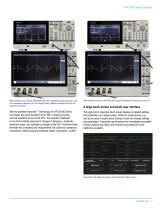
With InstaView turned off, the AFG31000 works like a traditional function generator. Due to an impedance mismatch, the AFG display shows a different waveform from the one observed at the DUT. With InstaView turned on, the AFG31000 shows the waveform as observed at the DUT. With the patented InstaView ™ technology, the AFG31000 Series can display the actual waveform at the DUT, instead of just the nominal waveform as set on the AFG. The waveform displayed on the AFG instantly responds to changes in frequency, amplitude, waveform shape, and impedance changes at the DUT. InstaView helps eliminate...
Open the catalog to page 3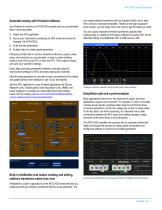
Use Kickstart to control your AFG31000 remotely and set up automated tests in four easy steps: 2. Set up your instrument by selecting an AFG model and name (for example, My AFG31252). 3. Enter the test parameters. 4. Enable output to initiate signal generation. Kickstart provides built-in common waveforms like sine, square, pulse, ramp, and noise that you can simulate, or load a custom arbitrary function from a file on your PC or from the AFG. Then capture, export, and save your waveform settings. Easily align and swap parameters between channels using the InterChannel settings for AFGs and tests...
Open the catalog to page 4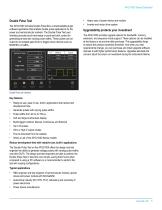
The AFG31000 includes Double PulseTest, a downloadable plugin software application that enables double pulse applications for the power and semiconductor markets. The Double Pulse Test user interface provides touch-and-swipe or point-and-click control for generating at least two varying pulse widths. These pulses can be output to an isolated gate driver to trigger power devices such as MOSFETs or IGBTs. • Heavy user of power device and module • Inverter and motor drive system The AFG31000 provides upgrade options for bandwidth, memory extension, and sequence mode support. These options can be...
Open the catalog to page 5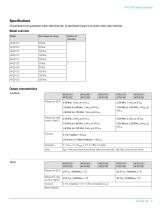
Specifications All specifications are guaranteed unless noted otherwise. All specifications apply to all models unless noted otherwise. Table continued...
Open the catalog to page 6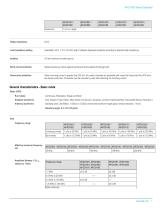
Table continued... Amplitude flatness (1 VP-P, relative to 1'kHz)
Open the catalog to page 7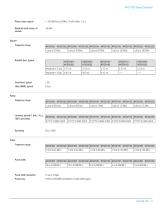
Phase noise, typical < -125 dBc/Hz at 20 MHz, 10 kHz offset, 1 VP-P Residual clock noise, all -63 dBm models Frequency range Rise/fall time, typical Frequency range Frequency range Pulse width Linearity, typical (1 kHz, 1 VP-P, 100% symmetry) Pulse width resolution 10 ps or 5 digits Pulse Duty 0.001% to 99.999% (limitations of pulse width apply)
Open the catalog to page 9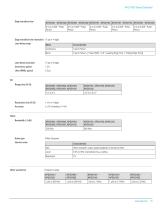
Edge transition time Edge transition time resolution Lead delay range Lead delay resolution Overshoot, typical Jitter (RMS), typical
Open the catalog to page 10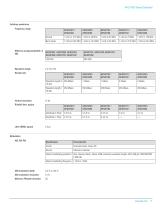
Arbitrary waveforms Frequency range Effective analog bandwidth (-3 dB) Minimum FM peak deviation DC
Open the catalog to page 11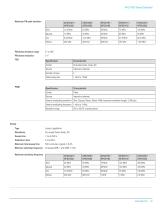
Maximum FM peak deviation PM phase deviation range 0° to 180° Waveforms Sweep time Hold/return time Maximum total sweep time Minimum start/stop frequency Linear, Logarithmic All, except Pulse, Noise, DC 1 ms to 500 s 0 s to 500 s Maximum start/stop frequency
Open the catalog to page 12All Keithley Instruments catalogs and technical brochures
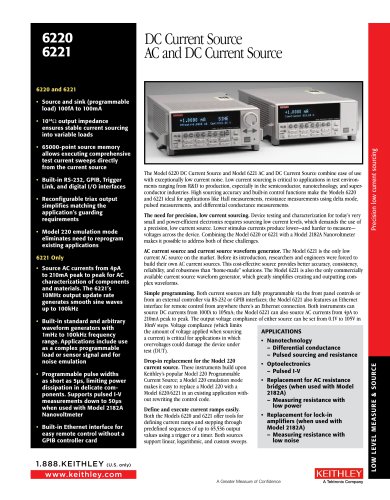
 6220-6221
5 Pages
 2520
25208 Pages
 2606B
2606B13 Pages
 2601B
2601B20 Pages
 AFG1000 Series
13 Pages
 AFG31000 Series Datasheet
22 Pages
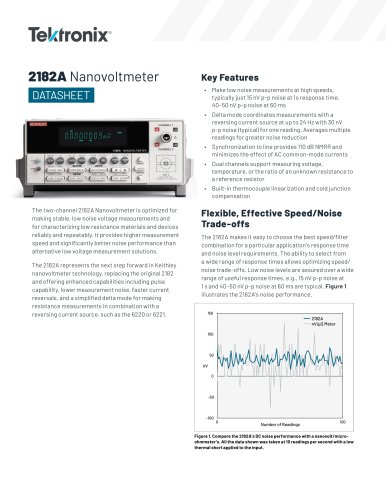 2182A Nanovoltmeter
11 Pages
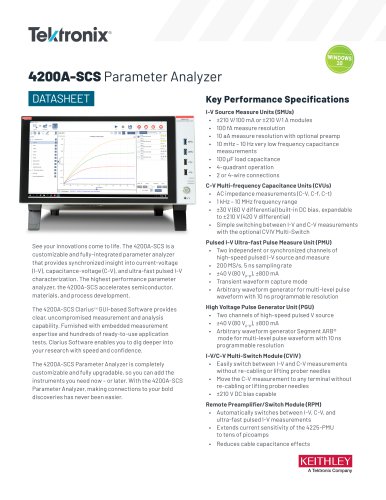 4200A-SCS Parameter Analyzer
45 Pages
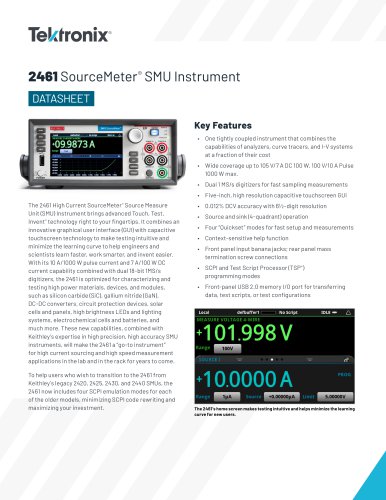 2461 SourceMeter® SMU Instrument
16 Pages
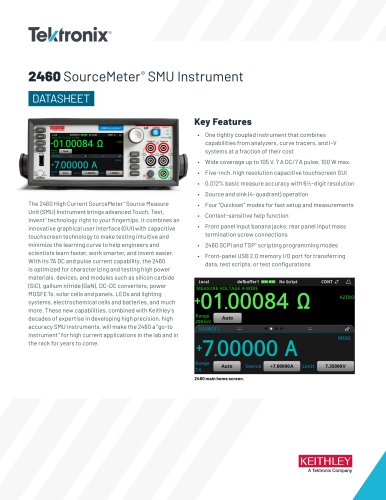 2460 SourceMeter® SMU Instrument
14 Pages
 MDO4000C Series Datasheet
43 Pages
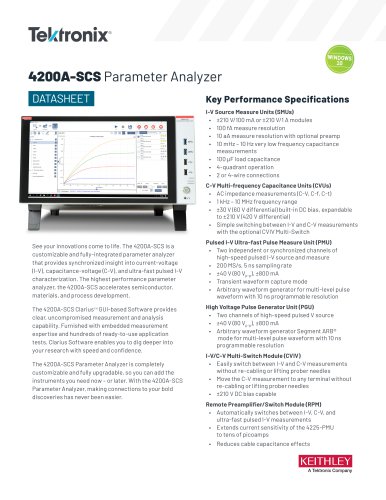 4200A-SCS Parameter Analyzer
45 Pages






Archived catalogs
 6 Series B MSO
69 Pages
 Isolated Measurement Systems
8 Pages
 TBS1000B-EDU Series
14 Pages
 3 Series MDO
36 Pages
 4 Series MSO
40 Pages
 TSG4100A Series
24 Pages
 2461-EC Graphical Potentiostat
16 Pages
 2460-EC Graphical Potentiostats
15 Pages
 2450-EC Graphical Potentiostat
15 Pages
 RTPA2A
6 Pages
 TPA-N-PRE Datasheet
4 Pages
 DPO4PWR·MDO3PWR Datasheet
6 Pages
 DPO4LMT/MDO3LMT Datasheet
6 Pages
 DPO7000 Series Datasheet
28 Pages
 SourceXpress® Datasheet
4 Pages
 10G-KR Datasheet
8 Pages
 DPO70000SX Series Datasheet
46 Pages
 AWG4000 Series Datasheet
20 Pages
 TLA6400 Series Datasheet
14 Pages
 Potentiostats 2450-EC
8 Pages
 2013 Keithley product catalog
403 Pages
 Nanotechnology Measurement
13 Pages
 Semiconductor Device Test
11 Pages
 Series 2400 SourceMeter®Family
16 Pages
 8 Series Sampling Oscilloscope
14 Pages
 Multimeter/Switch System
1 Page




- Power supply unit
- DC power supply
- AC/DC power supply
- Measuring device
- Management software solution
- Analysis software solution
- Real-time software
- Windows software
- Single-output power supply
- Portable tester
- Measurement software
- Interface software
- Digital tester
- Compact power supply
- Visualization software solution
- Tabletop power supply
- Automated software
- Automatic test kit
- Digital gauge