
- Catalogs
- KASTAS SEALING TECHNOLOGIES
- Kastas Technical Catalogue


Kastas Technical Catalogue

Kastas Technical Catalogue
This technical catalogue by Kastas Sealing Technologies A.S. provides an overview of hydraulic and pneumatic seals, emphasizing that laboratory-determined parameters like maximum pressure, temperature, and sliding speed may not be achievable in all applications. The company advises consulting their sales department for specific application recommendations.
Seal Programme
The catalogue details a comprehensive seal programme, including hydraulic piston-rod seals, hydraulic rod seals, hydraulic piston seals, wipers, special sealing elements, pneumatic sealing elements, guide elements, and static sealing elements. Each section includes product codes, materials, temperature ranges, sliding speeds, and maximum pressure ratings.
Technical Information
This section discusses materials used in sealing elements, such as elastomers, thermoplastics, and thermoplastic elastomers, including their characteristics, storage, and installation information. Specific materials like Nitrile (NBR), Hydrogenated Nitrile-Butadiene Rubber (HNBR), Silicone (MVQ), Fluoroelastomer (FKM), and Polyurethane (PU) are described.
Hydraulic and Pneumatic Sealing Elements
The catalogue explains the working principles, selection criteria, and installation guidelines for hydraulic and pneumatic sealing elements, including considerations for surface roughness and system tolerances.
Guide and Static Sealing Elements
This section discusses materials used in guide elements and provides calculations for width and cross-sectional thickness. It also details static sealing elements like back-up rings, flange seals, cover seals, and O-rings.
Quality and Service
Kastas emphasizes its commitment to quality and service, highlighting its ISO 16949 Quality Certification and focus on providing high-performance, reliable sealing solutions.
Introduction to Rubber Materials
The document provides an overview of different types of rubber and their characteristics, including temperature ranges and resistance to various substances.
Types of Rubber
Details on Ethylene-Propylene Diene Rubber (EPDM), Styrene Butadiene Rubber (SBR), and Natural Rubber (NR) are provided, including their temperature ranges and resistance properties.
Thermoplastics and Elastomers
Materials like Polytetrafluoroethylene (PTFE), Thermoplastic Polyester Elastomer (TPE), Polyamide (PA), and Polyoxymethylene (POM) are discussed for their properties and applications.
Physical Properties and Performance
A table compares the physical properties of various rubber materials, such as tensile strength, elongation, flexibility, and resistance to wear, tear, aging, ozone, fuel, grease, oil, acid, alkali, and hot water.
Storage and Handling of Sealing Elements
Guidelines for storing sealing elements in a controlled environment to prevent degradation are provided.
Installation and Maintenance
Proper installation and maintenance are crucial for the longevity of sealing elements, with guidelines on avoiding contamination and ensuring correct installation procedures.
Surface Roughness and System Tolerances
The document discusses the importance of surface roughness and system tolerances in the performance and lifespan of sealing elements.
Installation and Assembly
Proper installation of hydraulic sealing elements is emphasized, recommending heating seals for elasticity and using special assembly tools.
Permissible Sealing Gap
The permissible sealing gap is vital to prevent extrusion under maximum operating pressure.
Sample Designs and Seal Programme
The document includes sample designs for various applications and a seal program detailing product advantages, applications, and operating conditions.
Technical Specifications
Technical specifications for various sealing elements, including material codes, temperature ranges, pressure limits, and sliding speeds, are provided.
Assembly and Installation Instructions
Guidelines for assembling seals into grooves using soft materials and lubricating with system oil are provided.
Material and Operating Conditions
Details on material codes, media compatibility, temperature range, and speed limits are provided.
Product Specifications
Specifications for various seal models, including dimensions and tolerances, are listed.
Hydraulic Rod Sealing Elements
Descriptions of rod sealing elements, including material composition and operating conditions, are provided.
Rod Packing and Seals
Details on rod packing and seals, including their composition and applications, are provided.
Technical Document Summary
1. Specifications and Product Details
Detailed specifications for various rod and piston seals are provided.
2. Product Advantages and Applications
Each seal type is described with its unique advantages and suitable applications.
3. Installation and Operating Conditions
Guidelines for installation and operating conditions are provided.
4. Surface Roughness and Sealing Gaps
Recommended surface roughness values and permissible sealing gaps are specified.
5. Material Codes and Composition
Materials used in the seals are listed with their properties.
6. Tables and Data Interpretation
Tables provide detailed dimensions and specifications for each seal type.
7. Notes and Recommendations
Additional notes emphasize the importance of using correct sealing gap values and surface contact area.
Operating Conditions
Specifications for piston seals using different media are provided.
Material Codes
Materials used for the seals are listed with their properties.
Sealing Gap
Permissible sealing gap values for different pressures are provided.
Piston Seal K17
Specifications for the K17 piston seal are provided.
Compact Piston Seal K18
Details on the K18 seal, including installation notes and product advantages, are provided.
Surface Roughness and Installation
Recommendations for surface roughness and installation procedures are provided.
Product Advantages and Applications
The K18 seal offers economic sealing and guiding solutions.
Overview
Technical specifications and installation guidelines for various piston seals are provided.
Specifications
Details on various piston seals, including dimensions and materials, are provided.
Installation Procedures
Guidelines for installing seals using soft material tools are provided.
Material and Operating Conditions
Details on materials and operating conditions for seals are provided.
Product Advantages
Advantages of various seals, including high sliding speed and low friction, are provided.
Applications
Applications for seals in various machinery are provided.
Surface Roughness and Sealing Gaps
Specific roughness values and permissible sealing gaps are provided.
Overview
Specifications and descriptions of various piston seals are provided.
K23 Piston Seal
Specifications for the K23 piston seal are provided.
K26 Piston Seal
Details on the K26 piston seal, including applications and installation, are provided.
K40 Piston Seal
Specifications for the K40 piston seal are provided.
K41 Piston Seal
Details on the K41 piston seal, including applications and installation, are provided.
K42 Compact Piston Seal
Specifications for the K42 compact piston seal are provided.
K43 Sealing Set
Details on the K43 sealing set, including applications and installation, are provided.
General Notes
Notes on using soft materials for assembly tools and oiling seals before installation are provided.
Operating Conditions
Specifications for various sealing products are provided.
Piston Seals
Details on specifications for different piston seals are provided.
Surface Roughness and Installation
Recommendations for surface roughness and installation are provided.
Wipers
Details on various wiper products are provided.
Product Advantages and Applications
Advantages and applications for various products are provided.
Permissible Sealing Gaps
Tables provide permissible sealing gap values for different pressure levels.
Overview
Specifications and applications for various hydraulic sealing components are provided.
Specifications
Details on multiple products with their respective dimensions and material codes are provided.
Product Advantages
Advantages of each product are provided.
Applications
Applications for products in various machinery are provided.
Installation Guidelines
Guidelines for using soft material tools and oiling wipers before installation are provided.
Operating Conditions
Specifications for media, temperature, and speed limits for each product are provided.
Surface Roughness
Detailed surface roughness requirements are provided.
Special Sealing Elements
Information on special sealing elements is provided.
Surface Roughness Specifications
Specifications for surface roughness are provided.
Installation Procedures
Guidelines for installing V-rings and chevron rings are provided.
Material Codes and Operating Conditions
Details on materials and operating conditions are provided.
Product Specifications
Specifications for V-Rings and Chevron Rings are provided.
Applications
Applications for sealing products in various industries are provided.
Additional Notes
Notes on permissible sealing gaps and special PTFE mixtures are provided.
Overview
Specifications and guidelines for pneumatic sealing elements are provided.
Specifications
Details on various models of O-rings and sealing elements are provided.
Sealing Elements
Details on pneumatic sealing elements are provided.
Key Parameters
Important factors in selecting sealing elements are provided.
Surface Roughness
Significance of surface roughness is highlighted.
Installation Guidelines
Detailed instructions for installing sealing elements are provided.
Material Recommendations
Recommendations for materials used in sealing elements are provided.
Friction and Wear
Impact of friction forces on seal performance is discussed.
Conclusion
The document serves as a comprehensive guide for selecting, installing, and maintaining pneumatic sealing elements.
Overview
Specifications and descriptions of various pneumatic rod and piston seals are provided.
Product Specifications
Details on various pneumatic rod and piston seals are provided.
Installation Guidelines
Guidelines for installing seals are provided.
Material Codes
Material codes for different seals are provided.
Notes
Notes on high-temperature applications and contacting customer service for dimensions not listed are provided.
Installation and Material Specifications
Details on installation procedures and material specifications for pneumatic piston seals are provided.
Product Specifications
Specifications for various pneumatic piston seals are provided.
Guide Elements
Details on guide elements and their importance are provided.
Material Characteristics
Characteristics of materials used in guide elements are provided.
Guide Element Calculations
Calculations for guide elements are provided.
Overview
Specifications and details for various piston and rod guide rings, guide strips, and sealing elements are provided.
1. Piston and Rod Guide Rings
Details on guide rings are provided.
2. Guide Strips
Details on guide strips are provided.
3. Sealing Elements
Details on sealing elements are provided.
Installation and Notes
Guidelines for installation and notes on surface roughness and sealing gap values are provided.
Overview
Specifications and guidelines for K83 and K84 cover seals and O-rings are provided.
Specifications
Details on K83 and K84 cover seals are provided.
Product Advantages
Advantages of K84 cover seals are provided.
Applications
Applications for seals in hydraulic applications are provided.
Surface Roughness
Surface roughness requirements are provided.
Installation Guidelines
Guidelines for installing seals are provided.
O-Rings
Details on O-rings are provided.
Housing Values
Housing values for O-rings are provided.
Conclusion
The document serves as a comprehensive guide for selecting and installing K83 and K84 cover seals and O-rings.
Overview
Specifications and descriptions of various chemicals and their compatibility ratings with materials are provided.
Main Sections
Details on chemical compatibility ratings, rating scale explanation, and contact information are provided.
Key Data and Recommendations
Details on refrigerants, acids, salts, oils, and general recommendations are provided.
Catalog excerpts

@KASTA$ Hydraulic and Pneumatic Seals
Open the catalog to page 1
All information contained in our catalogue is released only for general usage and not valid for special applications. Given parameters such as maximum pressure, temperature, sliding speed, surface contact pressure and media are determined in laboratory conditions. In case the operating parameters are requested at maximum level, these values may not be achieved. Design-based system failures arising from our customers do not relate to Kastas Sealing Technologies A.S. In no event will Kastas Sealing Technologies A.S. be liable for any loss, damage, claim or expense directly or indirectly due to...
Open the catalog to page 2
@KASTA$ Hydraulic and Pneumatic Seals TECHNICAL CATALOGUE
Open the catalog to page 3
Storage of Sealing Elements 14 General Installation Information 14 Units, Quantities and General Tolerances 15 HYDRAULIC SEALING ELEMENTS Working Principle of Sealing Elements 18 Choosing Sealing Elements 18 System Tolerances and Designs 22 General Installation Information 25 ^ HYDRAULIC PISTON-ROD SEALING ELEMENTS Product Programme 33 HYDRAULIC ROD SEALING ELEMENTS Product Programme 61 K31- Heavy Duty Rod Seal 76 K701- Spring Loaded Rod Seal 108 HYDRAULIC PISTON SEALING ELEMENTS Product Programme 113 K18- Compact Piston Seal 124 K19- Heavy Duty Piston Seal...
Open the catalog to page 4
YOUR PRODUCTIVITY PARTNER Ever since the establishment of our company in 1981, the demand for our extensive range of products has steadily increased as the international market recognized the quality of our products as well as our customer service. The developments are continued with confidence and self-sacrifice keeping the indispensable principles. Fast, reliable, effective solutions are offered with high quality of products to our customers. Continuous innovations are carried through our production, in order to keep up with the globally increasing demand. ALWAYS THE BETTER... We value the...
Open the catalog to page 5
QUALITY AND SERVICE... We have strengthened our company principles with quality control mechanisms that we have built up. We were certified with ISO 16949 Quality Certification in 2007. • All the activities are managed effectively with process approach in order to achieve corporate targets • For us, continuous improvement is not a word it's our company philosophy • We understand the exact needs of our customers and personnel in order to maintain the continuity of customer satisfaction • We create the necessary environment for our employees to use their capabilities in accordance with corporate...
Open the catalog to page 6
SEAL PROGRAMME
Open the catalog to page 7
SEAL PROGRAMME
Open the catalog to page 9
TECHNICAL INFORMATION
Open the catalog to page 13
HISTORY OF RUBBER The first type of the rubber used in the world is the natural rubber and it is obtained from the resin by crosswise cutting of the rubber tree. Commercial usage of the natural rubber started in 1736 with moving from South America to France. During the early applications in England, it was seen that the natural rubber was able to erase the lead pencil and this material was named as “rubber” in the meaning of rubbing. Charles Goodyear managed to vulcanize rubber and sulphur. The First World War proved that rubber was a strategic compound and increasing needs caused the invention...
Open the catalog to page 14
POLYTETRAFLUOROETHYLENE-PTFE This material is known as Teflon, the trademark of DUPONT Company. PTFE material does have the lowest coefficient of friction. Due to the low friction coefficient and high wear resistance, it performs well on poorly lubricating conditions as well as high sliding speeds. PTFE can be used in temperatures between -200°C to +260°C. It has very good resistance to all chemicals except alkaline metals, high pressure-temperature chlorotriflour and basic flourines. Hardness and elasticity make the material to be used widely in hydraulic applications. Depending onto the application;...
Open the catalog to page 15
The mechanical and physical properties of sealing elements produced from elastomers, thermoplastics and thermoplastic elastomers can change. This could be caused by many factors such as; • Oxygen • Ozone • Direct sun light • High temperature • Ultra-violet rays • Humidity • Dirtand chemical effects The sealing elements produced from elastomers, thermoplastics and thermoplastic elastomers do not change any mechanical or physical properties if not exposed to the above mentioned conditions. OXYGEN AND OZONE These two elements are oxidizing agents. It is recommended to store the seals in the packages...
Open the catalog to page 16
UNIT, QUANTITY AND GENERAL TOLERANCES FURTHER OFFICIAL DERIVED UNITS IN MECHANICS 1 ENERGY, WORK, AMOUNT OF HEAT Nm = 1 Joule (J) = 1 Ws PRESSURE MECHANICAL STRESS 1 Pascal (Pa) = 1 N/m2 : 1 Mpa (106 Pa) = 1 N/mm2 = 0.102 kp/mm2 Pa MPa bar kp / cm 2 mm Hg atm mWs
Open the catalog to page 17
TOLERANCES FOR MACHINED PARTS OF THERMOPLASTICS Permissible deviations of dimensions in mm.
Open the catalog to page 18
HYDRAULIC SEALING ELEMENTS
Open the catalog to page 19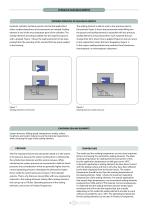
HYDRAULIC SEALING ELEMENTS WORKING PRINCIPLE OF SEALING ELEMENTS Hydraulic cylinders are being used in mechanical applications where reciprocating forces and movements are needed. Sealing element is one of the most important parts of the cylinders. The sealing elements are being installed into the respective groove with a preload. Figure 1 shows the sealing element in free state, preload after the assembly of the seal and the free space needed in the housing. The sealing element is able to work in low pressures due to this preload. Figure 2 shows the pressurized media filling into the groove...
Open the catalog to page 20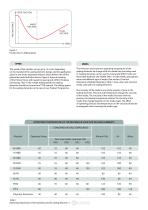
SPEED The speed of the cylinder can go up to 15 m/sec depending on the material of the sealing element, design and the application. Speed is one of the important features which defines the oil film generation and the friction forces. Figure 3 shows increasing of the friction forces with speed increasing and oil film thickness decreasing. That is why at high sliding speeds the sealing elements should be chosen from PTFE material. The sliding speed for the sealing elements can be seen in our Product Programme. MEDIA The minimum and maximum operating temperature of the sealing elements do change...
Open the catalog to page 21All KASTAS SEALING TECHNOLOGIES catalogs and technical brochures
 TPU Materials overview
1 Page
 New SmartSeal Materials
1 Page
 Product Overview
16 Pages
 New Products Catalogue 2014
86 Pages


Archived catalogs
 TECHNICAL CATALOGUE-ENGLISH
324 Pages

