


KANTHAL Alloys for Thermocouples, Extension and

KANTHAL Alloys for Thermocouples, Extension and
This document provides an overview of alloys used in thermocouples, extension, and compensating cables. It explains the principle of thermocouples based on Seebeck's discovery, where a circuit formed with two dissimilar metals generates an emf proportional to the temperature difference between junctions. Kanthal offers a range of thermocouple materials, including Thermothal P and N alloys, suitable for high-temperature applications up to 1260°C.
Thermocouples are categorized into standard, special, and sheathing grades. Standard grade is calibrated for the entire operating temperature range, while special grade offers closer tolerances for higher accuracy. Sheathing grade is used for mineral-filled sheathed elements requiring specific emf requirements.
The document details various thermocouple types, including Type N (Nicrosil/Nisil), Type K (Thermothal P/N), Type E (Thermothal P/Cuprothal), Type T (Copper/Cuprothal), and Type J (Iron/Cuprothal). Each type is suited for different temperature ranges and atmospheric conditions.
All thermocouples are calibrated to ensure correct emf over specified temperature ranges. Special features include oxidized surfaces for corrosion resistance and specific calibration for sub-zero temperatures. Hard and half-hard processing is used for joint manufacturing, requiring annealing to achieve correct emf.
Kanthal alloys comply with international standards such as ASTM, ANSI, IEC, DIN, BS, NF, UNI, JIS, and GHOST. The document emphasizes the importance of selecting the appropriate thermocouple based on temperature, atmosphere, and physical characteristics.
Kanthal provides a comprehensive range of thermocouple alloys, offering technical advice and expertise in this specialized field. The document serves as a guide for selecting and using thermocouples in various industrial applications.
1. Thermocouple Types and Applications:
- Type T (Copper/Cuprothal (TN)): Primarily used at room and cryogenic temperatures.
- Type E (Thermothal P (EP)/Cuprothal (EN)): Suitable for applications requiring high thermoelectric values.
- Type K (Thermothal P/Thermothal N): Widely used for temperatures above 500 °C due to strong oxidation resistance.
- Type N (Nicrosil/Nisil): Developed as an improvement over Type K, offering better stability and longer life.
- Temperature: Life decreases by about 50% with a 50 °C increase.
- Diameter: Doubling the wire diameter increases life by 2-3 times.
- Thermic Cycling: Exposure to cycling from room temperature to above 500 °C reduces life by about 50%.
- Protection: Using protective sheaths and ceramic insulators extends life.
- Detailed tables provide maximum recommended temperatures for various thermocouple types and wire diameters, both bare and protected.
- Tables list nominal compositions, melting points, and other properties of thermocouple and compensating alloys.
- Type N: Offers improved oxidation resistance and stability over Type K, but requires instrumentation modification for substitution.
- Type K: Not suitable for alternating oxidizing/reducing atmospheres or sulphur-containing gases without protection.
- Type E: Known for the largest emf output among common thermocouples, used up to 900 °C.
- Type T: Suitable for temperatures -185 °C to +370 °C, with copper's oxidation resistance being a limiting factor.
- Type J: High emf and low cost, used in oxidizing conditions up to 760 °C or reducing conditions up to 900 °C.
- Specific precautions for each thermocouple type are provided, including environmental considerations and material compatibility.
- Extensive tables provide emf-temperature characteristics for various thermocouple types against Pt 67, based on ITS 90 standards.
1. Diameter Tolerances: For diameters ≤ 3 mm, the tolerance is ± 1 mm on the length. For diameters between 3 mm and 10 mm, the tolerance is -0/+4 mm. Specific tolerances are provided for different diameter ranges in both metric and imperial units.
2. Wire Size Tolerances: Detailed tolerances are provided for wire sizes ranging from 0.10 mm to 9.00 mm, with corresponding tolerances in inches.
1. Thermocouple Alloys: The document lists standard refractory tubes with varying Al2O3 content, which is chosen based on the wire alloy and working temperature. For Fe Cr Al alloys, an Al2O3 content over 60% is recommended.
2. Refractory Tubes: Specifications for standard refractory tubes are provided, including dimensions and the number of holes.
1. Kanthal Super Protection Tubes: Made of molybdenum disilicide, these tubes can operate up to 1700 °C and are less porous and brittle than ceramic tubes, making them suitable for high temperatures and corrosive environments.
2. Kanthal Metallic Protection Tubes: These tubes, made from Kanthal AF and APM alloys, can operate up to 1400 °C. They offer high resistance to sulphur and carbon compounds and have a long service life due to their thin walls, which allow rapid heat transmission.
1. Kanthal Protection Tubes: Various dimensions and wall thicknesses are provided, with maximum lengths up to 6000 mm. Tubes are supplied with one end closed and threaded for connection.
Kanthal AB, Box 502, SE-734 27 Hallstahammar, Sweden. Tel. +46 220 210 00, Fax +46 220 163 50, Website: www.kanthal.com
Catalog excerpts

Alloys for Thermocouples,Extension andCompensating Cables >
Open the catalog to page 1
Design and set in DTP by Mediaid, Eskilstuna. (275)Printed in Sweden by PRIMAtryck.This information, which may be subject tochange, is offered solely for your considera- tion and should not be taken as warranty or representation for which we assume legal responsibility. It is not to be understood as permission or recommendation to practice apatented invention without a license and the user should determine weather relevant patent exist. >
Open the catalog to page 2
Alloys for Thermocouples,Extension andCompensating Cables >
Open the catalog to page 3
3Thermocouple AlloysIntroduction and General Comments > The principle on which the modern thermocouple ope-rates is derived from Seebecks discovery that if a cir- cuit is formed using two dissimilar metal conductors with one junction at a higher temperature than the other, then a current will flow in the circuit. The resul- tant emf is proportional to the temperature difference between the junctions.For many industrial heating processes, particularlythose carried out at high temperatures, a thermocou- ple is the most accurate, convenient and simple met- hod of temperature measurement. In some...
Open the catalog to page 5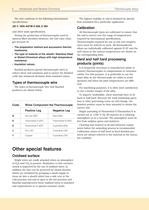
4Thermocouple AlloysIntroduction and General Comments JIS C 1605-ASTM E 608,E 585 > and other main specifications.During the production of thermocouples used inmineral filled sheathed elements, the emf value chan- ges because of: All thermocouple types are calibrated to ensure thatthe emf is correct over the range of temperatures required by international specifications. Thermocouples required for use at sub zero tempera- tures must be ordered as such. All thermoelectric alloys are individually calibrated against Pt 67 and the emf values at the various temperatures are shown on the corresponding...
Open the catalog to page 6
Cuprothal CL has a very high emf value against Pt67,the highest among the different types of Cuprothal. This property comes from the low content of additional elements in its chemical composition. On the contrary, in the other types of Cuprothal, some additions are necessary to meet the emf values requested by the norms. Due to this characteristic of having a high thermoelectric output, Cuprothal CL is used mostly in the manufacture of thermocouples to detect the pre- sence of the flame in gas burners, connected to safety devices. > E.M.F. testing must be carried out on annealed materi-al. Reference...
Open the catalog to page 16
To form the hot junction, a suitable method has to beadopted to obtain a good electrical contact between the thermocouple wires.At low temperatures, where generallyCopper/Cuprothal (TN) couples are used, soft or silver soldering can be adopted.For Thermothal P/Thermothal N and other combina-tions, for use in high temperature measurements, wel- ding is the only method to obtain a suitable joint.For this purpose oxy-acetylene welding is mostlyused, but arc welding also gives good results. > The wires are cleaned and twisted as in gas weldingand are then held in a vice which is connected to a +VE...
Open the catalog to page 19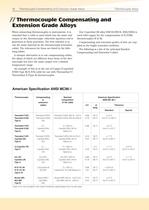
ThermocoupleCompensating NominalAmerican SpecificationorcompositionANSI MC 96-1extensionof the cablecablesmVat TolerancetempStandardSpecial Thermothal P(KP) / Thermothal P(KPX) /Thermothal P(KPX): 90% Ni -10% Cr4.096100 Cб2.2 C Thermothal N(KN) Thermothal N(KNX)Thermothal N(KNX): 95% M+Al-Mn-Si8.139200 аCfrom 0C to 200 аC (Type K) (KX) Thermothal P(KP) / Cu / Cu: 100% Cu4.096100 Cб2.2 C Thermothal N(KN) Cuprothal (VNX)Cuprothal (VNX): 44% Ni-from 0аto 100 C (Type K) (VX)*Balance Cu Thermothal P (EP) / Thermothal P (EPX) -Thermothal P(EPX): 90% Ni-10% Cr6.319100 аC1.7 ѰC Cuprothal (EN) Cuprothal...
Open the catalog to page 20
28Thermocouple AlloysKanthal Protection Tubes > The advantages offered by using Kanthal protectiontubes for thermocouples are: These metallic protection tubes are manufactured from our high temperature resistance alloy Kanthal AF, 6.0 - 22.0 mm dia and Kanthal APM 22.0 - 40.0 mm with maximum operating temperature in air of 1400 C These tubes are made of moloybdenum disilicade, asour Kanthal Super heating elements. Kanthal Super protection tubes have the following advantages: ? The highest operating temperature is 1700 аC . ? Porosity and brittleness are lower than for ceramicprotection tubes.The...
Open the catalog to page 30
TEXT & REPROPRIMAtryck, Hallstahammar >
Open the catalog to page 32All Kanthal catalogs and technical brochures
 HIGH POWER HEATING ELEMENTS
8 Pages
 KANTHAL® AM100
3 Pages
 Thermocouple wire and strip
32 Pages
 Resistance heating strip
100 Pages
 double layer capacitors
40 Pages
 Axial-leaded resistors
4 Pages
 Furnace rollers
2 Pages
 Furnace tubes
36 Pages
 Diffusion cassettes
44 Pages
 Air heating cassettes
8 Pages
 heating elements
147 Pages


- Measuring device
- Heater
- Infrared heater
- Temperature measuring module
- Air heater
- Electric power radiant heater
- Electric heater
- Air heater unit
- Tubular electric heater
- Process control system
- Ceramic heating element
- Industrial radiant heating circuit
- Industrial electric heater
- Heating strip
- Electric air heater unit
- Heating cable
- Control measuring instrument
- Flexible heating element
- Nickel alloy