
- Catalogs
- Kant Druckschalter GmbH
- Type 903/953

Type 903/953

Type 903/953
Document Overview
This technical document focuses on the concept and application of Changeover Switches (also known as transfer switches) used in electrical power systems. It covers definitions, types, operational principles, and relevant standards and recommendations.
1. Definitions and Basic Concepts
A Changeover Switch is defined as a device that allows switching between two power sources, typically to ensure continuous power supply by transferring load from one source to another. The document distinguishes between manual and automatic changeover switches, as well as open, closed, and change types based on their operational modes.
The switching action can be mechanical or electrical, and the integrity of the switching depends on the mechanical spring preload and the electrical interlock mechanisms.
2. Types of Changeover Switches
- Manual Changeover Switches: Operated by hand, used where automatic transfer is not required.
- Automatic Changeover Switches: Equipped with sensors and control logic to detect power failure and switch sources automatically.
- Open Type: Switches that physically separate the two sources without overlap.
- Closed Type: Switches that allow brief overlap or make-before-break operation.
3. Operational Principles
The document explains the importance of the mechanical spring preload in ensuring reliable switching and the role of electrical interlocks to prevent simultaneous connection of both sources, which could cause faults.
It also discusses the influence of the applied preload on the switching speed and reliability, emphasizing that the preload must be carefully adjusted.
4. Standards and Norms
The document references standards such as IEC 60947-3 related to low-voltage switchgear and controlgear, which define requirements for changeover switches.
It also mentions the importance of compliance with safety and performance standards to ensure proper operation under fault conditions.
5. Recommendations and Best Practices
- Ensure proper mechanical preload adjustment to maintain switching integrity.
- Use electrical interlocks to avoid simultaneous source connection.
- Choose the appropriate type of changeover switch based on application needs (manual vs automatic, open vs closed).
- Regular maintenance and testing to verify correct operation.
6. Additional Technical Details
The document includes references to various electrical parameters such as voltage, current ratings, and switching times, although specific numerical values are not clearly extracted.
It also briefly mentions auxiliary components like hydraulic fluids, oils, and cooling methods relevant to switchgear operation.
7. Summary
This document serves as a technical guideline for understanding, selecting, and applying changeover switches in electrical power systems. It highlights critical factors affecting switch performance, including mechanical and electrical design considerations, and stresses adherence to international standards for safety and reliability.
All Kant Druckschalter GmbH catalogs and technical brochures
 TYPE 902
1 Page
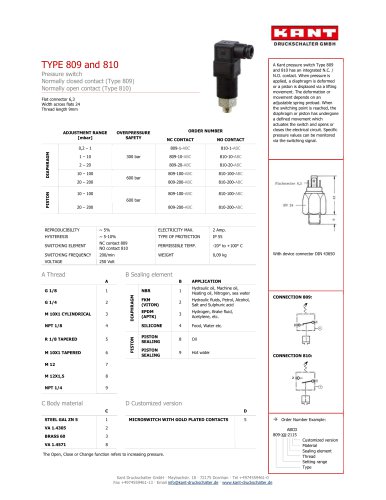 TYPE 809 and 810
1 Page
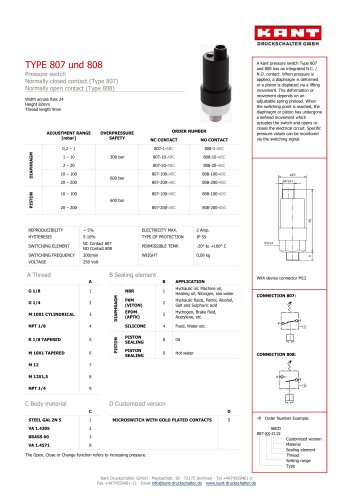 TYPE 807 and 808
1 Page
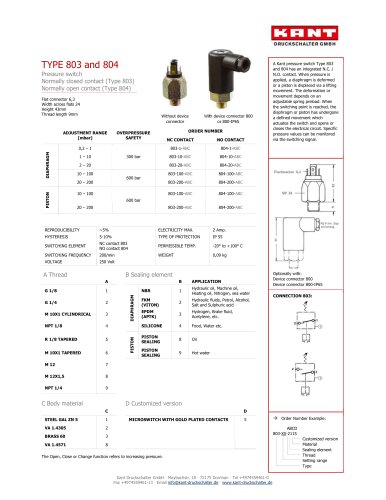 TYPE 803 and 804
1 Page
 TYPE 702
1 Page
 TYPE 701
1 Page
 TYPE 606
1 Page
 TYPE 605
1 Page
 TYPE 603
1 Page
 Type 801/802 and 851/852
2 Pages
 TYPE 909
1 Page
 TYPE 607
1 Page
 TYPE 602
1 Page
 TYPE 501
1 Page
- Pressure switch
- Plastic cap
- Round plug
- Cylindrical cap
- Plastic plug
- Mechanical pressure switch
- Waterproof pressure switch
- Diaphragm pressure switch
- Adjustable pressure switch
- Liquid pressure switch
- Protection plug
- IP65 pressure switch
- Cylindrical plug
- Piston pressure switch
- Pressure switch for hydraulic applications
- Threaded pressure switch
- Water pressure switch
- Oil pressure switch
- NC pressure switch
- NO pressure switch