
- Catalogs
- Kant Druckschalter GmbH
- TYPE 605

TYPE 605

TYPE 605
- Dimensions: Width across flats 27mm, Height 68mm, Thread length 9mm.
- Adjustment Range: Various ranges from 0.2-2 bar to 20-200 bar, with overpressure safety limits up to 600 bar.
- Reproducibility: Approximately 2-5%.
- Electricity: Maximum 6 Amp, Voltage 250 Volt.
- Hysteresis: Approximately 20%, adjustable upon request.
- Protection: IP 65.
- Switching Element: Change over contact.
- Permissible Temperature: -20° to +80°C.
- Switching Frequency: 200/min.
- Weight: 0.15 kg.
- Thread and Sealing Elements: Various combinations for different applications, including hydraulic oils, petrol, alcohol, and food.
- Body Material: Options include steel, brass, and stainless steel.
Catalog excerpts

A Kant pressure switch Type 605 has an integrated electric change over switch. When pressure is applied, a diaphragm is deformed or a piston is displaced via a lifting movement. The deformation or movement depends on an adjustable spring preload. When the switching point is reached, the diaphragm or piston has undergone a defined movement which actuates the switch and opens or closes the electrical circuit. Specific pressure values can be monitored via the switching signal. Pressure switch with changeover switch With bayonet catch Width across flats 27 Height 68mm Thread length 9mm ADJUSTMENT RANGE [bar] OVERPRESSURE SAFETY ~ 20% ; smaller upon request SWITCHING ELEMENT Change over contact PERMISSIBLE TEMP. SWITCHING FREQUENCY Hydraulic oil, Machine oil, Heating oil, Nitrogen, sea water Hydraulic fluids, Petrol, Alcohol, Salt and Sulphuric acid EPDM (APTK) Hydrogen, Brake fluid, Acetylene, etc. PISTON SEALING PISTON SEALING Device connector with bayonet catch PG with strain relief MICROSWITCH WITH GOLD PLATED CONTACTS WATERPROOF MICROSWITCH WITH GOLD PLATED CONTACTS Order number example: STEEL NICKEL PLATED The Open, Close or Change function refers to increasing pressure. Kant Druckschalter GmbH · Maybachstr. 18 · 72175 Dornhan · Tel +4974559461-0 Fax +4974559461-13 · Email [email protected] · www.kant-druckschalter.de Customized version Material Sealing element Threa
Open the catalog to page 1All Kant Druckschalter GmbH catalogs and technical brochures
 Type 903/953
2 Pages
 TYPE 902
1 Page
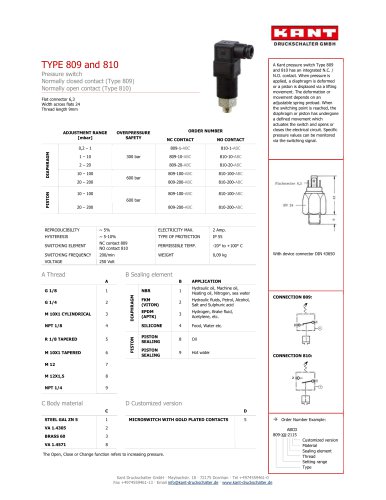 TYPE 809 and 810
1 Page
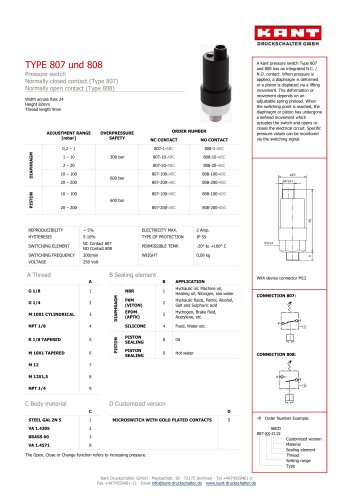 TYPE 807 and 808
1 Page
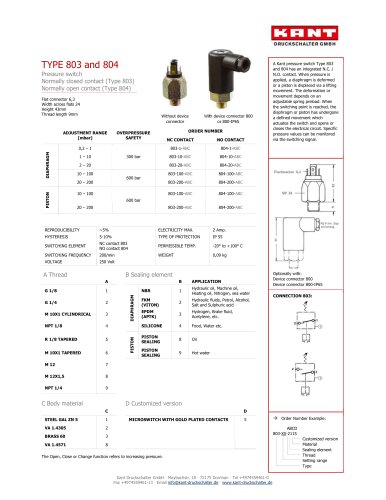 TYPE 803 and 804
1 Page
 TYPE 702
1 Page
 TYPE 701
1 Page
 TYPE 606
1 Page
 TYPE 603
1 Page
 Type 801/802 and 851/852
2 Pages
 TYPE 909
1 Page
 TYPE 607
1 Page
 TYPE 602
1 Page
 TYPE 501
1 Page
- Plastic cap
- Round plug
- Cylindrical cap
- Plastic plug
- Mechanical pressure switch
- Waterproof pressure switch
- Diaphragm pressure switch
- Adjustable pressure switch
- Liquid pressure switch
- Protection plug
- IP65 pressure switch
- Cylindrical plug
- Piston pressure switch
- Pressure switch for hydraulic applications
- Threaded pressure switch
- Water pressure switch
- Oil pressure switch
- NC pressure switch
- NO pressure switch