
- Catalogs
- Kanomax USA
- Kanomax Indoor Air Quality Solutions 2014

Kanomax Indoor Air Quality Solutions 2014
1 /4Pages

Kanomax Indoor Air Quality Solutions 2014
1 /4Pages
Catalog excerpts
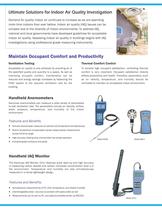
Ultimate Solutions for Indoor Air Quality Investigation Demand for quality indoor air continues to increase as we are spending more time indoors than ever before. Indoor air quality (IAQ) issues can be complex due to the diversity of indoor environments. To address IAQ, national and local governments have developed guidelines for acceptable indoor air quality. Assessing indoor air quality in buildings begins with IAQ investigations using professional grade measuring instruments. Maintain Occupant Comfort and Productivity Ventilation Testing Acceptable air quality is only achieved by providing...
Open the catalog to page 2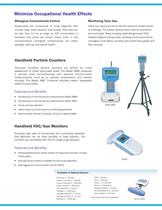
Minimize Occupational Health Effects Biological Contaminants Control Bioaerosols are compounds of living organism that include fungi, mold, bacteria, and viruses. Their size can be less than 0.1 to as large as 100 micrometers in diameter and some are known toxics. Even in low concentrations, biological contaminants can affect allergies, asthma, and overall health. There are many sources of harmful airborne contaminants in buildings. The Carbon Dioxide level must be monitored and controlled. Many building materials generate VOCs (Volatile Organic Compounds). Building owners and facility managers...
Open the catalog to page 3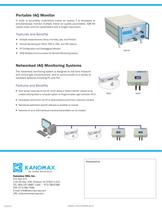
In order to accurately understand indoor air quality, it is necessary to simultaneously monitor multiple indoor air quality parameters. IQM 60 covers most common parameters with a single instrument. • Multiple measurements (Temp, Humidity, Gas, and Particle) • Particle Monitoringfor PM10, PM2.5, PM1, and TSP (Option) • PC Configuration and Datalogging Software • GSM Wireless Communication for Remote Monitoring (Option) Networked IAQ Monitoring Systems The networked monitoring system is designed to real-time measure and control gas concentrations, and to communicate to a variety of hardware systems...
Open the catalog to page 4All Kanomax USA catalogs and technical brochures
 Sound Meter Model 4431
1 Page
 Dif-Kit
2 Pages
 AES-1000 Particle Monitor
2 Pages
 Remote Particle Sensor
2 Pages
 Poratble Particle Counter
2 Pages
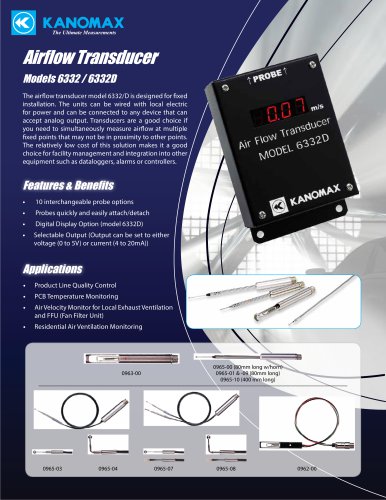 Airflow Transducer
2 Pages
 TABmaster Model 6715
2 Pages
 Vane Anemometers
2 Pages
 Anemomaster LITE
1 Page
 Anemomaster Professional
2 Pages
 Climomaster
2 Pages
 Kanomax General Catalog (2015)
56 Pages
 Kanomax Corporate Profile
6 Pages




- Flowmeter
- Volume flow monitor
- Gas flow monitor
- Benchtop analyser
- Solids analyser
- Spectrometer
- Gas detector
- Filtration unit
- Portable gauge
- Leak tester
- Portable detector
- Laboratory spectrometer
- Measurement monitoring module
- Environmental monitoring system
- Pressure leak testing machine
- Anemometer
- Clamp-on flow meter
- Vibration analyzer
- Sound level meter