
- Catalogs
- KAESER Kompressoren
- Heat recovery systems


- Company
- Products
- Catalogs
- News & Trends
- Exhibitions
Heat recovery systems

Heat recovery systems
Catalog excerpts

Heat Recovery Systems For hot air and hot water applications
Open the catalog to page 1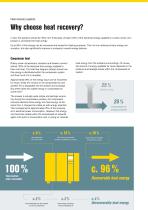
Heat recovery systems Why choose heat recovery? In fact, the question should be: Why not? Amazingly, virtually 100% of the electrical energy supplied to a rotary screw compressor is converted into heat energy. Up to 96% of this energy can be recovered and reused for heating purposes. This not only reduces primary energy consumption, but also significantly improves a company’s overall energy balance. Compressor heat Rotary screw compressors, boosters and blowers convert almost 100% of the electrical drive energy supplied to them into heat. The heat flow diagram (below) shows how this energy is...
Open the catalog to page 2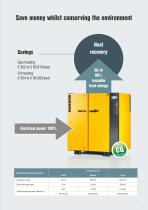
Save money whilst conserving the environment Heat recovery Up to 96% reusable heat energy Plate-type heat exchanger systems Compressor size “Small” Compressor model Drive motor rated power
Open the catalog to page 3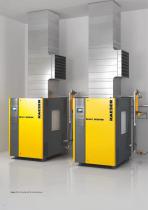
Image: DN 45 C booster with hot air heat recovery
Open the catalog to page 4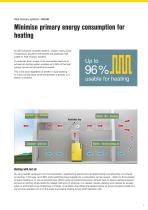
Heat recovery systems – Hot air Minimise primary energy consumption for heating As self-contained complete systems, modern rotary screw compressors, boosters and blowers are especially well suited for heat recovery systems. In particular, direct usage of the recoverable heat via an exhaust air ducting system enables up to 96% of the total energy input to be recovered and reused. This is the case regardless of whether a fluid-injecting or a dry-running rotary screw compressor, a booster or a blower is involved. Heating with hot air By using heated cooling air from the compressor, neighbouring...
Open the catalog to page 5
Heat recovery systems – Hot water Minimise primary energy consumption for process, service and hot water heating By reusing the exhaust heat from the compressor, heat exchanger systems can provide heating and service water on demand at temperatures up to +70°C, or even +90°C if required. For standard applications using heat recovery systems for the production of hot water and service water, PTG platetype heat exchangers are used. Special, fail-safe heat exchangers are used in the case of operations without an interconnected water circuit, or for applications with the highest demands of purity...
Open the catalog to page 6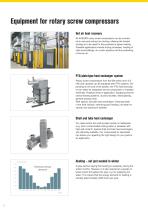
Equipment for rotary screw compressors Hot air heat recovery All KAESER rotary screw compressors can be connected to user-end exhaust air ducting, allowing the heated cooling air to be used for the purposes of space heating. Possible applications include drying processes, heating of halls and buildings, air curtain systems and the preheating of burner air. PTG plate-type heat exchanger system Rotary screw compressors from the SM series (from 5.5 kW) and upwards can be equipped with PTG systems. Depending on the size of the system, the PTG heat exchanger can either be integrated into the compressor...
Open the catalog to page 8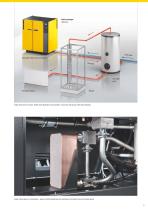
Heat exchanger (Internal) Cold water Air-cooled rotary screw compressor Hot water Hot-water heating Image: Heat recovery process. Potable water applications only possible in conjunction with special, safety heat exchanger Image: Internal layout of a compressor – system comprising plate-type heat exchanger, thermostatic valve and complete piping
Open the catalog to page 9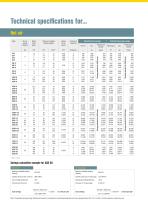
Technical specifications for... Hot air Type Rated motor power Maximum available heating capacity Potential fuel oil savings Potential natural gas savings Natural gas Heating cost savings Savings potential for 4000 hrs/yr Savings potential for 4000 hrs/yr Savings potential for 2000 hrs/yr Heating cost savings Savings potential for 2000 hrs/yr Savings calculation example for ASD 50 For fuel oil Maximum available heating capacity: Maximum available heating capacity: Calorific value per litre of fuel oil: Calorific value per m³ natural gas: 10.2 kWh/m³ Fuel oil heating efficiency: Natural gas heating...
Open the catalog to page 10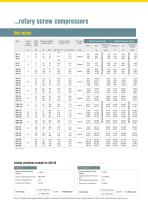
...rotary screw compressors Hot water Type Rated motor power Maximum available heating capacity Hot water volume (heating to 70 °C) Potential fuel oil savings Potential natural gas savings Heating cost savings Heating cost savings Savings potential for 4000 hrs/yr Savings potential for 4000 hrs/yr Savings potential for 2000 hrs/yr Savings potential for 2000 hrs/yr Savings calculation example for ASD 50 For fuel oil Maximum available heating capacity: Calorific value per litre of fuel oil: Fuel oil heating efficiency: Maximum available heating capacity: Calorific value per m³ natural gas: Natural...
Open the catalog to page 11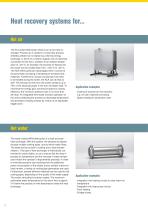
Heat recovery systems for... Hot air The Air-Cooled Aftercooler (ACA) is an air/air heat exchanger. Process air is cooled in a cross-flow process, whereby ambient air is heated via a thermal energy exchange. In terms of a medium supply, only an electrical connection for the fan is needed. At an ambient temperature of +20°C, for example, the process air flowing into the cooler can be cooled down from +150°C to +30°C. The ACA offers particular advantages when it comes to the pneumatic conveying of temperature-sensitive bulk materials. Furthermore, should a production hall need to be heated during...
Open the catalog to page 12
Image: DC 236 C with ACA compressed air aftercooler Image: FBS 660 S SFC with shell and tube heat exchanger
Open the catalog to page 13
Technical specifications: Heat recovery systems... Hot air Model Total mass Dimensions WxDxH Connection nominal width Max. process air flow rate Savings calculation example for ACA 350 (production hall heating) ACA 350 Blower (37 kW) Flow rate: Heat output: Pressure differential: Inlet temperature: Process air pressure loss: Discharge temperature: Cost savings approx. € 5,600 per year* * Calculation as per rotary screw compresso
Open the catalog to page 14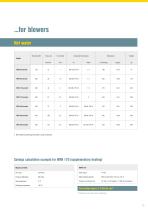
...for blowers Hot water Nominal width Connection dimensions *) With welded counterflange (included in scope of delivery) Savings calculation example for WRN 170 (supplementary heating) WRN 170 Blower (37 kW) Flow rate: Heat output: Pressure differential: Water heating capacity: Inlet temperature: Process air pressure loss: 20 mbar = 2 kW (approx. 1.2 kW more at blower) Discharge temperature: Cost savings approx. € 3,150 per year* * Calculation as per rotary screw comp
Open the catalog to page 15
The world is our home As one of the world’s largest manufacturers of compressors, blowers and compressed air systems, KAESER KOMPRESSOREN is represented throughout the world by a comprehensive network of branches, subsidiaries and authorised distribution partners in over 140 countries. By offering innovative, efficient and reliable products and services, KAESER KOMPRESSOREN’s experienced consultants and engineers work in close partnership with customers to enhance their competitive edge and to develop progressive system concepts that continuously push the boundaries of performance and technology....
Open the catalog to page 16All KAESER Kompressoren catalogs and technical brochures
 ECO-DRAIN series
8 Pages
 KF F6 to F320 Series
11 Pages
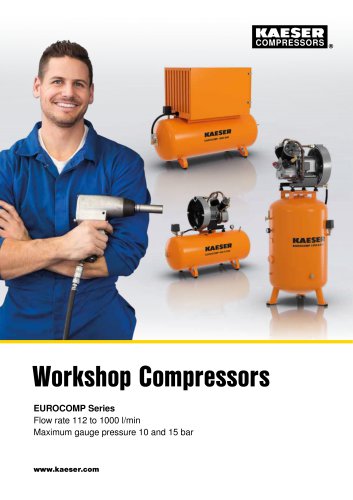 Workshop Compressors
9 Pages
 Heat Recovery Systems
9 Pages
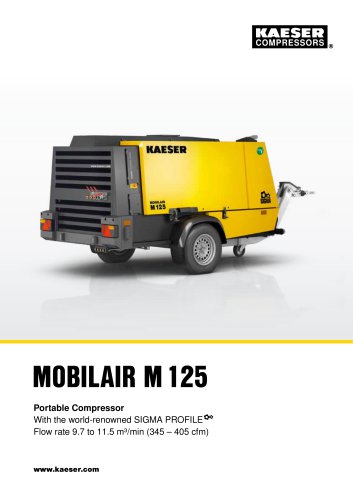 MOBILAIR M 125
5 Pages
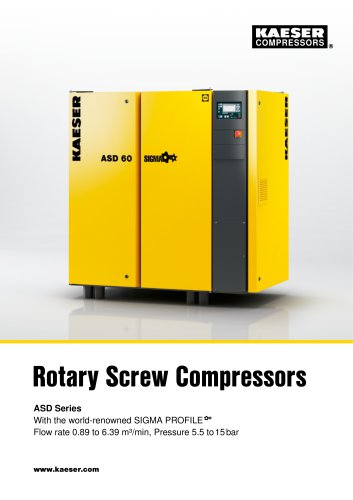 ASD Series
11 Pages
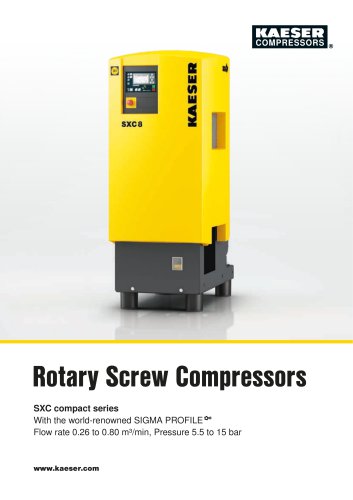 SXC compact series
5 Pages
 i.Comp 3 series
12 Pages
 Boosters series DN C
20 Pages
 KAESER Blowers
32 Pages
 Hybritec Combination Dryer
9 Pages
 Membrane dryers KMM series
5 Pages
 Rotary Screw Compressors
36 Pages
 Boosters N Series
5 Pages
 Air receivers
8 Pages
 Desiccant dryers DC 12-1545
24 Pages
 SIGMA AIR MANAGER 4.0
11 Pages
 Air main charging system DHS 4.0
12 Pages
 KAESER Product Range Overview
12 Pages
 MOBILAIR® M27/M30/M31
12 Pages
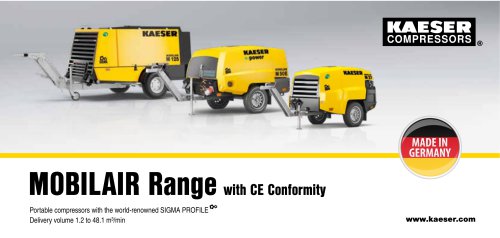


Archived catalogs
 Mobilair general catalogue
20 Pages
 MOBILAIR® M118 /M125
8 Pages
 MOBILAIR® M13/M15/M17
8 Pages
 ASD Series
20 Pages
 SXC compact series
8 Pages


- Vessel
- KAESER air compressor
- KAESER positive-displacement compressor
- KAESER stationary compressor
- Measuring device
- KAESER industrial compressor
- Storage vessel
- KAESER electrically-powered compressor
- KAESER piston compressor
- Metal tank
- KAESER lubricated compressor
- KAESER oil-free compressor
- Air blower
- KAESER compact compressor
- Centrifugal blower
- Single-stage blower
- Stainless steel pre-filter
- Centrifugal classifier