MI-165
MI-165
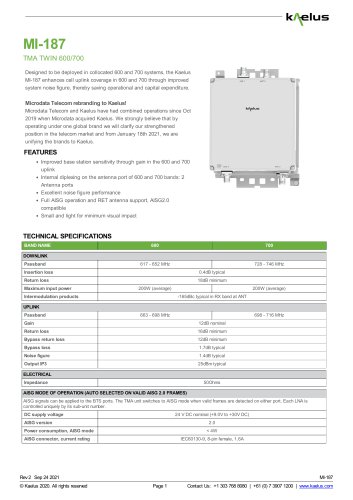
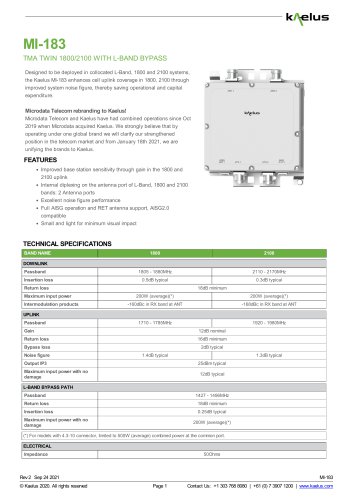
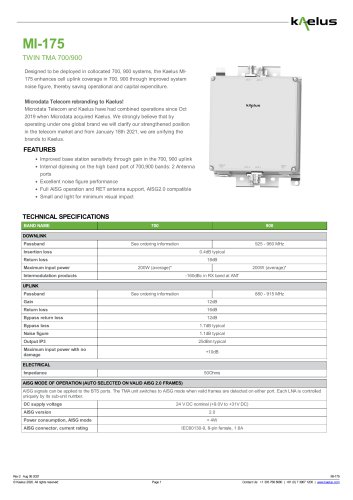
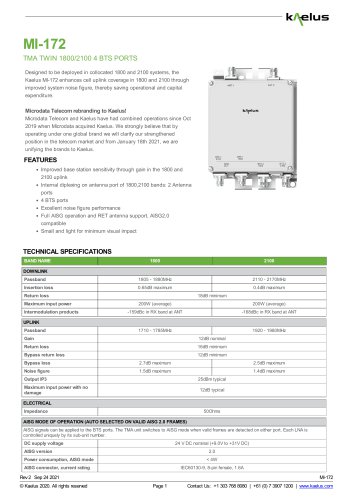
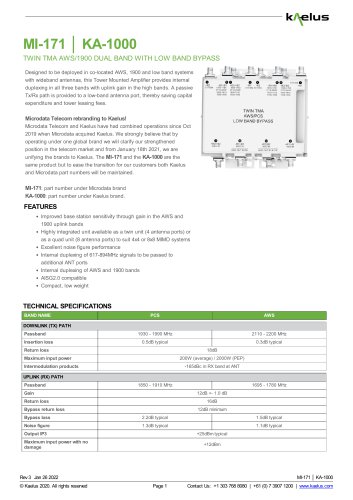
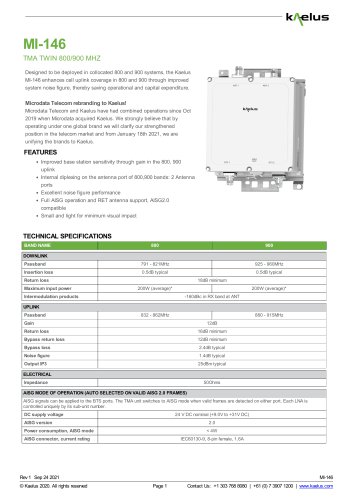
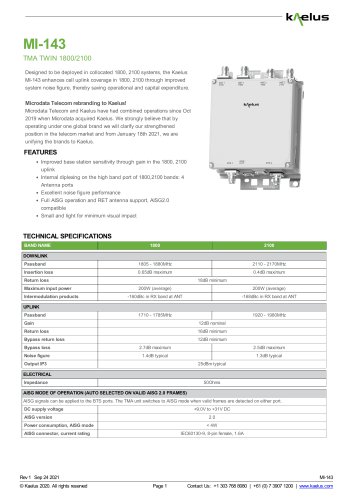
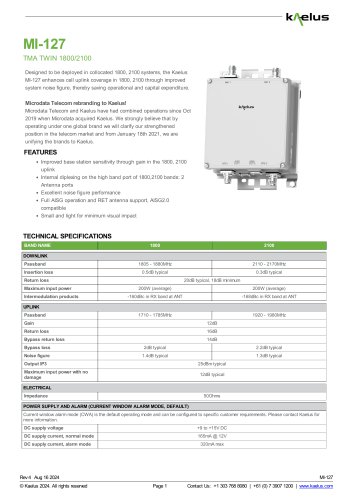
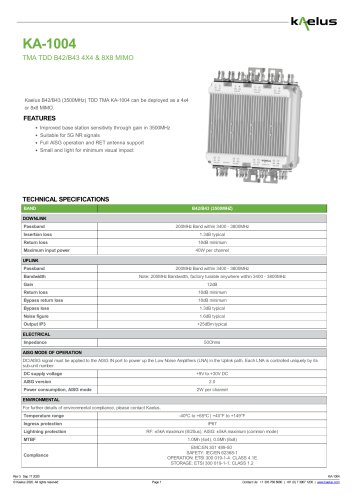
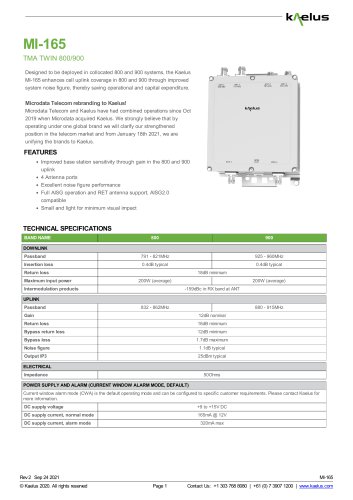
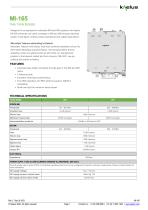
The Kaelus MI-165 is designed for deployment in collocated 800 and 900 MHz systems, enhancing cell uplink coverage through improved system noise figure. It features improved base station sensitivity, four antenna ports, excellent noise figure performance, and full AISG operation with RET antenna support. The product is small and lightweight to minimize visual impact.
Technical Specifications
Downlink:
- Passband: 791 - 821 MHz (800), 925 - 960 MHz (900)
- Insertion Loss: 0.4 dB typical
- Return Loss: 18 dB minimum
- Maximum Input Power: 200W (average)
- Intermodulation Products: -159 dBc in RX band at ANT
Uplink:
- Passband: 832 - 862 MHz (800), 880 - 915 MHz (900)
- Gain: 12 dB nominal
- Return Loss: 16 dB minimum
- Bypass Return Loss: 12 dB minimum
- Bypass Loss: 1.7 dB maximum
- Noise Figure: 1.1 dB typical
- Output IP3: 25 dBm typical
Electrical Specifications
- Impedance: 50 Ohms
- Power Supply: +9 to +15V DC, 165mA @ 12V (normal mode), 320mA max (alarm mode)
AISG Mode of Operation
The TMA unit switches to AISG mode when valid frames are detected. It supports AISG versions 1.1 or 2.0 with a power consumption of less than 4W.
Environmental Specifications
- Temperature Range: -40ºC to +65ºC
- Ingress Protection: IP67
- Lightning Protection: IEC61312-1
- MTBF: >1,000,000 hours
- Compliance: EMC (EN 301 489-8), Safety (EN 62368-1), Operation (ETSI EN 300 019-1-4 class 4.1E), Storage (ETS 300 019-1-1 class 1.2)
Mechanical Specifications
- Dimensions: 249 x 152 x 234 mm
- Weight: 9.5 kg
- Finish: Powder coated, NCS 1502-R
- Mounting: Pole/wall bracket
Ordering Information
Various configurations are available with different connector types and AISG modes. The part numbers include MI-16501, MI-16502, MI-16506, MI-16531, MI-16532, and MI-16536, each offering specific features and configurations.
Company Information
Microdata Telecom rebranded to Kaelus in January 2021 to unify operations under one global brand, strengthening their position in the telecom market.
Catalog excerpts
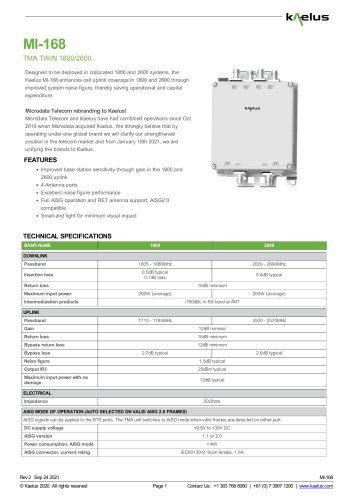
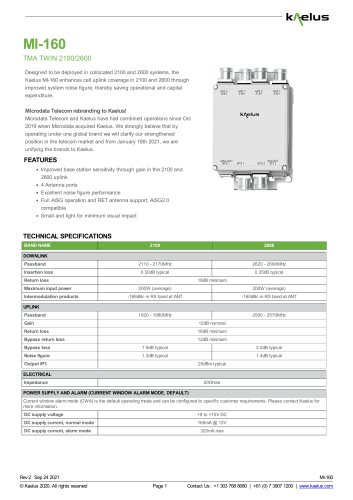
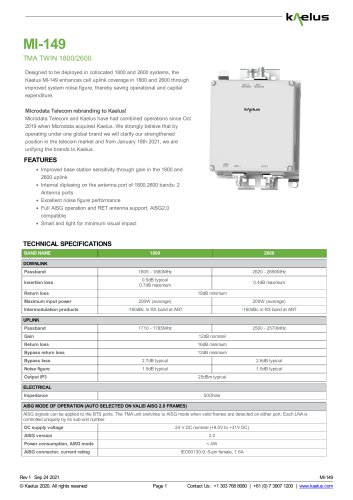
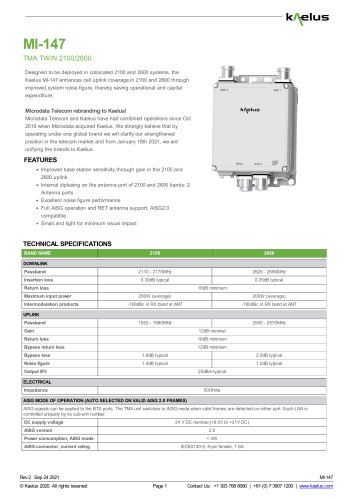
Designed to be deployed in collocated 800 and 900 systems, the Kaelus MI-165 enhances cell uplink coverage in 800 and 900 through improved system noise figure, thereby saving operational and capital expenditure. Microdata Telecom rebranding to Kaelus! Microdata Telecom and Kaelus have had combined operations since Oct 2019 when Microdata acquired Kaelus. We strongly believe that by operating under one global brand we will clarify our strengthened position in the telecom market and from January 18th 2021, we are unifying the brands to Kaelus. • Improved base station sensitivity through gain in the 800 and 900 uplink • Excellent noise figure performance • Full AISG operation and RET antenna support, AISG2.0 compatible • Small and light for minimum visual impact © Kaelus 2020. All rights reserved Page 1 Contact Us: +1 303 768 8080 | +61 (0) 7 3907 1200 | www.kaelus.com
Open the catalog to page 1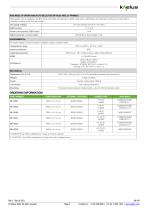
© Kaelus 2020. All rights reserved Page 2 Contact Us: +1 303 768 8080 | +61 (0) 7 3907 1200 | www.kaelus.com
Open the catalog to page 2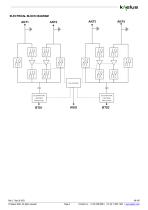
ELECTRICAL BLOCK DIAGRAM Rev 2 Sep 24 2021 © Kaelus 2020. All rights reserved
Open the catalog to page 3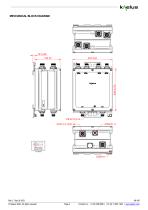
MECHANICAL BLOCK DIAGRAM Rev 2 Sep 24 2021 © Kaelus 2020. All rights reserved
Open the catalog to page 4