
- Catalogs
- Kadant Johnson Europe B.V.
- Thermocompressors


- Company
- Products
- Catalogs
- News & Trends
- Exhibitions
Thermocompressors

Thermocompressors
Kadant steam jet thermocompressors are engineered for energy efficiency, designed to recirculate or boost lower-pressure steam for reuse in various industries such as pulp and paper, petrochemical, food processing, desalination, and specialty chemical production.
Thermocompressors mix lower-pressure steam with higher-pressure steam. The high-pressure motive steam entrains the lower-pressure steam, increasing its pressure. The process involves a nozzle, mixing chamber, and diffuser, where steam flows are mixed, accelerated, and pressure is increased.
- Computational fluid dynamics for flow modeling.
- Custom sizing based on operating conditions.
- Retrofit without piping modifications.
- Optimized geometry for improved efficiency.
- Entrainment efficiency improvements up to 25%.
- Reduced motive steam use and increased energy efficiency.
Kadant offers high-efficiency thermocompressors with improved energy utilization, custom-engineered for optimal performance. These units provide significant energy conservation benefits, including increased power generation and elimination of steam venting.
The document provides detailed sizing charts and specifications for various thermocompressor models, based on parameters like motive, suction, and discharge steam pressures and flow rates. A sizing example is provided to illustrate the calculation of entrainment, motive, and discharge steam flow rates.
Kadant Johnson Europe B.V., Weesp, The Netherlands. Contact details are provided for further inquiries.
Catalog excerpts

Energy-efficient steam jet compressors.
Open the catalog to page 1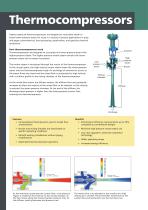
Thermocompressors Kadant steam jet thermocompressors are designed to recirculate steam or boost lower-pressure steam for reuse in a variety of process applications in pulp and paper, petrochemical, food processing, desalination, and specialty chemical production. How thermocompressors work Thermocompressors are designed to accurately mix lower-pressure steam with higher-pressure steam. The higher-pressure motive steam entrains the lowerpressure steam and increases its pressure. The motive steam is introduced through the nozzle of the thermocompressor. As the nozzle opens, the high velocity motive...
Open the catalog to page 2
High-efficiency thermocompressors In addition to retro-fitting existing steam jet compressors, Kadant also provides high-efficiency thermocompressors for improved energy utilisation. Based on extensive product development, modeling, testing, and field applications, Kadant’s high-efficiency thermocompressor offers entrainment ratio improvements of up to 25% over conventional steam jet compressors. Standard Unit High-Efficiency Unit Booster and recirculating applications Retrofit existing installations Match thermocompressor to syphons Maximise entrainment ratio Minimise motive steam use Improve...
Open the catalog to page 3
Thermocompressor Sizing The following charts can be used to estimate the size of a thermocompressor. The size is based on the motive, suction, and discharge steam pressures and the required steam flow. The following parameters are used for these estimates: P = Atmospheric pressure (absolute) = 1 bar (typical) Pm = Motive steam pressure (absolute) = gauge pressure + atmospheric pressure Ps = Suction steam pressure (absolute) = gauge pressure + atmospheric pressure Pd = Discharge steam pressure (absolute) = gauge pressure + atmospheric pressure Mm = Motive steam flow rate Ms = Suction steam flow...
Open the catalog to page 4All Kadant Johnson Europe B.V. catalogs and technical brochures
 Rotary Joints G line
20 Pages
 SPRAY NOZZLES
142 Pages
 M-CLEAN™ SYSTEM
4 Pages
 ELSX™ ROTARY JOINTS
2 Pages
 Plant Optimization Services
4 Pages
 Dryer Equipment Services
1 Page
 LJX™ Rotary Joint
2 Pages
 CorrPro® Rotary Joints
2 Pages
 LJ-PT™ Steam Joint
1 Page
 FLEXIBLE METAL HOSE
1 Page
 SIGHT FLOW INDICATORS
2 Pages
 VACUUM BREAKERS
4 Pages
 SX Rotary Joint
2 Pages
 Thermocompressors
4 Pages
 Metals Industries
8 Pages
 Multi-Passage Rotary Unions
2 Pages
 ELS™ Rotary Joints
2 Pages
 Custom Rotary Unions
8 Pages
 Rotary Scoop Syphon
2 Pages
 Pivot Body™ Syphon Elbow
2 Pages
 Flexible Metal Hose
2 Pages


Archived catalogs
 ELSX™ Rotary Joint
2 Pages
 Sight Flow Indicators
2 Pages
 Vacuum Breakers
4 Pages
 PTX Rotary Joint
8 Pages
 Rotary Joints Type G
20 Pages
 SNX Rotary Joint
2 Pages
 G™ Rotary Unions
20 Pages
 RX Rotary Unions
28 Pages
 ELS Rotary Joints
20 Pages
- Liquid filter
- Structure hose
- Flexible hose
- KADANT rotary union
- Spray tip
- Industrial use filter
- Liquid nozzle
- KADANT multi-passage rotary union
- KADANT steel rotary union
- Steel hose
- Tube connector
- KADANT stainless steel rotary union
- Cleaning nozzle
- KADANT oil rotary union
- KADANT air rotary union
- KADANT water rotary union
- Y-strainer filter
- Multi-jet nozzle
- Basket filter