
- Catalogs
- Kadant Johnson Europe B.V.
- Multi-Passage Rotary Unions


- Company
- Products
- Catalogs
- News & Trends
- Exhibitions
Multi-Passage Rotary Unions

Multi-Passage Rotary Unions
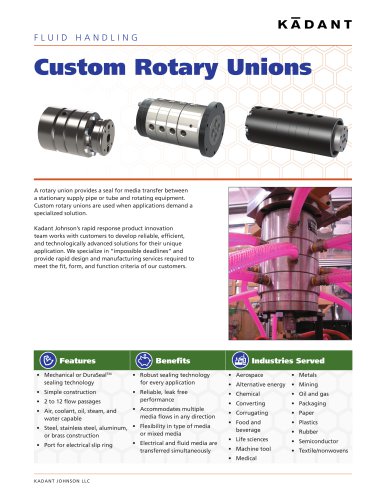
Multi-passage rotary unions are designed to transfer multiple types of media into and out of rotating equipment while maintaining media separation. They are applicable for use in equipment such as drums, index tables, clutches, or spindles.
Features
- Utilizes mechanical or DuraSeal™ sealing technology.
- Simple construction with two to twelve flow passages.
- Capable of handling air, coolant, oil, steam, and water.
- Constructed from materials such as steel, stainless steel, aluminum, or brass.
- Includes a port for an electrical slip ring.
Benefits
- Robust sealing technology ensures reliable, leak-free performance.
- Accommodates multiple media flows in any direction, offering flexibility in media type or mixed media.
- Allows simultaneous transfer of electrical and fluid media.
Standard Ratings
- Maximum Pressure: 4,500 psi (310 bar)
- Maximum Temperature: Up to 200ºF (93ºC)
- Maximum Speed: Up to 250 rpm
- Passage Sizes: 1/8”, 1/4”, 3/8”, 1/2”
- Connection Types: NPT, BSPT, G/BSP (ISO 228), O-ring
Specifications
Specifications are subject to change and are provided for reference only. The dimensions vary based on the number of passages and whether an electrical port is included. For example, a 2-passage unit without an e-port measures 3.86 x 3.86 x 5.79 inches, while a 12-passage unit with an e-port measures 5.91 x 5.31 x 20.47 inches.
Mounting Options
- Accessory mounting option for use with electrical slip rings.
- Table and journal mounting options available, with bolt patterns determined by the customer.
Contact Information
Kadant Johnson LLC, 805 Wood Street, Three Rivers, MI 49093 USA. Tel: +1-269-278-1715, Email: [email protected]
Note: This document replaces all previous versions as of June 2019.
Catalog excerpts
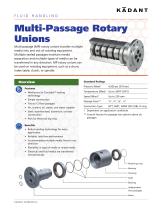
FLUID HANDLING Multi-Passage Rotary Unions Multi-passage (MP) rotary unions transfer multiple media into and out of rotating equipment. Multiple sealed passages maintain media separation and multiple types of media can be transferred in any direction. MP rotary unions can be used on rotating equipment, such as a drum, index table, clutch, or spindle. Overview Features • Mechanical or DuraSeal™ sealing technology • Simple construction • Two to 12 flow passages • Air, coolant, oil, steam, and water capable • Steel, stainless steel, aluminum, or brass construction • Port for electrical slip ring Standard Ratings Pressure (Max)* Passage Sizes** Connection Type NPT, BSPT, G/BSP (ISO 228), O-ring * Dependent on application conditions ** Consult factory for passage size options above six passages Benefits • Robust sealing technology for every application • Reliable, leak-free performance • Accommodates multiple media flows in any direction • Flexibility in type of media or mixed media • Electrical and fluid media are transferred simultaneously Retaining ring Bearing Housing Seals Bearing Independent flow passa
Open the catalog to page 1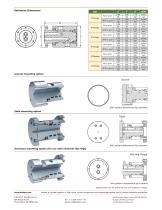
Journal mounting option Journal Bolt pattern determined by customer. Table mounting option Table Accessory mounting option (for use with electrical slip rings) Slip ring flange Bolt pattern determined by customer. Specifications are for reference only and subject to change. Kadant is a global supplier of high-value, critical components and engineered systems used in process industries worldwide. KADANT JOHNSON LLC 805 Wood Street Three Rivers, MI 49093 USA Multi-Passage Rotory Unions-1000 (US) 06/2019 Replaces All Previous Versions © 2019 Kadant Johnson LLC
Open the catalog to page 2All Kadant Johnson Europe B.V. catalogs and technical brochures
 Rotary Joints G line
20 Pages
 SPRAY NOZZLES
142 Pages
 M-CLEAN™ SYSTEM
4 Pages
 ELSX™ ROTARY JOINTS
2 Pages
 Plant Optimization Services
4 Pages
 Dryer Equipment Services
1 Page
 LJX™ Rotary Joint
2 Pages
 CorrPro® Rotary Joints
2 Pages
 LJ-PT™ Steam Joint
1 Page
 FLEXIBLE METAL HOSE
1 Page
 SIGHT FLOW INDICATORS
2 Pages
 VACUUM BREAKERS
4 Pages
 SX Rotary Joint
2 Pages
 Thermocompressors
4 Pages
 Metals Industries
8 Pages
 ELS™ Rotary Joints
2 Pages
 Custom Rotary Unions
8 Pages
 Rotary Scoop Syphon
2 Pages
 Pivot Body™ Syphon Elbow
2 Pages
 Flexible Metal Hose
2 Pages


Archived catalogs
 ELSX™ Rotary Joint
2 Pages
 Sight Flow Indicators
2 Pages
 Vacuum Breakers
4 Pages
 Thermocompressors
4 Pages
 PTX Rotary Joint
8 Pages
 Rotary Joints Type G
20 Pages
 SNX Rotary Joint
2 Pages
 G™ Rotary Unions
20 Pages
 RX Rotary Unions
28 Pages
 ELS Rotary Joints
20 Pages
- Piping
- Liquid filter
- Structure hose
- Flexible hose
- Spray tip
- Industrial use filter
- Liquid nozzle
- KADANT steel rotary union
- Steel hose
- Tube connector
- KADANT stainless steel rotary union
- Cleaning nozzle
- KADANT oil rotary union
- KADANT air rotary union
- KADANT water rotary union
- Y-strainer filter
- Multi-jet nozzle
- Basket filter