


The MAC motor. AC servo motor with integrated driver. MAC50, 95, 140 1nd 141

1 / 8 PagesView full catalog
The MAC motor. AC servo motor with integrated driver. MAC50, 95, 140 1nd 141
Product catalog summary
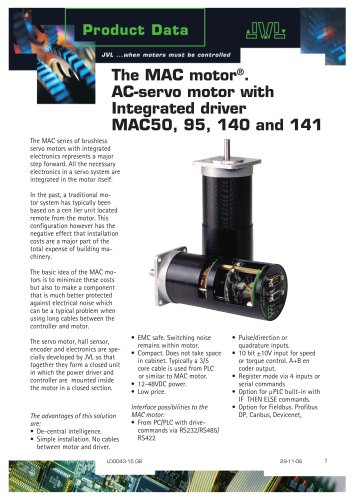
Overview: The MAC motor series by JVL integrates AC servo motors with built-in electronics, offering a compact solution that reduces installation costs and enhances protection against electrical noise. These motors are designed to replace traditional systems that require separate controllers and long cables.
Key Features:
- Integrated electronics within the motor, eliminating the need for separate controllers.
- De-central intelligence and simple installation with no cables between motor and driver.
- Multiple control modes including pulse/direction, ±10V input for speed or torque control, and serial commands.
- Options for built-in micro PLC and Fieldbus compatibility (Profibus, Canbus, Devicenet).
- EMC safe design with compact form factor.
- Operates on 12-48VDC power supply.
Interface and Control: The MAC motor can be controlled via RS232/RS485/RS422 interfaces and supports ±10V for speed or torque control. It can replace step or servo systems without software changes, and parameters are configured through a Windows program.
Operating Modes:
- Gear Mode: Functions like a step motor system with encoder feedback for monitoring.
- Positioning Mode: Positions the motor via RS422 or serial interface commands.
- Serial Mode (FastMac): Utilizes internal registers for parameter sets and positions.
- Velocity/Torque Mode: Controls motor velocity/torque via analogue input.
Performance Specifications:
- Rated output varies from 46W to 134W depending on the model (MAC50, MAC95, MAC140, MAC141).
- Speed range up to 4000 RPM, with a recommended maximum of 2700 RPM for MAC141.
- Torque specifications include peak and rated torque values, with detailed torque versus speed graphs provided.
Expansion Modules: Various modules are available to enhance functionality, including high-speed multi-axis modules, general-purpose modules, and wireless modules. These modules offer features like multi-axis operation, IP67 protection, and compatibility with different communication protocols.
Technical Data: The document provides detailed technical specifications, including control modes, input power supply, feedback systems, and protective functions. The motors are CE approved, with UL approval pending, and offer IP42 or IP67 protection.
Conclusion: The MAC motor series offers a versatile and integrated solution for industrial automation, reducing installation complexity and cost while providing robust performance and flexibility through various control and expansion options.
Specifications: The document outlines the specifications of various gear types and MAC motors. Key features include high shaft loading capacity, low backlash design, strong caged roller bearings, and precision input pinion with balanced clamp collar. Dimensions such as gear length including flange (L1), gear housing diameter (D2), and output shaft diameter (D2) are specified.
Gear Types: HTRG and HSPG type gears are detailed with specifications such as backlash, gear ratio, efficiency, rated torque, emergency stop torque, inertia at motor shaft, noise level, radial and axial load capacities, and weight. Specific models like HTRG05N003MHN23106J and HSPG60-35-SAA-N23 are mentioned with their respective parameters.
Power Supply: The power supply section describes a system capable of feeding several MAC motors up to 1000 W total. It includes a large capacitor for energy absorption during deceleration and a built-in power dump resistor for voltage regulation. The PSU00-PD1 model is highlighted.
MAC Motors: Various MAC motor models such as MAC50, MAC95, MAC140, and MAC141 are discussed. Features include unbalanced and balanced asynchronous serial interfaces, analogue inputs for speed/torque control, pulse inputs and outputs, digital user inputs and outputs, and integrated brakes. Protection classes range from IP42 to IP67.
Expansion Modules: The document lists expansion modules for MAC motors, including connector modules with cable glands, Nano PLCs, Bluetooth modules, and Profibus DP modules. Communication interfaces like RS232 and RS422 are specified with baud rates and full duplex capabilities.
Mechanical Dimensions: Detailed mechanical dimensions for MAC motors and accessories are provided, including standard NEMA23 dimensions and mounting hole specifications.
Accessories and Ordering Information: Accessories such as cables, software for motor setup, end covers, power supplies, and transformers are listed. Ordering information for MAC motors includes motor type, rated output, protection level, and standard features.
See more
All JVL A/S catalogs and technical brochures
 MAC140-F
2 Pages
 Mac Motor brochure
2 Pages
 Integrated ServoStep NEMA17
3 Pages
 Integrated ServoStep NEMA23
2 Pages
 JVL closed-loop
2 Pages
 Power supplies psu48
2 Pages
 ld058gb
4 Pages
 ld044gb
4 Pages
 ld016gb
4 Pages
 ld025gb
4 Pages
 ld011gb
2 Pages
 ld008gb
2 Pages
 ld022gb
2 Pages
 ld021gb
2 Pages
 ld038gb
2 Pages
 DC Motor Controller DMC10
2 Pages





Archived catalogs


Related Searches
- JVL electric motor
- Display module
- JVL DC power supply
- Electrical cable
- JVL DC motor
- JVL AC/DC power supply
- JVL actuator
- LCD display panel
- Multipole motor
- Angular encoder
- JVL linear actuator
- Automation software solution
- Industrial display panel
- JVL planetary gear reducer
- Electric actuator
- JVL coaxial gear reducer
- Incremental encoder
- Power cable
- Electromotor for industrial applications
*Prices are pre-tax. They exclude delivery charges and customs duties and do not include additional charges for installation or activation options. Prices are indicative only and may vary by country, with changes to the cost of raw materials and exchange rates.
About DirectIndustry
DirectIndustry is a marketplace that offers B2B players a complete experience, from product sourcing to purchase. DirectIndustry is an entity of VirtualExpo Group.
Are you a buyer?
Are you a supplier?