

- Company
- Products
- Catalogs
- News & Trends
- Exhibitions
JK-05
JK-05
Application Areas
The document outlines various application areas including aerospace instrumentation, medical devices, signal cables, cryogenic high-field environments, insulated cables, and transportation systems. It also mentions vApplications and technical specifications relevant to these fields.
Technical Specifications and Temperature Ranges
Key temperature ranges are specified for different applications: from -200°C to +300°C and from -60°C to +250°C. These ranges indicate the operational limits for materials or components discussed.
Electrical and Mechanical Properties
The document references parameters such as flame retardant ratings (VW-1), radiation resistance levels up to 850 KGy, and voltage ratings up to 600 V. Mechanical strength is indicated by a minimum tensile strength greater than 80 MPa.
Product Advantages and Characteristics
Advantages highlighted include water vapor permeability, excellent electrical properties, and resistance to mechanical and dielectric breakdowns. The document emphasizes the importance of these characteristics for reliable performance in demanding environments.
Summary of Key Parameters
- Temperature ranges: -200°C to +300°C and -60°C to +250°C
- Flame retardant rating: VW-1
- Radiation resistance: up to 850 KGy
- Voltage rating: 600 V
- Mechanical tensile strength: >80 MPa
- Water vapor permeability: low
- Electrical and dielectric properties: excellent
Recommendations and Best Practices
While specific procedures are not detailed, the document implies the importance of selecting materials and components that meet these stringent specifications to ensure safety, durability, and performance in specialized applications such as aerospace and medical instrumentation.
Catalog excerpts
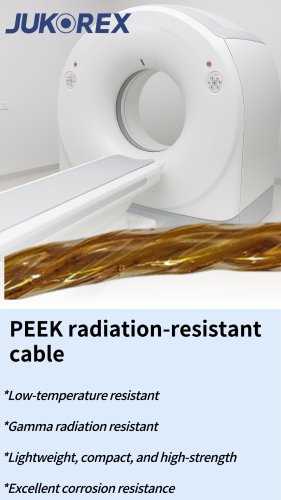
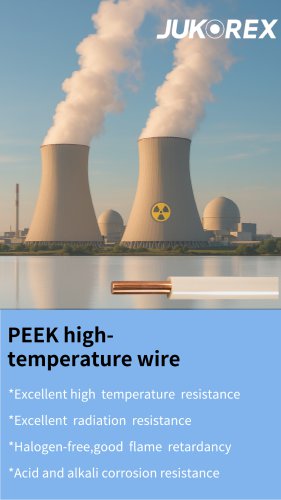
*Low-temperature resistant *Gamma radiation resistant *Lightweight, compact, and high-strength *Excellent corrosion resistance
Open the catalog to page 1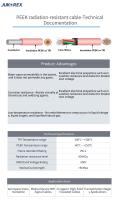
PEEK radiation-resistant cable-TechnicalDocumentation Product Advantages Water vapor permeability is the lowest, and it does not permeate any gases. Excellent electrical properties such as in sulation resistance and dielectric breakd own voltage Corrosion resistance - Resists virtually al l chemicals and oxidizing agents. Excellent electrical properties such as in sulation resistance and dielectric breakd own voltage Low-temperature resistance - No embrittlement or creep occurs in liquid nitroge n, liquid oxygen, and liquefied natural gas.
Open the catalog to page 2All Jukorex New Material Co.,Ltd. catalogs and technical brochures
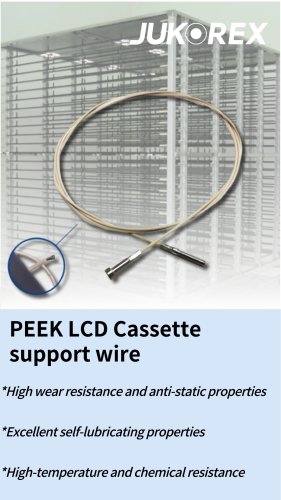
- Electrical cable
- Power cable
- Insulated electrical cable
- Multi-strand cable
- Multi-wire electrical cable
- Electrical data cable
- IEC electrical cable
- Industrial cable
- Halogen-free cable
- Switch electrical cable
- Flame-retardant cable
- Halogen-free electrical cable
- Armored cable
- Flame-retardant electrical cable
- 3D printer filament
- Single-conductor cable
- Solid electrical cable
- Armored electrical cable
- Oil-resistant cable
- VirtualExpo Group
- Our Partners
- Recruitment
- Testimonials