


Precision Ball & Roller Bearings for Machine Tools

Precision Ball & Roller Bearings for Machine Tools
This document is a revised catalog for KOYO's precision ball and roller bearings, specifically designed for machine tools. It addresses the increasing demand for compact, lightweight bearings with longer service life, higher performance, and reliability.
- Types and Structures: Details various types of precision ball and roller bearings, including spindle bearings and support bearings for precision ball screws, highlighting features like contact angles and high-speed performance.
- Selection of Bearings: Provides guidelines for selecting the appropriate bearing based on operating conditions, bearing requirements, and cost performance, considering factors like installation space, load types, and rotational speeds.
- Service Life and Load Ratings: Explains how to calculate the service life of bearings, including dynamic and static load ratings, and permissible axial loads.
- Rigidity and Preload: Information on the rigidity and preload of bearings, emphasizing their importance in improving machining precision.
- Lubrication: Discusses grease and oil lubrication methods, including the design of peripheral parts like spacers for oil/air lubrication.
- Angular Contact Ball Bearings: Provides details on types, features, and tolerances, along with standard preloads and axial load considerations.
- Cylindrical Roller Bearings: Includes information on types, features, and radial internal clearances.
- Tapered Roller Bearings: Covers types, features, and axial load considerations for tapered roller bearings.
- Handling of Bearings: Provides guidelines for the proper handling and mounting of bearings.
- Oil/Air Lubrication System: Describes the oil/air lubricator and air cleaning unit for effective lubrication.
Discusses common bearing failures, their causes, and countermeasures to help users prevent and address issues.
Additional tables provide information on shaft tolerances, housing bore tolerances, steel hardness conversion, and lubrication intervals.
The catalog serves as a comprehensive guide for selecting and using precision ball and roller bearings in machine tools, offering insights into design considerations, performance optimization, and maintenance practices.
Discusses the load capacity of bearings, expressed in terms of the basic load rating found in bearing dimension tables. Emphasizes selecting the optimal bearing type based on load magnitude, direction (axial or radial), vibration, and shock levels.
Standard values for rotational speed limits are provided in bearing dimension tables. Limiting speeds depend on bearing type, size, running accuracy, cage type, load magnitude, and lubrication.
Table 4.1 presents typical spindle bearing arrangements for machine tools, highlighting the use of ceramic bearings for high-speed spindles.
Explains the concept of bearing service life, affected by repetitive loads leading to fatigue. The basic dynamic load rating represents the bearing's load capacity.
Dynamic equivalent loads account for varying load conditions, combining radial and axial loads. Calculations for dynamic equivalent loads are provided.
Outlines the specifications for dynamic and static load ratings of bearings. Defines the maximum dynamic equivalent load (Pmax) and the mean rotational speed (nm) for ball and roller bearings.
The static equivalent load is calculated to simulate the contact stress under actual loading conditions.
A safety coefficient (ƒs) is used to ensure the bearing's safety concerning its static load rating.
Discusses the service life of greases used in bearings, emphasizing the importance of selecting the right grease type and amount to prevent bearing failures.
Permissible axial loads are defined to prevent deformation and damage to bearings under large axial loads.
Methods to improve bearing rigidity include using roller bearings for high radial rigidity and angular contact ball bearings for high axial rigidity.
The relationship between preload and axial rigidity is illustrated, showing how preload affects displacement and rigidity.
Preload can vary due to fitting conditions and rotation, influenced by factors like centrifugal force and temperature rise.
Provides detailed specifications for shaft fits in the case of a rotating inner ring, including tolerance classes and target interferences for various bearing types.
To maintain bearing performance, selecting the appropriate preload method and amount is crucial, especially for high-speed applications.
The permissible rotational speed of a bearing is influenced by factors such as bearing type, dimensions, lubrication, and loading conditions.
Lubrication is critical for reducing wear, removing heat, and extending bearing life.
Grease lubrication is commonly used due to its simplicity.
This method supplies a small amount of oil intermittently using compressed air.
Oil mist lubrication is cost-effective and suitable for high-speed performance.
Jet lubrication involves injecting a large quantity of lubricant at high velocities through the bearing side to lubricate and cool simultaneously.
The precision of shafts and housings is crucial as their shapes influence the bearing's raceway surface and running accuracy.
Chamfer dimensions and fillet radii are defined by imaginary arcs tangent to the bearing surfaces.
Dimensions for spacers used in oil/air lubrication systems are detailed for various bearing series.
- Angular Contact Ball Bearings: The 3NCHAC000 and 3NCHAC900 series are commonly used with contact angles of 15° and 20°.
- Spacers for Oil/Air Lubrication: Dimensions for spacers in the 3NCHAD000, 3NCHAF000, and 3NCHAF900 series are detailed.
- Cylindrical Roller Bearings: Specifications for the NN3000, N1000, and 3NCN1000 series are provided.
- High Ability Bearings: These bearings are optimized for machine-tool spindles, excelling in high-speed performance and rapid acceleration/deceleration.
- Types and Applications: Various types of High Ability bearings are available, each suited for different applications.
- Performance Improvements: High Ability bearings offer a 20-30% reduction in temperature increase and 1.2 to 1.5 times increase in speed limits compared to conventional products.
- Type D Bearings: Designed for oil/air lubrication with an oiling groove in the inner ring for improved lubrication reliability.
- Type F Bearings: Feature an oiling port in the outer ring, providing excellent high-speed performance and stability against rapid acceleration/deceleration.
- Figures in the document compare temperature increases, noise levels, and air consumption between different bearing types and conventional bearings.
- High Ability bearings show better performance in terms of temperature control and speed limits, especially when using ceramic balls.
- Ceramic bearings, made from silicon nitride, offer advantages such as reduced slip, improved rigidity, and longer service life.
- The document includes a comparison of properties between ceramics and bearing steel, highlighting the benefits of ceramics in high-speed applications.
JTEKT has established standard load ratings for ceramic bearings based on experimental results.
Ceramic bearings, specifically those made from Si3N4, exhibit superior properties compared to bearing steel (SUJ2).
Ceramic bearings are categorized into different types based on their structure, such as 3NC and 6NC.
Ceramic bearings outperform steel bearings in high-speed applications due to their lower density and linear expansion coefficient.
Ceramic bearings have a longer fatigue service life and seizure life compared to steel bearings.
Angular contact ball bearings can handle radial, unidirectional axial, or combined loads.
These bearings are adjusted for preload and axial clearance, available in four preload classes: slight, light, medium, and heavy.
- Specifications: The document lists basic load ratings, mounting dimensions, and permissible axial loads for different bearing models.
- Load Ratings: Basic dynamic and static load ratings are provided for single-row, tandem, back-to-back, and face-to-face configurations.
- Contact Angle: Bearings have a contact angle of 20°, which affects the load distribution and performance.
- Types and Features: The document describes double row and single row cylindrical roller bearings, highlighting their high radial rigidity and suitability for high-speed rotation.
- Bearing Series: It covers the NN3000, NNU4900, N1000, and 3NCN1000 series, detailing their composition, including cage symbols, tolerance classes, and internal clearance symbols.
- Lubrication: Some bearings feature a lubrication groove and holes to ensure adequate lubrication supply.
- Mounting and Dismounting: The document provides guidelines for mounting and dismounting bearings, emphasizing the separability of outer and inner rings.
- Preload and Speed Coefficients: Preload types (M, H, S, L) and their corresponding speed coefficients are discussed, indicating variations based on bearing distance.
The document provides detailed specifications for various types of angular contact ball bearings, including dimensions, load ratings, and speed limits.
Instructions are provided for the mounting of bearings, including the use of spacers for oil/air lubrication and discharge intervals.
The document adheres to JTEKT standards for tolerance classes, which are equivalent to JIS Classes 5 and 4.
Recommendations include selecting bearings with greater contact angles for applications where rigidity is a priority.
Tables provide detailed dimensions and load ratings for various bearing series.
Critical parameters include the nominal bore and outside diameters, bearing width, and the specific preload values for high-speed matched pair angular contact ball bearings.
The document provides detailed specifications for various types of bearings, including angular contact ball bearings and tapered roller bearings.
The document outlines the procedures for selecting and using bearings, emphasizing the importance of matching the small and large bore diameter types with the appropriate tapered-bore diameter sides.
The bearings are designed to meet ISO sub-unit specifications, ensuring interchangeability on an international level.
Recommendations include using pairs of single row tapered roller bearings in face-to-face or back-to-back arrangements to handle unidirectional axial loads.
The tables and figures in the document provide comprehensive data on the dimensions, load ratings, and speeds of various bearings.
The document provides detailed specifications for various types of bearings, particularly focusing on support bearings and support bearing units for precision ball screws.
Support bearings are available in matched pairs or stack configurations, indicated by suffixes such as DB (back-to-back), DF (face-to-face), DFD (three bearings), and DFF (four bearings).
The document outlines the composition of identification numbers for bearings, which include nominal bore and outside diameters, internal design codes, and tolerance class symbols.
Tables in the document specify permissible dimensional deviations for inner and outer rings, as well as axial load and displacement relationships.
These units combine SAC type support bearings with high-precision housings, offering simple mounting, excellent dust-proof performance, and adaptability to various design requirements.
The document includes graphs illustrating the relationship between axial load and displacement for different bearing types.
The document serves as a comprehensive guide for selecting and understanding the specifications, configurations, and applications of support bearings and bearing units for precision ball screws.
This section provides detailed specifications for various support bearings and units, including dimensions, mounting hole details, and applicable shaft diameters.
- Oil / Air Lubricator: This system is designed to prevent atmospheric contamination by supplying a small quantity of oil directly into bearings using air pressure.
- Air Cleaning Unit: The KAU05 unit efficiently removes moisture, oil, and dust from compressed air using filters, an air dryer, and mist separators.
- Handling Precautions: Bearings require careful handling due to their precision.
- Storage and Mounting: Bearings should be stored in a controlled environment to maintain quality.
- The document outlines various specifications such as squareness, flatness, parallelism, coaxiality, circularity, and cylindricity in relation to components like retaining plates, spacers, locknuts, and shafts.
- Mounting Bearings: The preparation for mounting bearings varies based on bearing types and lubrication.
- Shrinkage Fit: Bearings are heated to expand before mounting, ensuring no force is applied during operation.
- Inner Ring: Locknuts are used to fix inner rings, but deviations can cause shaft bending and decreased accuracy.
- For cylindrical roller bearings with tapered bores, spacer dimensions are adjusted to achieve desired radial clearance.
- Proper cleaning, degreasing, and grease application are crucial.
- The document includes figures illustrating mounting methods, heating jigs, and grease sealing points.
Bearings lubricated with grease require a breaking-in process to prevent rapid temperature rise when operated at maximum speed.
Preload Checking: Preload affects bearing rigidity and heat generation.
Tables provide causes and countermeasures for bearing noise and temperature rise.
Careful dismounting is crucial to avoid damage.
Regular maintenance and inspection are vital for stable machine operation.
Catalog excerpts

Roller Bearings for Machine Tools Precision Ball & Roller Bearings for Machine Tools Precision Ball & Roller Bearings for Machine Tools Precision Ball & Roller Bearings for Machine Tools CAT. NO. B2005E-1 Printed in Japan '11.06-5BDS ('06.09)
Open the catalog to page 1
Ball & Roller Bearings Value & Technology
Open the catalog to page 2
Precision Ball & Roller Bearings for Machine Tools Preface Thank you for your valuable support of KOYO products. Nowadays, there is a pressing demand in the industrial world for sophisticating machine tools in all aspects. Accordingly, ball & roller bearings for machine tools must be more compact and lightweight and exhibit such features as longer service life, higher performance, and higher reliability. This is made possible only through a wide range of high Under these circumstances, we have decided to publish this revised version of the KOYO catalog, Precision Ball & Roller Bearings for Machine...
Open the catalog to page 4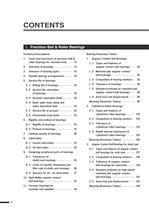
CONTENTS I . Precision Ball & Roller Bearings Technical Descriptions Bearing Dimension Tables 1. Types and structures of precision ball & roller bearings for machine tools ····· 12 1. 2. Selection of bearings······················ 14 3. Selection of bearing types ··············· 15 4. Spindle bearing arrangements ········· 16 1. 2 Matched pair angular contact ball bearings····························· 54 5. Service life of bearings 1. 3 Composition of bearing numbers··· 55 Angular Contact Ball Bearings 1. 1 Types and features of angular contact ball bearings······ 53 5. 1 Rating life of bearings...
Open the catalog to page 5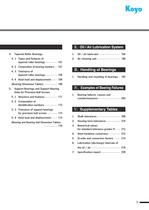
II. Oil / Air Lubrication System 4. Tapered Roller Bearings 4. 1 Types and features of tapered roller bearings ·············· 157 1. Oil / air lubricator ·························· 184 2. Air cleaning unit····························· 188 4. 2 Composition of bearing numbers ··· 157 4. 3 Tolerance of tapered roller bearings ·············· 158 III. Handling of Bearings 1. Handling and mounting of bearings ··· 192 4. 4 Axial load and displacement ······· 159 (Bearing Dimension Tables) ················ 160 5. Support Bearings and Support Bearing Units for Precision Ball Screws 5. 1 Structure and...
Open the catalog to page 6
I. Precision Ball & Roller Bearings
Open the catalog to page 8
CONTENTS Technical Descriptions 1. Types and structures of precision ball & roller bearings for machine tools ····· 12 2. Selection of bearings······················ 14 3. Selection of bearing types ··············· 15 4. Spindle bearing arrangements ········· 16 5. Service life of bearings 5. 1 Rating life of bearings ················ 18 5. 2 Service life calculation of bearings ······························· 18 I . Precision Ball & 5. 3 Dynamic equivalent loads ··········· 20 Roller Bearings 5. 4 Basic static load rating and static equivalent load ················· 23 5. 5 Service life of greases...
Open the catalog to page 10
Precision Ball & Roller Technical Descriptions
Open the catalog to page 12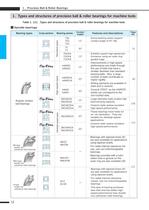
I . Precision Ball & Roller Bearings 1. Types and structures of precision ball & roller bearings for machine tools Table 1. 1(1) Types and structures of precision ball & roller bearings for machine tools Bearing types Bearing series Angular contact ball bearings Some bearing series support Exhibits superb high-speed per- formance using an outer ring guided cage. performance are made through the use of balls that have a smaller diameter than standard bearing balls. Also, a large number of balls contributes to higher rigidity. Rolling elements are available in non-contact seal. Large-diameter balls...
Open the catalog to page 13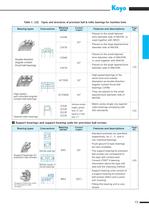
Table 1. 1(2) Types and structures of precision ball & roller bearings for machine tools Bearing types Placed on the small tapered- bore diameter side of NN30K, or used together with NN30. Placed on the large tapered-bore angular contact thrust ball bearings Placed on the small tapered- bore diameter side of NNU49K, or used together with NNU49. Placed on the large tapered-bore pair-mounted angular contact ball bearings same bore and outside angular contact thrust ball They are placed on the small tapered-bore diameter side of Tapered roller bearings Nominal contact angles: greater Metric series...
Open the catalog to page 14All JTEKT catalogs and technical brochures
 ONI Flyer
2 Pages
 EasyFit NC-Ball Bearing Units
16 Pages
 Ball Bearing Units
2 Pages
 Ball & Roller Bearings
397 Pages
 INSERT BEARING UNITS
194 Pages
 Spherical Roller Bearings
8 Pages
 Ceramic bearings
17 Pages
 B1011E Traction Drive Unit
4 Pages
 B1005E EXSEV Product Guidebook
13 Pages
 Agriculture and Construction
6 Pages
 catb2018e
272 Pages
 DRIVE SHAFTS for INDUSTRY
25 Pages
 Ball & Roller Bearings
80 Pages
 Ceramic&Exsev bearing
87 Pages
 OIL SEALS & O-RINGS
129 Pages
 TAPERED ROLLER BEARINGS
83 Pages
 LARGE SIZE BALL & ROLLER BEARINGS
245 Pages


Archived catalogs
 Needle Roller Bearings
274 Pages
 NEEDLE ROLLER BEARINGS_2010
158 Pages
 CERAMIC & EXSEV BEARINGS
70 Pages
 Ball Bearing Units
194 Pages
 Ball & Roller Bearings
200 Pages
 High Performance Bearings
6 Pages
 Miniature Bearings
71 Pages
 Miniature One Way Clutch
6 Pages
 Roll Neck Bearings
8 Pages
 Sprag Clutches
19 Pages
 Exsev Bearings
19 Pages
 Ceramic Bearings
6 Pages
 Oil Seals & O-Rings
119 Pages

