


LARGE SIZE BALL & ROLLER BEARINGS

LARGE SIZE BALL & ROLLER BEARINGS
- Types of Bearings: Covers deep groove ball bearings, angular contact ball bearings, cylindrical roller bearings, tapered roller bearings, spherical roller bearings, thrust ball bearings, and specialized bearings for applications like crane sheaves and continuous casting machines.
- Technical Specifications: Provides detailed specifications for each bearing type, including dimensions, load ratings, and material properties, along with tables for tolerances, fits, and internal clearances.
- Service Life and Load Ratings: Explains bearing service life concepts, factors affecting it, and formulas for calculating load ratings, considering temperature and material characteristics.
- Lubrication and Materials: Offers guidelines for lubrication and material selection to enhance performance and longevity, emphasizing the importance of appropriate lubricant and material choice.
- Failure Analysis: Discusses common bearing failures and recommendations for minimizing them through proper selection and maintenance.
- Supplementary Information: Includes tables and conversion factors for unit conversions, steel hardness, and viscosity.
- Lubrication: Ball bearings should use lubricants with a kinematic viscosity of 13 mm2/s or less, and roller bearings with 20 mm2/s or less.
- Operation: Bearings should operate at slow rotational speeds, with specific speed limitations.
- Contamination: Lubricant contamination is expected.
- Misalignment: Greater misalignment of inner and outer rings is present.
- Hardness: Corrections to the basic dynamic load rating are necessary when bearing hardness is diminished by heat.
- Loads include forces from supported objects, transmission forces, and operational loads.
- Load Coefficient: Actual loads are often greater than calculated due to vibration and impact.
- Dynamic Equivalent Load: Bearings receive combined radial and axial loads, and the dynamic equivalent load is calculated to compare actual load with basic dynamic load rating.
- Basic Static Load Rating: Excessive static or impact loads can cause permanent deformation.
- Static Equivalent Load: Calculated to generate the same contact stress as actual loading conditions.
- Ensures safety in relation to the basic static load rating, varying based on operating conditions and bearing type.
- Tolerances and permissible values for boundary dimensions and running accuracy are specified by standards such as JIS, ISO, and ABMA.
Outlines tolerances for shaft and housing bore diameters in relation to bearing fits, specifically for class 0 tolerance bearings, and includes a diagram illustrating the relationship between these tolerances and different types of fits.
Factors include load characteristics, temperature distribution, bearing internal clearance, surface finish, material, and thickness of shaft and housing, mounting and dismounting methods, and compensation for shaft thermal expansion.
Categorized into rotating inner ring load, rotating outer ring load, and indeterminate direction load.
Radial loads cause the inner ring to expand, reducing initial interference.
Effective interference after fitting can differ from calculated interference due to plastic deformation.
Operating temperatures higher than ambient can reduce effective interference due to thermal expansion.
Excessive stress from interference fits can cause bearing ring fractures.
For high accuracy, improved tolerances for shaft and housing are necessary.
Tables provide recommended fits for various bearing types and conditions.
Provides detailed specifications for bearing fits, focusing on internal clearance and recommended fits for various types of bearings.
For thrust bearings, outlines fits for both shafts and housings, specifying tolerance ranges and conditions under which different classes should be used.
Discusses the use of interference and clearance fits for roll neck bearings, depending on load and speed conditions.
Internal clearance is crucial for bearing performance, affecting factors like fatigue life, heat generation, and noise.
Includes tables detailing recommended fits and internal clearance values for different bearing types and sizes.
Provides detailed specifications for the axial and radial internal clearance of various types of bearings.
Lubrication is critical for bearing performance, influencing bearing life significantly.
Comparison between grease and oil lubrication, highlighting factors such as sealing device complexity, lubricating ability, rotation speed suitability, ease of lubricant replacement, lubricant life, cooling effect, and dirt filtration capability.
Discusses closed lubrication and feeding method, advising on the amount of grease to use.
Provides guidance on grease feeding intervals based on rotational speed.
Spherical roller bearings require a kinematic viscosity of 20 mm2/s or higher.
Discusses materials used for bearing rings, rolling elements, and cages.
Examples of bearing failures, such as flaking and cracking, are discussed with their causes and countermeasures.
For optimal bearing performance, recommends selecting appropriate materials and maintaining proper lubrication and sealing methods.
- Axial Cracks: Occur due to excessive axial load and improper axial clearance.
- Brinelling: Caused by improper handling.
- Scuffing: Results from improper lubrication and excessive axial load.
- Smearing: Occurs due to improper lubrication and slip of rolling elements.
- Corrosion: Caused by worn seals and ingress of water.
- Creeping: Due to insufficient lubrication between surfaces.
- Seizure: Results from improper lubrication and excessive axial load.
- Lubrication Failures: High temperature and water ingress lead to grease degradation.
- Deep Groove Ball Bearings: Suitable for radial and axial loads.
- Boundary Dimensions and Load Ratings: Detailed tables provide dimensions, load ratings, and design specifications.
- Ensure proper handling and mounting techniques.
- Regularly check and maintain seals.
- Select appropriate lubricants.
- Review operating conditions and adjust bearing specifications as necessary.
Cylindrical roller bearings are detailed with various dimensions, load capacities, and design types.
Outlines procedures for adjusting the clearance of tapered bore bearings.
Dimensions and tolerances are specified according to JIS B 1512 and JIS B 1514 standards.
Recommendations include using NU and N types as free side bearings.
Some bearings feature lubrication grooves or holes.
Tables provide detailed specifications for various bearing models.
Allowable misalignment values are provided for different load conditions.
Provides a comprehensive guide on SI units, conversion factors, and related technical specifications.
- Pressure: 1 Pascal (Pa) is equivalent to 0.10197 kgf/m2.
- Viscosity: 1 kgf·s/m2 equals 9.80665 Pa·s.
- Kinematic Viscosity: 1 mm2/s is equivalent to 1 centistokes (cSt).
- Surface Tension: Measured in N/m.
- Energy: 1 Joule (J) is equivalent to 1 N·m.
- Power: 1 Watt (W) is equivalent to 0.10197 kgf·m/s.
- Temperature: Conversion between Celsius and Kelvin is given by tK = t°C + 273.15.
- Heat: 1 calIT = 4.1868 J.
- Thermal Conductivity: 1 W/(m·K) is equivalent to 4.18605 cal/(s·m·;).
- Heat Transfer Coefficient: 1 W/(m2·K) is equivalent to 4.18605 cal/(s·m2·;).
- Inch/Millimeter Conversion: Provides a detailed table for converting inches to millimeters.
- Steel Hardness Conversion: Includes Rockwell, Vicker’s, and Brinell scales.
- Viscosity Conversion: Details conversion between kinematic viscosity in mm2/s and other units.
- Shaft Tolerances: Lists deviation classes for nominal shaft diameters in micrometers.
This document serves as a valuable reference for engineers and scientists requiring precise unit conversions and understanding of material properties.
Catalog excerpts

LARGE SIZE BALL & ROLLER BEARINGS LARGE SIZE BALL & ROLLER BEARINGS General Bearings CAT. NO. B2002E-1 Pr inted in Japan '12.0 8 - 5BDS ( ' 0 8.7) CAT. NO. B2002E-1 CAT. NO. B2002E-1
Open the catalog to page 1
1 Selection of bearing dimensions ⋅⋅⋅ 4 3 Bearing fits ⋅⋅⋅⋅⋅⋅⋅⋅⋅⋅⋅⋅⋅⋅⋅⋅⋅⋅⋅⋅ 31 5 Lubrication ⋅⋅⋅⋅⋅⋅⋅⋅⋅⋅⋅⋅⋅⋅⋅⋅⋅⋅⋅⋅ 52 2 Bearing tolerances ⋅⋅⋅⋅⋅⋅⋅⋅⋅⋅⋅⋅⋅⋅⋅⋅ 13 4 Internal clearance ⋅⋅⋅⋅⋅⋅⋅⋅ 43 7 Examples of failures ⋅⋅⋅⋅ 66 6 Bearing materials ⋅⋅⋅⋅⋅⋅⋅⋅ 62 Technical data Deep groove ball 68, 69, 160, 62 ,63, SB⋅⋅⋅, 3⋅⋅⋅ bearings 78, 79, 70, 72, 73 AC⋅⋅⋅ bearings DF DB 18, 28, 38, 19, 29, 10, 30, 31, 2, 22, 32, 3, 23, 33 NU (NJ) (NUP) Angular contact ball 2AC⋅⋅⋅ 3⋅⋅⋅ (N) NN (NF) DC48(V), 49(V) FC⋅⋅⋅, 3⋅⋅⋅, 4CR⋅⋅⋅ 48, 39, 49, 30, 40, 31, FC⋅⋅⋅, 3⋅⋅⋅ Cylindrical roller 99⋅⋅⋅, D99⋅⋅⋅, T99⋅⋅⋅ bearings...
Open the catalog to page 2
LARGE SIZE BALL & ROLLER Value & Technology
Open the catalog to page 3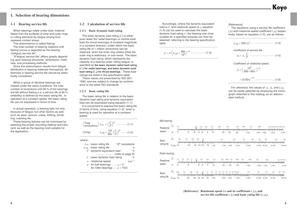
1. Selection of bearing dimensions 1-1 Bearing service life When bearings rotate under load, material flakes from the surfaces of inner and outer rings or rolling elements by fatigue arising from repeated contact stress. This phenomenon is called flaking. The total number of bearing rotations until flaking occurs is regarded as the bearing "(fatigue) service life". "(Fatigue) service life" differs greatly depending upon bearing structures, dimensions, materials, and processing methods. Since this phenomenon results from fatigue distribution in bearing materials themselves, differences in bearing...
Open the catalog to page 5
1. Selection of bearing dimensions 1-2-3 Correction of basic dynamic load rating for high temperature use and dimension stabilizing treatment In high temperature operation, bearing material hardness deteriorates, as material compositions are altered. As a result, the basic dynamic load rating is diminished. Once altered, material composition is not recovered, even if operating temperatures return to normal. Therefore, for bearings used in high temperature operation, the basic dynamic load rating should be corrected by multiplying the basic dynamic load rating values specified in the bearing specification...
Open the catalog to page 6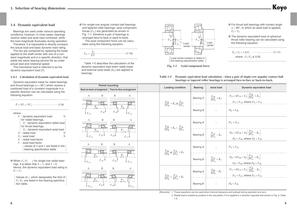
1. Selection of bearing dimensions 1-4 Dynamic equivalent load Bearings are used under various operating conditions; however, in most cases, bearings receive radial and axial load combined, while the load magnitude fluctuates during operation. Therefore, it is impossible to directly compare the actual load and basic dynamic load rating. The two are compared by replacing the loads applied to the shaft center with one of a constant magnitude and in a specific direction, that yields the same bearing service life as under actual load and rotational speed. This theoretical load is referred to as the...
Open the catalog to page 7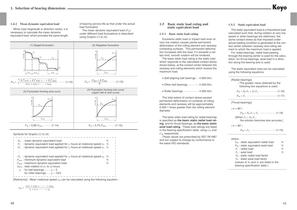
1. Selection of bearing dimensions 1-4-2 Mean dynamic equivalent load When load magnitude or direction varies, it is necessary to calculate the mean dynamic equivalent load, which provides the same length of bearing service life as that under the actual load fluctuation. The mean dynamic equivalent load (Pm) under different load fluctuations is described using Graphs (1) to (4). (1) Staged fluctuation P (2) Stageless fluctuation P P1 P2 Pm Pm Pn 0 0 n1t1 p Pm = n2t2 Pmin Σ niti nntn P1p n1t1 + P2p n2t2 + ⋅⋅⋅ + Pnp nntn ⋅⋅⋅⋅⋅⋅⋅⋅⋅ (1-12) n1t1 + n2t2 + ⋅⋅⋅⋅⋅⋅ + nntn (3) Fluctuation forming sine...
Open the catalog to page 8
1. Selection of bearing dimensions 2. Bearing tolerances 1-5-3 Safety coefficient The allowable static equivalent load for a bearing is determined by the basic static load rating of the bearing; however, bearing service life, which is affected by permanent deformation, differs in accordance with the performance required of the bearing and operating conditions. Therefore, a safety coefficient is designated, based on empirical data, so as to ensure safety in relation to basic static load rating. fs = Table 1-6 Values of safety coefficient fs Table 2-1 When high running accuracy is required With...
Open the catalog to page 9
2. Bearing tolerances Tolerances for inch series tapered roller bearings = ABMA 19 = Table 2-5 Unit : μm (1) Inner ring Applied bearing type Nominal bore diameter d , mm (1/25.4) over up to Deviation of a single bore diameter 3 ds Class 4 Class 2 Class 3 Class 0 upper lower upper lower upper lower upper lower 76.2 ( 3.0) − + 13 0 +13 0 +13 0 +13 0 76.2 ( 3.0) 266.7 (10.5) + 25 0 +25 0 +13 0 +13 304.8 (12.0) + 25 0 +25 0 +13 0 +13 609.6 (24.0) + 51 0 +51 0 +25 0 − − 914.4 (36.0) + 76 0 − − +38 0 − 1 219.2 (48.0) +102 0 − − +51 0 − − − +127 0 − − +76 0 − Class 4 Class 2 − upper lower upper Class...
Open the catalog to page 14
2. Bearing tolerances Table 2-6 Tolerances for metric J series tapered roller bearings1) Unit : μm (1) Bore diameter and width of inner ring and assembled bearing width Nominal bore diameter d mm over Deviation of a single bore diameter Deviation of a single inner ring width 3 ds 3 Bs Nominal bore diameter Deviation of the actual bearing width 3 Ts Class PK Class PN Class PC Class PB Class PK Class PN Class PC Class PB up to upper lower upper lower upper lower upper lower upper lower upper lower upper lower upper lower Class PK Class PN Class PC d mm Class PB upper lower upper lower upper lower...
Open the catalog to page 15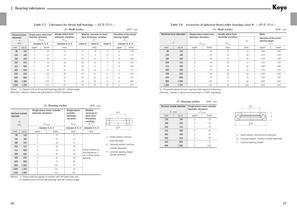
2. Bearing tolerances Table 2-7 Tolerances for thrust ball bearings = JIS B 1514 = Table 2-8 Nominal bore diameter d mm Single plane bore diameter variation Single plane mean bore diameter deviation 3 dmp Washer raceway to back face thickness variation Deviation of the actual bearing height classes 0, 6, 5 class 0 class 6 class 5 classes 0, 6, 5 over up to −150 80 5 0 0 −175 10 5 0 25 13 7 30 30 15 7 − 45 34 30 18 9 0 − 50 38 35 21 11 800 0 − 75 55 40 25 13 800 1 000 0 −100 75 45 30 1 000 1 250 0 −125 95 50 35 80 max. upper lower 120 0 − 20 15 +200 −200 120 180 0 − 25 19 +250 −250 −200 180 250...
Open the catalog to page 16All JTEKT catalogs and technical brochures
 ONI Flyer
2 Pages
 EasyFit NC-Ball Bearing Units
16 Pages
 Ball Bearing Units
2 Pages
 Ball & Roller Bearings
397 Pages
 INSERT BEARING UNITS
194 Pages
 Spherical Roller Bearings
8 Pages
 Ceramic bearings
17 Pages
 B1011E Traction Drive Unit
4 Pages
 B1005E EXSEV Product Guidebook
13 Pages
 Agriculture and Construction
6 Pages
 catb2018e
272 Pages
 DRIVE SHAFTS for INDUSTRY
25 Pages
 Ball & Roller Bearings
80 Pages
 Ceramic&Exsev bearing
87 Pages
 OIL SEALS & O-RINGS
129 Pages
 TAPERED ROLLER BEARINGS
83 Pages


Archived catalogs
 Needle Roller Bearings
274 Pages
 NEEDLE ROLLER BEARINGS_2010
158 Pages
 CERAMIC & EXSEV BEARINGS
70 Pages
 Ball Bearing Units
194 Pages
 Ball & Roller Bearings
200 Pages
 High Performance Bearings
6 Pages
 Miniature Bearings
71 Pages
 Miniature One Way Clutch
6 Pages
 Roll Neck Bearings
8 Pages
 Sprag Clutches
19 Pages
 Exsev Bearings
19 Pages
 Ceramic Bearings
6 Pages
 Oil Seals & O-Rings
119 Pages

